 |
|
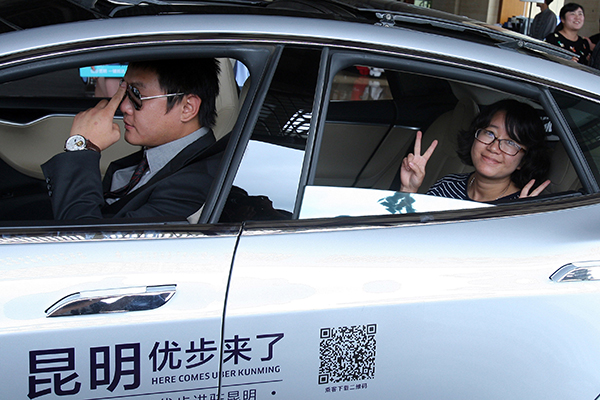
A cab-user (right) in Kunming, capital city of Yunnan, enjoys a Uber ride. Last month, US-based company Uber ended its fight with Didi in China and agreed a merger. [Photo/China Daily] |
Foreign net firms are realizing the hard way that success in China takes Herculean efforts
If China's Great Wall was difficult to scale or penetrate for Eurasian nomadic raiders of the past, the Chinese mainland's technology and digital market are posing similar problems to foreign companies now.
In a recent move, Uber decided to end its lone fight in China, and merge its China unit with its bitter rival Didi Chuxing, a Beijing-based transportation network company, after investing about $2 billion in the market in less than two years.
Though hailed as one of the world's most valuable startups, Uber, the San Francisco-headquartered US multinational online transportation network company, had trouble developing business in China, the world's largest car-sharing market.
In less than two years, Uber won 17 percent of the Chinese market share, while Didi Chuxing controlled 70 percent of the local market.
By this merger, investors in Uber's China unit will own 20 percent of Didi, while Didi will invest $1 billion in Uber.
"This is a win-win situation," said Li Xiaoxi, portfolio manager at Principal Global Investors Funds. "Merger could be the best option for Uber to advance in and benefit from the Chinese market."
Uber is not the first Western internet company not to succeed in China. Yahoo had attempted to enter China but its business was unsuccessful. Ditto for eBay. Then there's instant-messaging app WhatsApp, now owned by Facebook-popular in the US and outside China but utterly ineffective in weaning Chinese users away from WeChat.
"China is a very difficult market for Western companies to penetrate," said Robert Salomon, associate professor at the New York University's Stern School of Business. "It is especially difficult for Western technology companies."
Why? Complex reasons abound. But it's certainly not due to want of effort.
Uber did a pretty good job in China actually. It had made headway into quite a few Chinese cities, including some third-tier ones. The localisation effort was easily seen. It had partnered with Chinese internet search giant Baidu and online payment firm AliPay. Still, it couldn't avoid bruising competition with Chinese ride-hailing smartphone apps.
"The customers (in China) are very very different," said Salomon. "They have different cultural tastes and preferences and ways to consume products (and services); the products they want are not the same as those Western consumers want."
For instance, Uber has always partnered with private cars, while its rival Didi, when it first came into the market, built a platform involving taxi drivers. Although in first-tier cities Uber represents cool and fashion, most Chinese people have more trust in cabs that are under heavier scrutiny from the regulators.
Also, one of the services Didi provides is "designated driving", which puts drivers on the network for those who have to take their car home after drinking. Its advertisements are visible at a lot of restaurants and it has got really popular.
Local companies in China are familiar with these marketing techniques and can easily take advantage of that, making themselves handier than their Western rivals, said Henry Huang, associate professor of Yeshiva University's business school, located in New York.
"They (Western companies) don't know China's market culture, consumer behaviour, regulations. Therefore, they can't play to their strengths in the China market," said Huang.
Unlike Apple, the technology this ride-hailing company uses is pretty simple to copy. And Uber did not have the early mover advantage. It entered China after Didi got popular among riders. That put Uber at a disadvantage in its battle against its Chinese rivals.
Didi is just one example. Among others, there is WeChat, an instant-messaging app used by almost everyone with a smartphone in China. It has now become an all-powerful app covering many aspects of Chinese people's daily life, not just chitchatting.
People use WeChat also for sharing moments of their lives, reading, paying phone or electricity bills, buying cinema, theater and event tickets, sending greetings and making money transfers.
These are but just a few of WeChat's uses. Businesses use the app to reach out to consumers with promotions.
"I think the Chinese competitors have reached a certain level now where they become competitive on the global stage," says Salomon. "Facing the most technologically advanced foreign competitors will allow local Chinese companies to realize their strengths or force them in some way to improve by having to compete with those technologically advanced foreign competitors."
Xinhua


Copyright 1995 - . All rights reserved. The content (including but not limited to text, photo, multimedia information, etc) published in this site belongs to China Daily Information Co (CDIC). Without written authorization from CDIC, such content shall not be republished or used in any form. Note: Browsers with 1024*768 or higher resolution are suggested for this site.
License for publishing multimedia online 0108263 Registration Number: 130349