Bike-sharing is a growth vehicle
 |
|
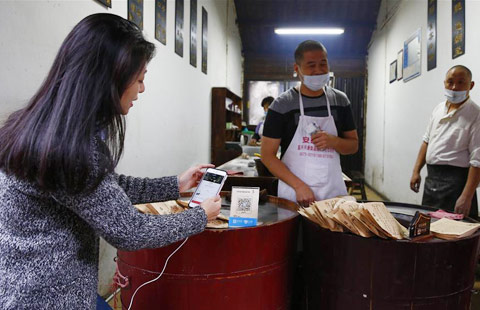
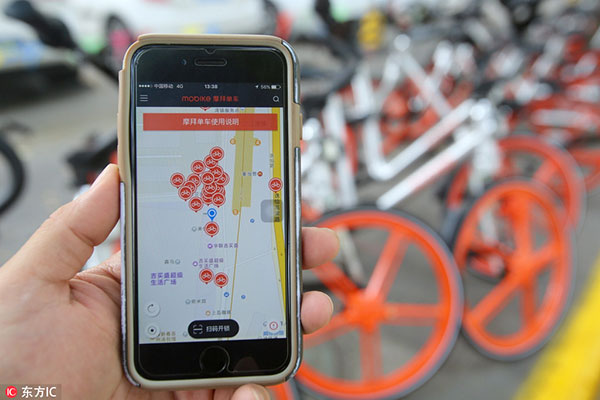
A Chinese mobile phone user scans the QR code on the bicycle of bike-lending service Mobike on a road in Shanghai, Aug 17, 2016. [Photo/IC] |
Mobike and ofo are major providers of the service, which is very popular among young urbanites
Hu Weiwei is a firm believer that bike riding can be used as an effective gauge to measure the quality of urban life.
"If a city is bike friendly, that means it has good-quality air, well-designed roads and plenty of big tall trees to make people feel safe and comfortable to travel on two-wheel vehicles," she said, adding that in a sense, a happy urban life cannot exist without bikes.
Based on this idea, Hu's bike-sharing startup Mobike aims to make cities in China, now the world's largest automobile market, move to bikes, and it seems that it has a chance of getting its way as a growing number of venture capital firms have poured in cash to support the effort.
Since August, the Beijing-based Mobike, which allows people to use an app to locate and borrow available bikes nearby, has landed four rounds of financing, totaling hundreds of millions of dollars.
But its record is not unique, as its cross-town rival, another bike-sharing startup named ofo, has also pulled off fundraising four times since August. According to a report from Bloomberg, ofo is valued at $500 million, an unusually large size for a company that is just 2 years old.
On average, every 15 days, these firms get new money from new investors. An array of big-name companies, including Didi Chuxing, Xiaomi Corp and Tencent Holdings Ltd, have given money and even other resources to bankroll the development of the bike-on-demand industry in China.
For Hu, the founder of Mobike, the investment has not come from nowhere. "People have always had the demand to use bikes for short-distance travel of less than 5 kilometers. With the development of mobile internet technology, we can now make that happen," she said.
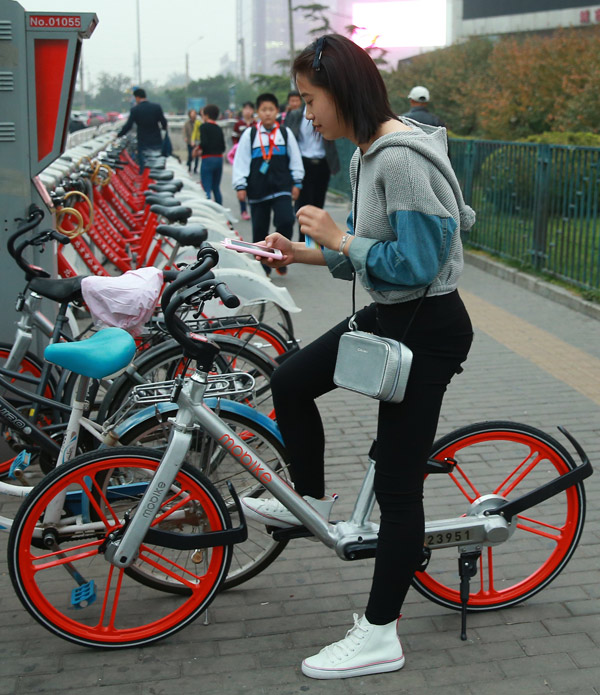
Many cities in China have government-run bike-rental programs, but Mobike and ofo have made things so much easier as users can borrow and return bikes, which are equipped with GPS systems, with just a smartphone. No complicated procedure, such as going to a specific location to pay a deposit, is required.
 |
|
A user scans the QR code with her smartphone for a Mobike ride in Beijing. The bike-sharing business is gaining popularity and developing fast in major cities like Beijing and Shanghai. Zou Hong / China Daily |
Nan Jiang, a 26-year-old doctorate student at the Beijing-based Beihang University, said he is a frequent user of ofo, which started as a campus-based program, and now gears up to take on more roads with the war chest provided by investors.
"It is very convenient and cheap-at 0.5 yuan (7 cents) per hour-and most importantly, you can park it wherever you want after using it. No need to return it to a certain location," he said.
Xiao Min, a partner with MatrixPartners China, which led a multimillion-dollar investment in ofo in September, said in an earlier interview that transportation is a very high-frequency service, which has the potential to create a market with a big transaction volume.
While ride-hailing services meet people's demand for mid-to-long distance travel, there is a huge demand for short-distance travel, which has not been met.
"For example, a large number of white-collar workers in Beijing and Shanghai use public transportation every day, which means there is demand to commute from their office buildings or apartments to the nearest bus station or subway station. And there is no better solution for this than bikes," he said.
According to a recent report from Roland Berger, the ride-hailing and car-rental market combined creates a market that is estimated to be valued at 1.8 trillion yuan in 2018.
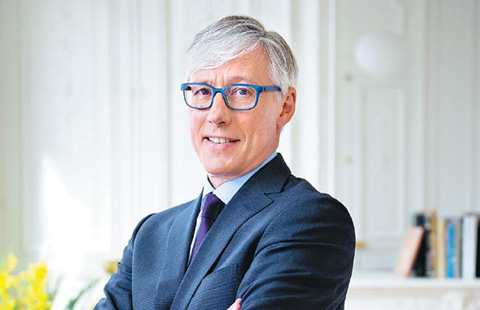
Raymond Wang, partner with Roland Berger China, estimated bike sharing is a multibillion-yuan market in China, and the bike-sharing model will be adopted mostly in urban areas.
"The top challenge of bike sharing is the business model and profitability. Will it make money from rental, advertising or subsidies from the government?" he said, adding in his opinion that rental is the most feasible model for bike-on-demand companies to make money.
However, for Hu, being profitable is not the subject on her mind yet. "If your product has value and is widely used, it will be profitable sooner or later. For us, at this stage, how to create value is what matters most," she said.
"The bike-rental war has just started. We all know that there will be only one player left in the battlefield at the end. But at this stage, competition is good to rapidly boost the size of the market," said ofo investor Xiao.