Comments
  Print
Print  Mail
Mail  Large Medium Small
On September 20, 1987, a group of researchers at the Institute for Computer Science of China's State Commission of Machine Industry sent an e-mail to the University of Karlsruhe in Germany. The message, written in English, was simple: "Across the Great Wall we can reach every corner of the world."

The message is now widely believed to be the first e-mail sent from China. As the researchers anticipated, the mail electronically linked the world with the nation that had just started opening up to the outside world.
The message was written on September 14, 1987 and typed by Zorn Werner, a professor at the University of Karlsruhe who was in China to help Chinese researchers send it. They weren't able to send it until they checked the computer hardware and software for almost one week.
There is still some debate on whether that was the first-ever e-mail sent from China. Wu Weimin, a former researcher at Chinese Academy of Sciences, claims he sent China's first e-mail more than a year earlier on August 25, 1986 to Jack Steinberger, a Nobel Laureate based in Switzerland.
But no one could deny that e-mail heralded the start of China's Internet era.
Initially the data network focused mainly on the scholarly exchange of information.
In the early 1990s. a number of educational networks were built to complement the first data network built by the Institute for Computer Science.
The China Research Network was established in 1990 and began by hosting more than 10 research institutes. In 1993 the State Education Commission began building the China Education and Research Network (CERNET), a nationwide backbone with a goal to link all of the country's universities.
Commercial uptake
In 1994 the former China Telecom signed an agreement with the giant United States telecom operator Sprint for a national Internet network interconnection. The following year China Telecom began building the backbone network for ChinaNet to provide public Internet access. On June 20, 1996, ChinaNet began formal commercial operation, putting an end to an era in which Internet applications were limited to researchers.
"The launch of ChinaNet was a watershed in China's Internet history. Since then the Chinese public began accessing the Internet," says CNNIC director Mao Wei, director of CNNIC (China Internet Network Information Center).
E-mail as well as the World Wide Web enabled Chinese to communicate with people around the world with much greater freedom and at a lower cost than the days when making international telephone calls was costly and sometimes required State approval.
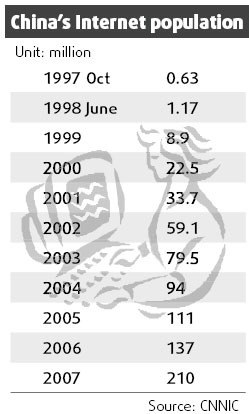
In October 1997 when the quasi-government CNNIC released its first survey of China's Internet industry, the country's Internet population was only 620,000. But last year it had swelled to 210 million, 56.5 percent of whom use e-mails frequently. Now China's Internet users spend an average of 18.6 hours each week surfing the Web.
Beiijing-based research firm BDA China Ltd last week said China already surpassed the United States to become the world's largest Internet population.
Dotcom boom
In 1997, Nicholas Negroponte, author of the 1995 best seller, Being Digital, and co-founder of the MIT Media Laboratory, paid a visit to China. "He looked like a rock star under the media spotlight," recalls Charles Zhang, founder and chairman of Sohu.com, a Chinese Internet portal listed in NASDAQ.
At that time Negroponte's book aroused much interest and passion among young Chinese, especially those like Zhang, billed as one of the "sea turtles" who studied in the United States and later returned to China with some knowledge and vision of the Internet.
Zhang in 1997, registered the domain Sohoo.com.cn, apparently with an intention to copy Yahoo! A year later with an investment from Negroponte, Zhang changed the domain name and launched Sohu.com.
Negroponte, billed as a cyber-soothsayer by Time magazine,was bullish about the Internet development both in the world and China.

His bullish predictions, as well as the success stories of Internet start-ups in the United States, sparked a rush for gold in China's fledgling Internet sector.
"No one could have exerted as much as influence in China's Internet and computer industry as Negroponte", says Fang Xingdong, an Internet pioneer in China and co-founder of China Labs, one of China's first Internet research companies.
"Except Bill Gates (who paid his first visit to China in 1994), no one in the Internet sector has gained as much of the spotlight as Negroponte," Fang says.
On November 28, 1990, Professor Qian Tianbai, a pioneer in China's Internet industry, registered China's national domain name, ".cn". By November 2007, China already had nine million ".cn" domains.
But Negroponte's biggest contribution to China's Internet industry was his venture investment in Sohu.com. Before the formal launch of Sohu.com, Zhang, an MIT graduate, secured an cash injection from Negroponte, another MIT professor and a student and in doing so he also introduced the "venture capital" concept for the first time to China.
Since then, the US venture capitalists have become a major driving force behind China's Internet boom as well as a rush for listings on NASDAQ.
(China Daily 03/17/2008 page2)

 Night views of Harbin through the lens
 Tibetans take train home after pilgrimage or travelling
 World's largest shaftless Ferris wheel built in China
 Ancient cities to be connected by Xi'an-Chengdu high-speed railway
 Snow turns Harbin into winter wonderland
 Reed Catkin Festival held in Wuhan
 Is it a building or a bookshelf?
 First flight
 Polar icebreaker Snow Dragon arrives in Antarctic
 Xi's vision on shared future for humanity
 UN's top environmental honors go to three in China
 German trains collide near Duesseldorf, several people injured
 China beats Germany 7-4 in men's curling Olympic qualification
 Bayern beat Paris Saint-Germain 3-1 in UEFA Champions League


Copyright 1995 - . All rights reserved. The content (including but not limited to text, photo, multimedia information, etc) published in this site belongs to China Daily Information Co (CDIC). Without written authorization from CDIC, such content shall not be republished or used in any form. Note: Browsers with 1024*768 or higher resolution are suggested for this site.
License for publishing multimedia online 0108263 Registration Number: 20100000002731