Comments
  Print
Print  Mail
Mail  Large Medium Small
In the last several years China has demonstrated its ability to act as a strong partner with international business entities looking to grow their markets and expand the base of their operations through the use of China's increasingly sophisticated workforce.

However, as China continues to attract local subsidiaries of foreign business entities, new IPR risks arise that should temper the aggressive view that these operations provide benefits without the potential for liability.
First, given the increasingly mobile workforce and the availability of alternative employment opportunities, there is the risk that intellectual property developed by the employees of China-based companies will migrate to foreign corporations when these individuals change employment.
Second, there is the risk to Chinese companies that they may be subject to litigation outside of China concerning whether they obtained the trade secrets of another company either when hiring the employees of the other company, or when engaged in joint venture activities with local operations of foreign entities.
Whether a China-based company has unlawfully come into possession of the trade secrets of another company may not necessarily be resolved through China's judicial system, even when the allegedly improper acquisition occurred wholly in China. For example, when a court in the United States considers whether it has jurisdiction over a China-based corporation the analysis is not limited to whether that corporation is physically present in the United States. Instead, a broader analysis is applied which looks at whether the defendant has purposefully availed itself of the privilege of doing business in the state in which it is being sued, or by purposefully directing activities at that state.
When the inquiry arises out of a claim that the defendant has misappropriated trade secrets, even where the alleged act of misappropriation occurred wholly outside of the United States, the courts sometimes apply an "effects test" that considers where the defendant's actions were felt. Thus, for purposes of establishing personal jurisdiction based on "purposeful direction" in a misappropriation of trade secrets case, the principal place of business of the plaintiff corporation determines the location where the corporate injury is felt as a result of the misappropriation.
While application of the "effects test" has not been uniform throughout the United States, courts that have applied the test have rejected challenges to jurisdiction based on the fact that a substantial portion of the market for the products that relate to the claim of misappropriation are in Asia, or that the Chinese corporation was neither registered to do business in the United States nor had made sales within the jurisdiction.
Rather, in responding to such arguments the courts in the United States have rejected evidence that conflates the location of consumers of the defendant's products with the location in which the harm from the misappropriation is felt. In such situations, the plaintiff corporation's principle place of business will determine the location where corporate injury is felt as a result of the misappropriation and the Chinese company may likely find itself litigating in the United States.
There are few if any precautions a Chinese company has available in order to avoid being hauled into court in the United States in the first instance when the claim of misappropriation is based on allegations that the plaintiff's former employees were induced by the defendant to misappropriate the trade secrets.
Jurisdictional disputes are addressed at the earliest stages of a lawsuit and, while a plaintiff bears the burden of proving all of the necessary jurisdictional facts. That burden is satisfied by merely demonstrating facts, which - if true - would support jurisdiction over the defendant. The focus of the China-based companies, therefore, should center on the steps to minimize the potential for such claims in the first instance.
Recommended procedures include use of proprietary inventions agreements for new employees, pursuant to which they represent that they are not bringing to their new employment any trade secrets or proprietary information that belonged to their former employer and to confirm that they will maintain as confidential all information belonging to third parties.
The new employees should also be asked to list all inventions, original works of authorship, developments, improvements, and trade secrets to which they claim ownership, and to agree that their new employer has a license to use any of this IP if it is included in the products of business operations of the new employer.
Where the China-based company engages in a joint venture with a foreign corporation, especially where the project involves joint research and development activities, there is a significant potential for IP migration due to the intermingling of employees and the shared purpose during the course of the venture.
Any disputes over ownership typically arise after the venture terminates and can exist in connection with ownership rights in jointly developed technology as well as whether the IP of one company still resides improperly in the possession of the other.
Careful attention in drafting the joint venture documents, including defining the basis for and rights to IP ownership, can avoid many problems before they arise.
To address unforeseen problems that cannot be resolved by reference to the language of the Joint Venture Agreement, many foreign based corporations will agree to a provision that requires any disputes be resolved through arbitration to be conducted in Hong Kong at the Hong Kong International Arbitration Center in accordance with the UNCITRAL Arbitration Rules then in force for resolution of commercial disputes.
The author is managing partner in the Silicon Valley office of Dechert LLP, a US law firm. The views expressed here are the author's own
(China Daily 01/05/2009 page11)

 Night views of Harbin through the lens
 Tibetans take train home after pilgrimage or travelling
 World's largest shaftless Ferris wheel built in China
 Ancient cities to be connected by Xi'an-Chengdu high-speed railway
 Snow turns Harbin into winter wonderland
 Reed Catkin Festival held in Wuhan
 Is it a building or a bookshelf?
 First flight
 Polar icebreaker Snow Dragon arrives in Antarctic
 Xi's vision on shared future for humanity
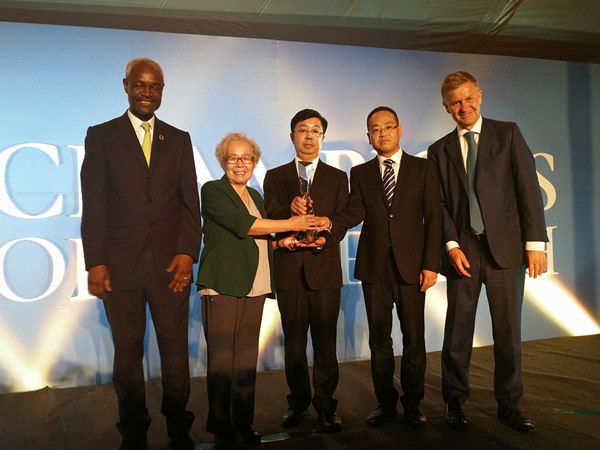 UN's top environmental honors go to three in China
 German trains collide near Duesseldorf, several people injured
 China beats Germany 7-4 in men's curling Olympic qualification
 Bayern beat Paris Saint-Germain 3-1 in UEFA Champions League


Copyright 1995 - . All rights reserved. The content (including but not limited to text, photo, multimedia information, etc) published in this site belongs to China Daily Information Co (CDIC). Without written authorization from CDIC, such content shall not be republished or used in any form. Note: Browsers with 1024*768 or higher resolution are suggested for this site.
License for publishing multimedia online 0108263 Registration Number: 20100000002731