Comments
  Print
Print  Mail
Mail  Large Medium Small
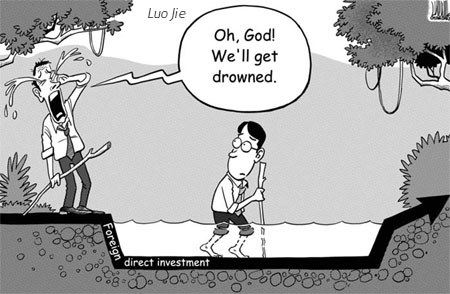
Since the 1990s foreign investment has been the main driving force behind China's economic growth. However, current foreign investment in China has fallen along with the global economy.
The latest figures released by Ministry of Commerce showed that foreign direct investment (FDI) in China dropped 26.23 percent in the first two months of 2009 from the same period a year earlier, while newly approved foreign-funded enterprises declined 36.85 percent year-over-year. Actually, foreign investment in China has been dropping since last October.
Luring foreign investment has been an important means for local governments to realize economic growth. In recent years, local governments have been trying to incorporate foreign funded projects into their strategy for industrial growth. If the inflow of foreign capital declines significantly for an extended period of time, the Chinese economy, especially in the coastal regions, will face tremendous challenges in sustaining a high growth rate.
The declining rate of foreign capital into China mirrors the decline in global FDI, which dropped by 21 percent year-over-year in 2008. It is expected to plummet by as much as 30 percent as the global financial crisis deepens, according to a recent report released by the United Nations.
Tight access to credit and rising investment costs are the immediate reasons for the shrinking global FDI. Since the middle of 2008 a number of European and American financial institutions recorded tremendous losses or significant drops in their profit, thus draining the global capital market.
Many multinational giants have held back on expanding their production capacity in the midst of a shrinking international market and uncertain economic outlook. Big automakers such as General Motor, Ford, Citroen and Renault have suspended their investment projects, laid off workers and reduced production. There are similar cutbacks in the finance, mining, steel, construction materials and aviation sectors.
However, the impact of the global financial crisis on different types of investment varies widely from region to region. The FDI of developed countries plunged nearly 33 percent in 2008 from a year earlier, while developing countries were still able to maintain more than 4 percent growth in FDI last year. In Africa, FDI grew 16.8 percent while in Southeast Asia there was 3.3 percent growth.
With shrinking market demand and falling commodity prices, investments targeting the market in developed countries are the most vulnerable to the global financial crisis. But there are opportunities for mergers and acquisitions in countries and regions with lower labor and manufacturing costs.
China still has many advantages for attracting global investors. With the diminishing flow of capital worldwide, China's FDI will also decline in the short term, but China remains the best investment destination and FDI is bound to increase in the long run.
China has made a strong commitment to maintain an 8 percent growth this year. The launch of an economic stimulus package will boost the domestic market. A favorable credit policy in China will also make it easier for multinationals to obtain financing.
Low labor and manufacturing costs have given China the competitive edge to continue to lure foreign investment.
Although investments by the US and Europe have plunged in the past five months, they only represented a small portion of foreign investment in China.
Asian countries and regions are the major source of China's FDI. As the Asian economies have suffered a lighter blow in the current economic crisis, their financial institutions are in better position than many of their Western counterparts.
In fact, few multinational firms in Asia have withdrawn capital or halted their overseas investment plans. As the impact of global financial crisis recedes, Asia investments will recover and China's FDI will correspondingly resume its robust growth.
Many countries, and especially the developed economies, are tilting toward trade protectionism. The United Nations has found that newly adopted restrictive regulations on FDI hit a record high worldwide in recent years. Many governments have used such measures as nationalizing financial institutions and restricting dividend distribution.
According to a survey of 226 top multinational companies conducted by the United Nations last year, global FDI growth is likely to fall in the short term, but cross-border investment will still be on the rise in the next three years as the trend of economic globalization will not change. The survey showed that of all investment destinations, China is the first choice for major multinationals.
The author is a researcher with the economic information department of China Council for the Promotion of International Trade. The article was reprinted from China Business News
(China Daily 04/13/2009 page2)

 Night views of Harbin through the lens
 Tibetans take train home after pilgrimage or travelling
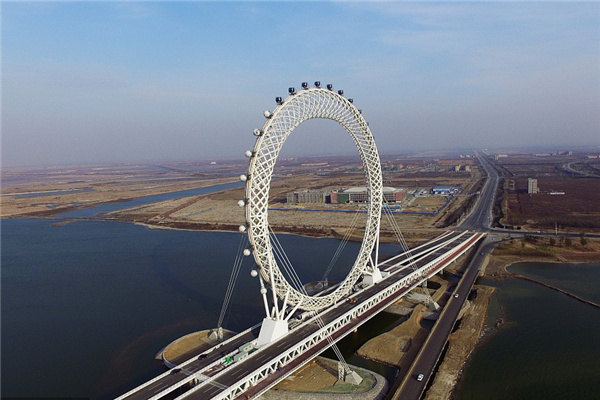 World's largest shaftless Ferris wheel built in China
 Ancient cities to be connected by Xi'an-Chengdu high-speed railway
 Snow turns Harbin into winter wonderland
 Reed Catkin Festival held in Wuhan
 Is it a building or a bookshelf?
 First flight
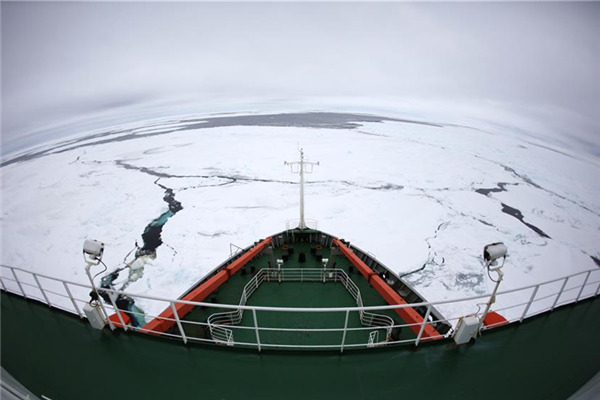 Polar icebreaker Snow Dragon arrives in Antarctic
 Xi's vision on shared future for humanity
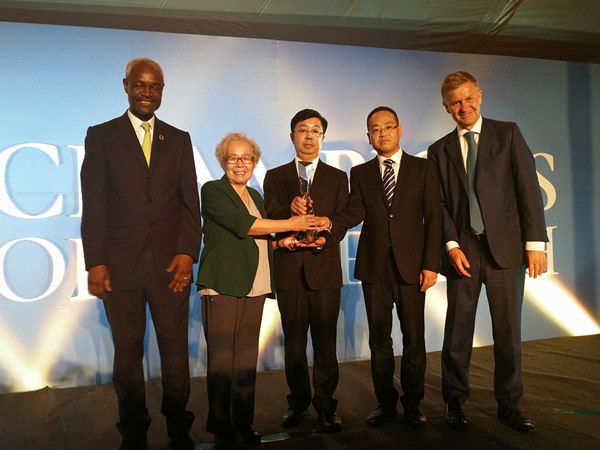 UN's top environmental honors go to three in China
 German trains collide near Duesseldorf, several people injured
 China beats Germany 7-4 in men's curling Olympic qualification
 Bayern beat Paris Saint-Germain 3-1 in UEFA Champions League


Copyright 1995 - . All rights reserved. The content (including but not limited to text, photo, multimedia information, etc) published in this site belongs to China Daily Information Co (CDIC). Without written authorization from CDIC, such content shall not be republished or used in any form. Note: Browsers with 1024*768 or higher resolution are suggested for this site.
License for publishing multimedia online 0108263 Registration Number: 20100000002731