Comments
  Print
Print  Mail
Mail  Large Medium Small
|
Feeding the world's largest population is China's top priority. Above, a farmer in Gaopo village, Guizhou province, prepares to harvest his rice crop. Wu Dongjun |
Tian Lanying has given up growing wheat.
For most of her 60 years, Tian has raised wheat on a small plot of land in Henan province and sold it to the State at a fixed price. This year, she will plant corn and vegetables instead. The reason?
"Wheat does not make much money," she said.
Tian's decision is a small piece in a very large puzzle for China, as it seeks to provide food for 1.3 billion people using limited natural resources. For the past decade, the nation has produced 95 percent of its own grain, but urbanization, climate change, and smuggling, among other things, make that goal increasingly difficult to achieve.
For Tian Lanying, the economics of growing wheat are simple. For each mu (0.16 acre) of land, she pays about $6 for plowing, $17 for seed, $22 for fertilizer, $1.5 for pesticide, and $9 for machinery to sow and reap her crop. In a good year, she can raise 400 kg of wheat; at the State price of $0.30 per kg, she makes about $51 per mu.
Actually, Tian is allotted slightly less than one mu of land, so her annual income from growing wheat is less than $50.
Corn is more profitable, because she does not need to plow the field in order to plant. Vegetables can be quite profitable, if there is a market for them; if not, she can always eat them.
"Farming is the last choice in my village," Tian said. "Young people with an education prefer to work in the cities. Only old people stay here in the country."
Tian gets by with help from her son, who lives in Beijing, and her daughter, who lives in Zhengzhou. She lives simply, and is vastly better off than her neighbor, who is paying for her son's postgraduate education in Beijing.
For China, the economics are more difficult.
In order to produce 95 percent of its own grain in 2020, the country must continue to farm 1.8 billion mu of land and produce 540 billion kg of grain, 38 billion kg more than in 2007, according to the National Grain Security Middle- and Long-Term Plan (2008-20) released last November by the National Development and Reform Commission.
However, urbanization and infrastructure continue to chip away at China's 1.8 billion mu of farmland.
"The only way for China to grow enough to feed its people is to increase the output per mu, which depends on farmers working hard and on technological breakthroughs," said 79-year-old Yuan Longping, China's most renowned agriculturalist.
Yuan is credited with feeding millions of Chinese with the hybrid rice he developed in the 1970s, which produces more than 800 kg per mu, more than twice the output of ordinary rice. His goal is to reach an output of 900 kg per mu by 2012.
Yuan recently proposed that China increase the State price for grain from $6 to $32 per 100 kg, in order to motivate farmers like Tian Lanying. Such an increase would cost the State $2.9 billion a year, which Yuan says it "is fully capable" of paying.
China's 720 million farmers currently receive about $15 in government subsidies for every mu of crops they grow. The average farmer tills 1.38 mu of land.
Farmers are also free to sell to food processors, who pay slightly more than the State price for high quality grain. After five years of successful harvests, the State granaries are full of low-quality grain, and the government has been gradually lowering the State price.
Other factors affecting China's food supply are out of the State's hands. Weather, climate change, and fluctuations in the international market all take a toll.
In early spring, a severe drought hit several provinces in north China. More than 60 percent of the winter wheat in Henan and Anhui provinces suffered from lack of irrigation; about 40 percent of the crop was still dry in March.
Although Wei Chao'an, deputy minister of agriculture, said last month he is "confident that the summer harvest will be successful, since the effect of the drought has largely been mitigated", the poor winter crop underlines how susceptible agriculture is to weather.
Smuggling is another significant threat to China's food supply.
Higher prices abroad invite smuggling. The price of rice in Thailand, a benchmark in the international market, shot up to $1000 per ton last April. Prices have moderated somewhat since then, but the international price remains at about $2 per kg, while the price in China is only $0.44.
"Smuggling deprives the country of grain for which it has already paid huge subsidies," said Wang Zhongming, director of the China Market Monitoring Center.
Despite five consecutive, successful harvests, Wang says the nation is not likely to loosen its controls on grain exports.
"China now maintains a balance between supply and demand in the grain market. More exports will only upset that balance," Wang said.
In fact, the country has moved recently to further restrict exports, abolishing rebates on export taxes for wheat, rice, corn, and soybeans.
How much grain is enough for a country of 1.3 billion people, each of whom consumed an average of 388 kg of grain last year?
Yuan Longping believes the country should maintain a 100-day supply of grain; 180 days would be better, he says. The United Nations advises a minimum of 70 days' supply.
But according to Yuan, no one knows the exact size of China's reserves. The nation began a three-month survey of its grain stores this month.
Faced with a declining amount of farmland and a decreasing number of farmers, some have suggested that China become less self-sufficient.
Liu Zhengmin, chief analyst of the China Zhengzhou Grain Wholesale Market, China's largest grain wholesaler, disagrees.
"Do not believe the theory that as long as you have money, you can buy grain," she said.
"At any point in time, there are about 100 million tons of wheat available on the international market. If China tried to buy even one-fifth of that amount, it would drive the market crazy. No matter what the price, the supply might not be available.
"We can't count on the international market to feed ourselves," Liu said.
(China Daily 04/20/2009 page7)

 Night views of Harbin through the lens
 Tibetans take train home after pilgrimage or travelling
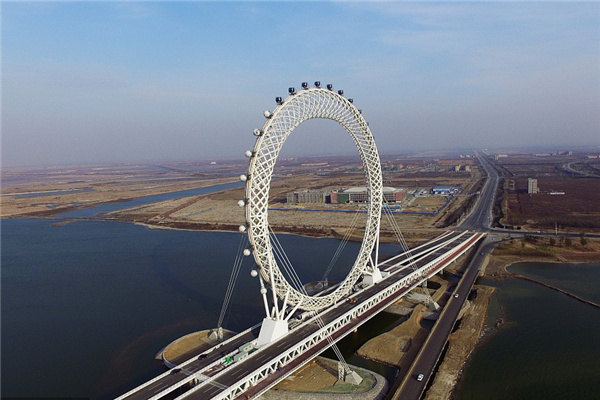 World's largest shaftless Ferris wheel built in China
 Ancient cities to be connected by Xi'an-Chengdu high-speed railway
 Snow turns Harbin into winter wonderland
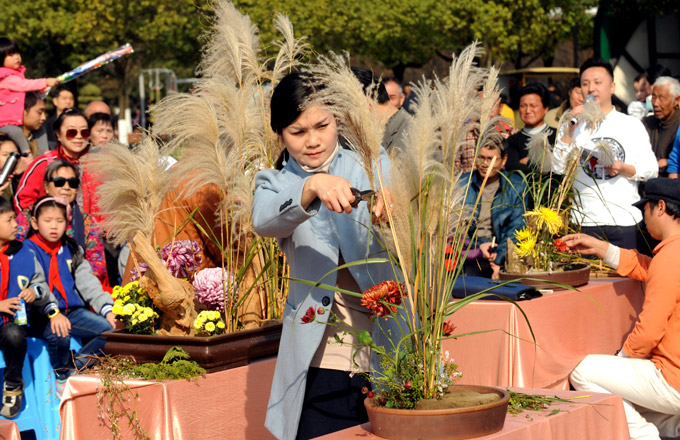 Reed Catkin Festival held in Wuhan
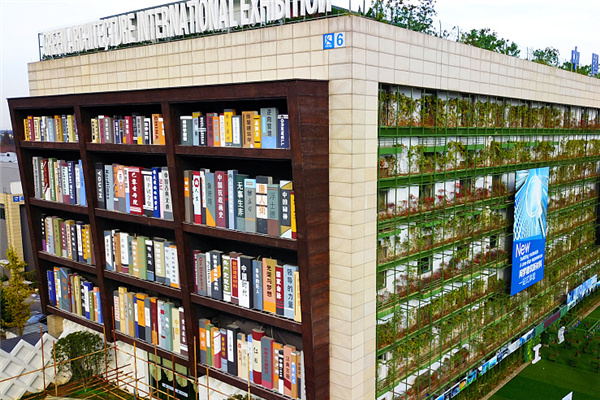 Is it a building or a bookshelf?
 First flight
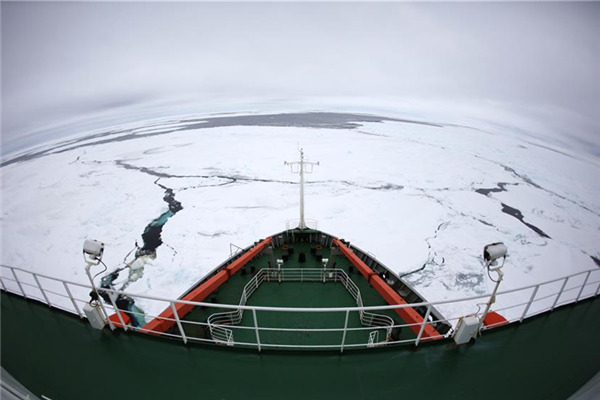 Polar icebreaker Snow Dragon arrives in Antarctic
 Xi's vision on shared future for humanity
 UN's top environmental honors go to three in China
 German trains collide near Duesseldorf, several people injured
 China beats Germany 7-4 in men's curling Olympic qualification
 Bayern beat Paris Saint-Germain 3-1 in UEFA Champions League


Copyright 1995 - . All rights reserved. The content (including but not limited to text, photo, multimedia information, etc) published in this site belongs to China Daily Information Co (CDIC). Without written authorization from CDIC, such content shall not be republished or used in any form. Note: Browsers with 1024*768 or higher resolution are suggested for this site.
License for publishing multimedia online 0108263 Registration Number: 20100000002731