Comments
  Print
Print  Mail
Mail  Large Medium Small
From mah-jong on the streets of Chengdu to cockfights in Kaifeng, Henan province, gambling has long been a way of life for many people in China. Although it has been banned since 1949, gambling continues unabated.
Now focused on Internet betting, underground casinos, and private lotteries, China's illegal gambling market generates enormous revenues each year and represents a huge headache for the Chinese government.
In February, Shanghai police arrested 20 people in what is believed to be the country's largest online gambling operation. The website, which began during the 2006 World Cup, took in bets of $1 billion and made a profit of $235,000, police said.
Earlier this month, police in Hangzhou arrested 11 people suspected of running an illegal gambling network involving bets of more than $73 million.
China revived legal betting in 1987 with two State-run lotteries: the welfare lottery and the sports lottery. Sales from scratch tickets have become a key source of revenue for new sports facilities and the country's social welfare programs.
Last year, revenue from China's legal lottery reached $15.6 billion, an increase of $632 million over 2007. Lottery revenue made up 0.03 percent of China's GDP, compared to 2 to 3 percent in Western countries, according to the China Center for Lottery Studies at Peking University.
However, those figures pale by comparison to illegal gambling revenues. Experts estimate that illegal wagers may be 10 times the country's legal lottery take.
"Legal lottery sales surpassed $14.7 billion in 2007, which means that revenue from illegal gambling could be as high as $147 billion" said Wang Xuehong, a researcher with the China Center for Lottery Studies.
To put that number in perspective, illegal gambling revenue in 2007, according to Wang's estimate, was close to the GDP of Beijing and the annual revenue of the country's tourism industry.
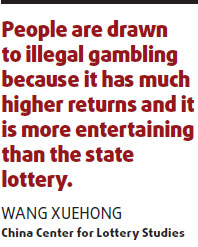
"People are drawn to illegal gambling because it has much higher returns and it is more entertaining than the state lottery," Wang said.
Online soccer betting is the most prevalent form of illegal gambling in China. Soccer pools began in 2002 and peaked in 2006 during the World Cup.
Online gambling companies took in $13 billion during the 2006 World Cup, 60 percent of it from the Chinese mainland and Southeast Asia, the Beijing Morning Post reported.
Total online gambling reached $88.2 billion in 2006, 15 times more than the amount spent on China's State-run lottery, according to the China Center for Lottery Studies.
In 2007, China launched a nationwide campaign to eradicate Internet gambling and casinos near the Chinese border. Police busted more than 1,900 gambling operations and shut down dozens of casinos and small gambling houses in neighboring countries.
Last year, police reported 179,000 cases of illegal gambling, involving 584,000 gamblers. Online gaming dropped to $44.1 billion - still a huge amount of money, Wang noted.
"It was enough to hold the Beijing Olympics twice," she said.
The huge amount of money spent on illegal gambling has prompted some to suggest that China liberalize its legal lottery. Experts are divided on the issue.
Proponents argue that increased revenue from legalized gambling could be used to fund rural development, improve welfare in urban areas, or provide universal, compulsory education.
"The market is there and it is part of human nature," said Wang. "The government will benefit from it and fewer people will be forced into underground casinos if more betting products are legalized."
Those who oppose the idea call for stricter measures to fight gambling, which they say has led to gambling addiction among millions of young people, as well as corruption involving government officials.
Although the lottery business is expanding, China remains the world's largest untapped gambling market.
If China were to liberalize its gambling market, it would present a huge business opportunity for foreign gambling companies such as MGM Mirage and Wynn Resorts, who are eager to invest billions of dollars in Asia.
Millions of mainland tourists pour into casinos in Macao, which replaced Las Vegas as the world's largest gambling center in 2007 with revenues of $6.95 billion.
In recent years, Las Vegas itself has seen a shift from Japanese businessmen to wealthy Chinese players, who now make up more than 50 percent of the high-end clientele at some Las Vegas casinos.
(China Daily 04/27/2009 page6)

 Night views of Harbin through the lens
 Tibetans take train home after pilgrimage or travelling
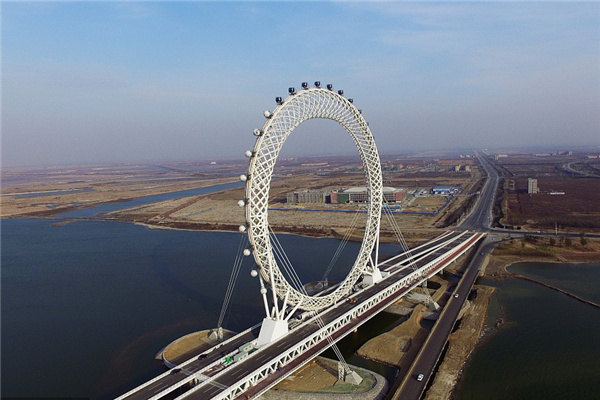 World's largest shaftless Ferris wheel built in China
 Ancient cities to be connected by Xi'an-Chengdu high-speed railway
 Snow turns Harbin into winter wonderland
 Reed Catkin Festival held in Wuhan
 Is it a building or a bookshelf?
 First flight
 Polar icebreaker Snow Dragon arrives in Antarctic
 Xi's vision on shared future for humanity
 UN's top environmental honors go to three in China
 German trains collide near Duesseldorf, several people injured
 China beats Germany 7-4 in men's curling Olympic qualification
 Bayern beat Paris Saint-Germain 3-1 in UEFA Champions League


Copyright 1995 - . All rights reserved. The content (including but not limited to text, photo, multimedia information, etc) published in this site belongs to China Daily Information Co (CDIC). Without written authorization from CDIC, such content shall not be republished or used in any form. Note: Browsers with 1024*768 or higher resolution are suggested for this site.
License for publishing multimedia online 0108263 Registration Number: 20100000002731