

 Comments
  Print
Print  Mail
Mail  Large Medium Small
Zhao Chunjiang paid a high price to save about 3 tons of coal from being burned with their consequent 9 tons of carbon dioxide emissions over the past two years.
The 55-year-old college professor and a solar energy enthusiast in Shanghai did that by building China's first family power generator plant, using 22 solar panels installed on the roof of his apartment.
So far the system has produced more than 7,000 kWh, enough to meet the needs of his family, but it came at a high cost.
Zhao paid $23,800 for his household generator, a price out of the reach of ordinary families in China. And because the Chinese government has no policy on purchasing electricity generated by renewable energy from a family's personal power plant, Zhao had to actually pay the local utility company to feed surplus electricity into the city's grid.
The cost of generating electricity from solar energy has dropped significantly over the past two years because the price of polysilicon, the main material used in producing solar cells, has plummeted to record lows amid the global economic downturn.
Polysilicon is now traded at about $30 to $40 a kg, down from the peak of $400 a kg last July.
"Now you can build a system like this for only half the money," said Zhao, who believes solar energy in China has a bright future.
|
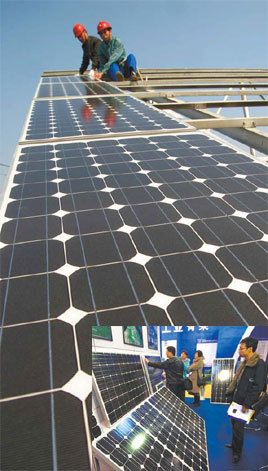
Installing photovoltaic panels on a building in Chaohu, Anhui province. (Inset): Potential customers inspect solar panels. Bian Bo & Wu Changqing |
What is more encouraging is the support from the government. The Ministry of Finance recently announced new subsidies for domestic solar projects, hoping to stimulate the home market because the export-led solar industry was hard hit by the sluggish demand from American and European markets.
The government will grant $2.93 a watt for solar projects with a generating capacity of at least 50 kW, according to the ministry's statement. Chinese solar stocks jumped after the announcement. China's leading solar companies such as Suntech Power Holdings will be the biggest beneficiaries from the new subsidies.
The current cost of solar power is about four to five times the alternatives such as wind power or electricity produced from coal. But with the price of raw materials further declining and more favorable subsidies being offered, the cost has now dropped to $0.26 per kWh for some large solar companies, which is about three times the cost of electricity from coal.
Experts estimate that if the trend continues the industry will see costs cut further to as little as $0.15 per kWh.
High costs and limited government subsidies were the major hurdles that held back the development of solar energy in China. Last year, China produced a quarter of the world's solar photovoltaic (PV) cells, surpassing Germany and Japan as the world's biggest producer of solar cells. But only less than 3 percent of those cells were bought in China.
China's installation of PV solar capacity is also meagre, having about 150 MG by the end of last year, which accounts for only 0.8 percent of the world's total capacity.
The insufficiently stimulated home market has made the Chinese solar industry heavily dependent on overseas markets. As much as 98 percent of Chinese solar cells are sold in overseas markets.
"The recent government subsidies on solar projects will help shift the focus back to the domestic market and will effectively promote the development of solar industry at home," said Lu Yanwu, deputy manager of Rijia Electric Company in Beijing.
China's demand for energy is surging with the country seeing double-digit economic growth in the past decade. So far China derives 75 percent of energy from coal.
To combat energy shortages and environmental degradation, the Chinese government has taken steps to boost renewable energy usage to fuel its booming economy.
The National Development and Reform Commission (NDRC), China's top economic planner, has set the goal of increasing the usage of renewable energy to 10 percent of total energy consumption by 2010 from the current 7.5 percent.
By 2020, China will develop 1.8 GW of solar photovoltaic power, according to the NDRC. The forecast is that by that time, more than $40 billion will be invested in the solar sector, accounting for 16 percent of the total renewable energy investment in China.
There is also a vast market potential in China's ambitious program of providing electricity to more than 20 million Chinese in more than 20,000 rural villages by 2010. The program will bring lucrative business opportunities for domestic producers of solar PV cells.
The construction of two MW-level solar power plants in Shanghai's Chongming island and in the Inner Mongolia autonomous region has recently been completed. They receive government subsidies of $0.59 per kWh.
To speed up the development of solar energy, China also plans to build a 1GW grid-connected solar PV power plant in Qaidam Basin, Qinghai province. It will be the world's largest when it is completed.
In the meantime, thin-film solar cells are being developed as a strong substitute for traditional solar cells to avoid the downside of polysilicon production that could cause pollution to the environment.
The Washington Post reported that some Chinese solar companies were dumping the toxic byproduct of polysilicon production - silicon tetrachloride, a highly toxic substance that poses environmental hazards.
Experts said the thin-film solar cells doesn't rely on the polysilicon raw material and if the project has a breakthrough in its current electricity conversion rate, it will have the positive prospect of further reducing the cost and the environmental risks.
(China Daily 05/04/2009 page6)

 Night views of Harbin through the lens
 Tibetans take train home after pilgrimage or travelling
 World's largest shaftless Ferris wheel built in China
 Ancient cities to be connected by Xi'an-Chengdu high-speed railway
 Snow turns Harbin into winter wonderland
 Reed Catkin Festival held in Wuhan
 Is it a building or a bookshelf?
 First flight
 Polar icebreaker Snow Dragon arrives in Antarctic
 Xi's vision on shared future for humanity
 UN's top environmental honors go to three in China
 German trains collide near Duesseldorf, several people injured
 China beats Germany 7-4 in men's curling Olympic qualification
 Bayern beat Paris Saint-Germain 3-1 in UEFA Champions League


Copyright 1995 - . All rights reserved. The content (including but not limited to text, photo, multimedia information, etc) published in this site belongs to China Daily Information Co (CDIC). Without written authorization from CDIC, such content shall not be republished or used in any form. Note: Browsers with 1024*768 or higher resolution are suggested for this site.
License for publishing multimedia online 0108263 Registration Number: 20100000002731