


 Comments
  Print
Print  Mail
Mail  Large Medium Small
Environmentalists easily find themselves at philosophical odds with green capitalists; but for some sustainable energy development and environmental protection can coexist with capitalism. All it needs is a little creative flair.
One such capitalist conservationist is William Ginn, a businessman-turned conservation practitioner.
Ginn wears many caps at The Nature Conservancy (TNC) - the world's biggest conservation NGO. He is the director of conservation banking and investment for the NGO and is also their director for global forest initiatives.
Attending the 2nd Annual Summit of China Green Companies held in Beijing on April 22-23, Ginn shared with the audience his ideas about how to create growth incentives to address environmental needs.
A typical businessman, Ginn said he believes that not all people are born environmentalists and need economic motivation to entice them into it. He quoted Gretchen Daily, one of TNC's board of directors, as saying that "conservation cannot succeed by charity alone. It has a fighting chance if we can change the rules of the game so as to produce new incentives for environmental protection".
Ginn is presently engaged in a worldwide campaign to reduce forest destruction by explaining the concept of trees being able to absorb and sequester carbon dioxide or CO2, which contributes to global warming, to the forest owners. He also said that industries producing CO2 want to reduce their carbon footprint and are willing to pay for trees to decrease that footprint.
He is all for attaching a value to those forests. "We have to establish a financial value for the carbon stored in standing forests," said Ginn.

"There is a growing consensus among world leaders and conservation organizations that credits earned through forest protection be included in a global carbon trading market," Mark Tercek, CEO of TNC, said earlier.
"China should introduce this concept as soon as possible," Ginn said. "US and China, the world's top two CO2 emitters, should joint hands to bring about more positive changes," he urged.
Ginn said China should also add the cost of restoring nature to the price of products, whose manufacturing process has polluted the water, air or soil. "Chinese goods are cheaper than those made in US, because manufacturers ignored the environmental cost," he said. "When you export products to the US, the US enjoying the cheap merchandise while the Chinese are paying for the deterioration of their environment."
"If this is done, China will begin to enjoy a better environment and so would the entire world," he said.
According to Ginn, about 24 percent of greenhouse gases emitted annually comes from the destruction of forests - that is more than GHGs emitted from planes, trains and automobiles collectively.
In the next few years, scientists predict that developing countries will produce more climate-changing emissions than all industrialized nations combined - much of this due to the destruction of tropical forest resources.
Ginn's proposal met with agreement from the Chinese minister of forestry, Jia Zhibang, who had earlier mentioned that China needed some financial tools and incentives to make forest conservation a powerful tool against climate change. China has 133 million acres of bare, hilly land - an area the size of France - that could be used to grow trees and generate carbon credits, said another official with the China's State Forestry Administration.
In China, forestry is undergoing a reform aimed at giving the right of managing forests to individual households instead of collectively to villages. The reform will make it possible for private money to be used in forest protection while generating revenue.
Currently, protection of forests is not recognized as a source for carbon emission reduction by existing climate policies, including the Kyoto Protocol and many people question why can't developing nations receive credits for reducing emissions by protecting forests.
They hope that such market mechanisms are included in the successor agreement to the Kyoto Protocol.
Meanwhile some are concerned that that forest carbon credits could flood the market, causing the price of carbon to crash and reducing the level of funds available for pollution abatement from industrial sources. It has been reported that the European Commission has passed a proposal to exclude forestry credits from the EU's emission trading scheme - the world's largest carbon market - until 2020.
(China Daily 05/11/2009 page3)

 Night views of Harbin through the lens
 Tibetans take train home after pilgrimage or travelling
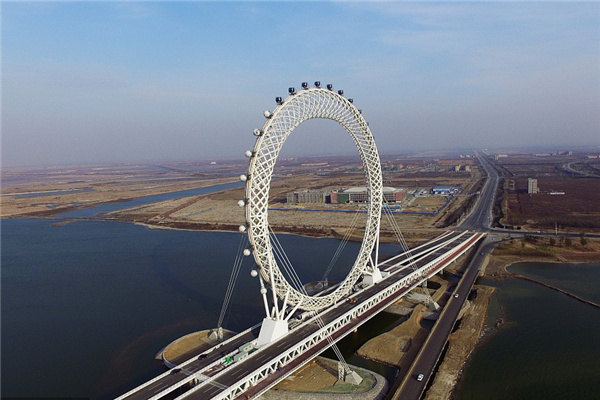 World's largest shaftless Ferris wheel built in China
 Ancient cities to be connected by Xi'an-Chengdu high-speed railway
 Snow turns Harbin into winter wonderland
 Reed Catkin Festival held in Wuhan
 Is it a building or a bookshelf?
 First flight
 Polar icebreaker Snow Dragon arrives in Antarctic
 Xi's vision on shared future for humanity
 UN's top environmental honors go to three in China
 German trains collide near Duesseldorf, several people injured
 China beats Germany 7-4 in men's curling Olympic qualification
 Bayern beat Paris Saint-Germain 3-1 in UEFA Champions League


Copyright 1995 - . All rights reserved. The content (including but not limited to text, photo, multimedia information, etc) published in this site belongs to China Daily Information Co (CDIC). Without written authorization from CDIC, such content shall not be republished or used in any form. Note: Browsers with 1024*768 or higher resolution are suggested for this site.
License for publishing multimedia online 0108263 Registration Number: 20100000002731