

 Comments
  Print
Print  Mail
Mail  Large Medium Small

Editor's Note: In his eyes, economic sustainability, compared to five years ago, is still a challenge for China. However, it is in a different context now.
This is what David Dollar, the US Treasury Department's economic and financial emissary to the US Embassy in Beijing, told China Business Weekly reporter Fu Jing during an exclusive interview before he ended his five-year tenure as World Bank China director in late July.
At his World Bank post, Dollar since 2004 has promoted efforts to reduce poverty and protect the environment in China.
Before his 20-year career with the World Bank, Dollar earned a PhD in economics from New York University and an undergraduate degree at Dartmouth College with a special major in Chinese language and history.
Dollar believes China's biggest economic challenge, as the global trade and economic system begins to recover, is to put domestic consumption back on a sustainable path. The following is the script of the interview.
Q: As you are preparing to leave the World Bank post, what impressed you most during your stay in Beijing, and what is China's biggest challenge now?
A: There have been many changes during the past five years. I would like to pick one thing that changed very fast in China, and that is the natural environment.
I am impressed at how clear the air has become in many cities and how clean the water has become in many regions in China.
And energy efficiency has been improved a lot in the past five years. This is not only happening in Beijing. It is a nationwide phenomenon.
The World Bank has launched many projects in western and middle parts of China, and we found that China has made a lot of progress on its environmental agenda.
Five years back when I started my World Bank work in Beijing, I believed environmental problems were the biggest challenge for China.
However, now the financial crisis has created a new challenge, that of spurring domestic consumption. I think this is the biggest challenge that China faces now.
Increases in household income and tax breaks cannot change the consumption pattern of Chinese households.
Policymakers need to expand institutional reforms and also prepare medium-term and long-term development strategies. The policy goal should be to make Chinese families feel more secure about spending money.
To achieve that, the nation should adopt pension plans and health insurance plans to make people feel confident about spending. If coordinated reforms are put in place, it will change household behavior and put China on a sustainable path.
Q: As World Bank China director, are you satisfied with the progress you and your team have achieved in China?
A: Yes, we are satisfied with the social progress China has made during the past five years. But we should not be over-satisfied. We should strive to do better, as there are still a lot of challenges ahead.
The Chinese government desires to do better on many fronts, and I am happy to see this healthy attitude.
I have been to nearly every province in China. I have been to poverty-stricken regions such as Gansu and Sichuan provinces, and I know how tough rural life is.
We found that China has performed well in reducing poverty by scrapping the rural tax, by offering free compulsory education for rural children and through rural cooperative healthcare plans and rural infrastructure improvements.
Q: This year, China is thinking about designing its 12th Five-Year Plan for 2011 through 2015. What suggestions can you offer to decision makers when they create the blueprint? What are the new economic engines that can be used as counter measures to the financial crisis?
A: In my opinion, China should consider dramatically increasing domestic consumption by boosting household income to have sustainable growth.
Our World Bank report analysis shows that, as global economic growth slows down, domestic consumption in the developed countries will not grow very fast.
The economy in the United States is in recovery, but domestic consumption there will not increase very quickly. It will be similar with Europe and Japan.
And so for China, the export market will not recover to the level of fast growth enjoyed in the past.
Exports are important for China. The growth rate of exports in the past has exceeded 20 percent annually, but it will be hard to achieve that in the coming years with the new global situation.
So China needs other sources of stimulus. The good news is that household income is increasing quite a bit.
Once household income increases, families want to live a better life, have a bigger apartment, give children a better education and want to enjoy vacations.
China needs a number of policies to boost the momentum. Then domestic consumption will become a large contributor to China's sustainable economic growth in the next five years.
Q: The United States is taking steps to rebalance its economy by increasing the savings rate and boosting domestic consumption. Does this mean that the Sino-US trade relationship will be weakened in the future?
A: I don't think the relationship will be weakened. First, China will continue to be big, possibly the biggest exporter in the world, and the United States is still a big market.
What we are discussing here is how fast the increase will be. The increase in China's exports to the United States will not be as fast as it was in the past, but the most likely scenario likely will involve an increase.
And as China's consumption increases, you will see more imports to China. And the trade ties with the United States, the European Union and Japan will increase.
The US-China trade relationship will be strengthened, but the character of that relationship in the coming five to 10 years will differ from what it was before.
Q: If I don't ask this question, my readers will be upset. What are your expectations about the US dollar and China's renminbi?
A: Here I am afraid that I will disappoint your readers, because I am still World Bank China director (when this interview took place).
The World Bank doesn't advise on exchange rate policies. That's the role of the International Monetary Fund. Frankly, I can't say much about the exchange rate.
However, from the World Bank's analysis, it's not in the best interest of China to have such a large trade surplus.
A large trade surplus means a lot of liquidity for China, and the central bank will save specifically to accumulate more reserves.
Your government has showed some concerns, and the World Bank has suggested taking measures to reduce the trade surplus.
China has done a very good job in meeting World Trade Organization commitments. There are a lot of world services that, if expanded, should benefit China.
So I think any measures you take to boost domestic consumption will help expand global services to China.
If the renminbi appreciates, that will be a good way to deal with the trade surplus.
(China Daily 08/03/2009 page2)

 Night views of Harbin through the lens
 Tibetans take train home after pilgrimage or travelling
 World's largest shaftless Ferris wheel built in China
 Ancient cities to be connected by Xi'an-Chengdu high-speed railway
 Snow turns Harbin into winter wonderland
 Reed Catkin Festival held in Wuhan
 Is it a building or a bookshelf?
 First flight
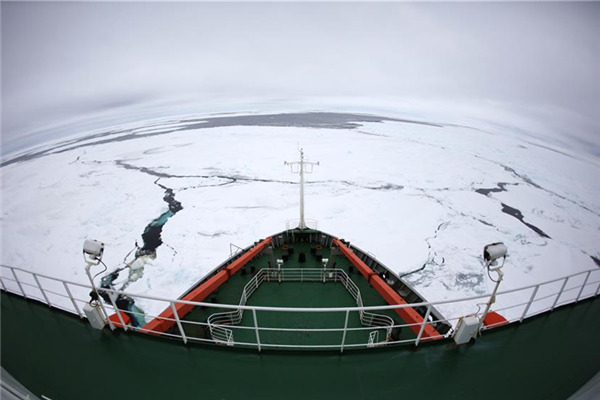 Polar icebreaker Snow Dragon arrives in Antarctic
 Xi's vision on shared future for humanity
 UN's top environmental honors go to three in China
 German trains collide near Duesseldorf, several people injured
 China beats Germany 7-4 in men's curling Olympic qualification
 Bayern beat Paris Saint-Germain 3-1 in UEFA Champions League


Copyright 1995 - . All rights reserved. The content (including but not limited to text, photo, multimedia information, etc) published in this site belongs to China Daily Information Co (CDIC). Without written authorization from CDIC, such content shall not be republished or used in any form. Note: Browsers with 1024*768 or higher resolution are suggested for this site.
License for publishing multimedia online 0108263 Registration Number: 20100000002731