Comments
  Print
Print  Mail
Mail  Large Medium Small
By the rest of the world's standards, China's property market is looking bubbly. After surging as much as 30 percent in certain hot markets during the past five months, prices are looking stretched on metrics such as affordability and rental yield.
But there are bigger factors at play. Massive infrastructure projects that raise the value of the land, China's unprecedented policy of loose bank credit, the urbanization movement that creates new demand, and the Chinese people's traditional love of brick and mortar have all contributed to the recent rebound from last year's lows.
While some people are sounding warning bells, a greater number are eager to participate in the recovery.
Pent-up demand has driven nationwide transaction volumes up 37 percent during the first seven months, with volumes in Beijing soaring 120 percent.
More than 1 trillion yuan has been earmarked for nationwide infrastructure building this year. Local governments are pouring billions of dollars into building subways, high-speed trains and stadiums in preparation for the World Expo in Shanghai, as well as the Asian Games and World Student Games in southern China.
Urbanization
Urbanization will continue for at least another decade. About 9 million villagers become city dwellers every year, creating more housing demand in China's already crowded mega-cities.
Supply now looks tight after developers rushed to sell down inventory late last year and early this year to raise money to pay down debt.
China Overseas Land sold more apartments in the first half of this year than its full-year target, and Sino-Ocean Land booked sales that amounted to 88 percent of its original 2009 target in the same period.
Banks might have become more cautious with lending, but China is still allowing second-home buyers to get mortgages, though they now need to put down a deposit worth 40 percent of the value of the property instead of the original 30 percent. First time buyers still enjoy 30 percent mortgage discounts, except those buying larger flats.
China will not want to prick the asset bubble before the economy gets on a solid footing, partly because real estate accounts for as much as a quarter of fixed asset investments.
Job creation
The industry also tends to drive demand everywhere. Construction work, which is labor-intensive, helps to create jobs and increase sales of concrete, steel and glass.
As people renovate their new homes and fill them with large flat-panel TVs, furniture and curtains, retail sales will get a big boost. This has already started happening.
The main thing that could stop this upward spiral would be if developers raised prices too much, too soon. With debt ratios slashed and margins depressed during the first half on heavy discounts, developers are tempted to increase prices.
Admittedly, prices look excessive if compared to income, especially in Beijing and Shanghai, where monthly mortgages now account for 76 percent of income on average.
However, the figure is distorted because official incomes are undervalued by as much as 42 percent, according to a paper authored by Wang Xiaolu of the National Economic Research Institute.
Taking that into consideration, mortgages only account for a more reasonable 35 percent of mid-income group earnings and 23 percent of high-income group earnings in Shanghai, according to Chinese brokerage firm CICC.
China's top cities are also becoming more similar to the likes of London and New York. Many top property buyers are rich people from elsewhere.
Young people might not be able to afford an apartment on their own, but they get a helping hand from their parents.
The country as a whole boasts a savings rate as high as 40 percent. Residents' deposits represent a whopping 74 percent of gross domestic product, while total bank credit to residents is only 19 percent of GDP.
Chinese bankers have not yet resorted to creating "smart" financial products such as the three-generation (100-year) mortgages seen during Japan's property bubble of the late 1980s, or the sub-prime loans that helped inflate the US housing market.
All property buyers are still required to put down 30 percent initially, which means that mortgages are still regarded as the safest assets of Chinese banks.
Rental yield is at a very low level of 1 percent to 2 percent in China, which can be read as evidence of a lack of real demand for properties. But it can also be partly explained by the Chinese people's preference to own rather than rent, which puts a premium on house prices.
Demographic change will shift the balance of supply and demand in 20 years time, when China's population peaks and the urbanization movement slows.
But in the short term, worries about inflation are likely to drive more people to buy property.
Wei Gu is a Reuters columnist. The views expressed here are her own.
(China Daily 09/14/2009 page2)

 Night views of Harbin through the lens
 Tibetans take train home after pilgrimage or travelling
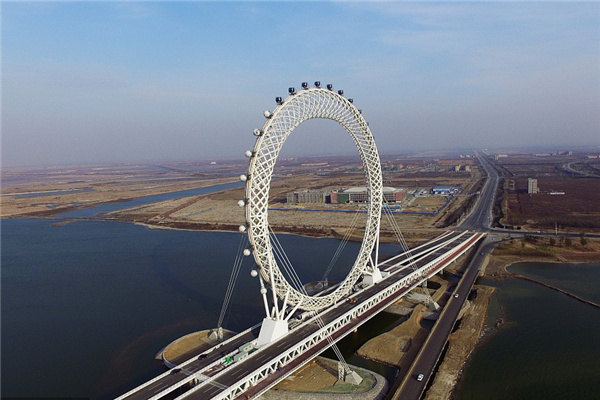 World's largest shaftless Ferris wheel built in China
 Ancient cities to be connected by Xi'an-Chengdu high-speed railway
 Snow turns Harbin into winter wonderland
 Reed Catkin Festival held in Wuhan
 Is it a building or a bookshelf?
 First flight
 Polar icebreaker Snow Dragon arrives in Antarctic
 Xi's vision on shared future for humanity
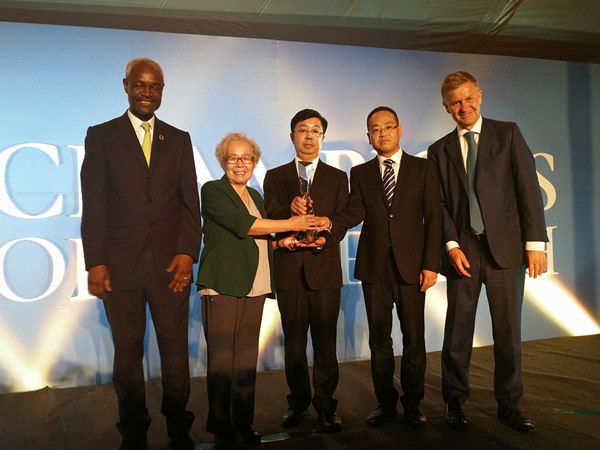 UN's top environmental honors go to three in China
 German trains collide near Duesseldorf, several people injured
 China beats Germany 7-4 in men's curling Olympic qualification
 Bayern beat Paris Saint-Germain 3-1 in UEFA Champions League


Copyright 1995 - . All rights reserved. The content (including but not limited to text, photo, multimedia information, etc) published in this site belongs to China Daily Information Co (CDIC). Without written authorization from CDIC, such content shall not be republished or used in any form. Note: Browsers with 1024*768 or higher resolution are suggested for this site.
License for publishing multimedia online 0108263 Registration Number: 20100000002731