Update enterprises with advanced technology and managerial expertise
September 18, 1978
A question which now confronts you is how the Anshan Iron and Steel Company should be updated. Whenever foreign technology is introduced, we should first master it and then upgrade or renovate it. You have many tasks ahead of you at this point, such as the training of workers and cadres. If you fail to do so, then they will not be capable of acquiring advanced foreign technology. We had a serious lesson along these lines. It is important for us to seize the hour, because our country is going to introduce about 1,000 projects from other countries. All our technologies and equipment as well as supporting facilities should be modern and up to the highest standards of the 1970s. The world is advancing. If we do not develop our technology, we cannot catch up with the developed countries, let alone surpass them, and we shall be trailing behind at a snail's pace. We should take the world's advanced scientific and technological achievements as starting points for our country's development. Such a lofty aspiration should be ours.
It is a good idea for the Anshan Iron and Steel Company to cut down the number of its staff members and departments. As for those units to be dissociated from the company, it is important that it should not have too many administrators or staff personnel. Large numbers of people in a modern and automated enterprise lead only to poor management. A steel enterprise with an annual output of six million tons in Japan has only 600 administrators, whereas the Anshan Iron and Steel Company with the same annual output has 23,000 managerial personnel. This is surely unreasonable. When advanced technology and equipment are imported, we must run enterprises with advanced management and operation techniques and set attainable quotas. In other words, we should manage the economy in accordance with the laws governing economic development. In a word, we need a revolution instead of just reforming the economy.
If we want to update enterprises so that their technology and management can reach the required level, we must have qualified managerial staff and workers. After technological upgrading, large numbers of workers with relatively high educational and technological levels should appear, otherwise new technologies and equipment cannot be used. All cadres and workers should be evaluated. Those who are unqualified should be designated as supernumerary personnel. Their livelihood should be guaranteed, but they cannot enjoy the same treatment as assigned personnel. They should be organized to study and receive training so as to become qualified for new jobs. We should resolve to accomplish this task.
Qualified managerial staff and workers should enjoy better treatment, so that the principle of distribution according to work can be truly carried out. This is not capitalism. A worker who has a salary of one or two hundred yuan cannot become a capitalist. But will this practice dampen others' initiative? There will be some complaints, but this can encourage people to advance. When the economy develops, workers' income should increase, which in turn promotes economic development. The same is true with agriculture; an increase in peasants' income stimulates agricultural growth and consolidates the alliance of workers and peasants. Socialism must demonstrate its superiority. Things should not continue as they are: although we have practiced socialism for more than 20 years, our country is still very poor. If things continue like this, why should we continue under socialism? We must initiate a revolution in technology and management so as to expand production and increase the income of workers and staff.
As you are planning to upgrade the steel enterprise, you also need to give consideration to every aspect of the social structure of Anshan. As production grows, the number of people directly engaged in production will decrease, and more and more people will engage in service trades. Service trades are numerous, such as seed companies and building and repair work. Therefore, there are many ways to re-employ the supernumerary people. You should see to it that there is a good sized scientific research department in your enterprise. All large enterprises in the United States and Japan have such institutes. We should strengthen and enlarge the ranks of our scientific researchers.
We should give more power to local authorities, and to enterprises in particular. Enterprises should have the right to make their own decisions and act independently. For instance, they should have the right to decide how many people they will employ and what should be increased or reduced. They should also have some foreign exchange at their disposal so as to be able to place orders and to exchange technology with other countries. When something is to be done, an enterprise currently has to submit its plan to the authorities of the province, the ministry, and the State Planning Commission for approval. This process is too slow. Some of our comrades listen only to what higher authorities dictate and are afraid to use their own minds. We should, as Chairman Mao put it, "put down our mental burdens and use our own minds". If an enterprise wishes to improve its technological and managerial levels, it has to be creative, enjoying decision-making power and flexibility. Cadres at all levels should use their own heads and should not be mentally lazy or rigid. Of course, this is the result of the system we practised in the past. In the future, we should give cadres at enterprises both the power to make their own decisions and the authority to assess the efficiency of their own work. We should carry out a system of responsibility whereby cadres are compelled to think critically. It is time for us to reform the superstructure.
(Excerpt from remarks made when hearing a report from the leading comrades of the Anshan Municipal Party Committee. )
(From Selected Works of Deng Xiaoping, Volume II <1975-1982>)



- China issues guidelines to develop 'all-for-one' tourism demonstration zones
- Torrential rain triggers disaster in Southwest China
- Harvest time for wheat reapers in Shanxi
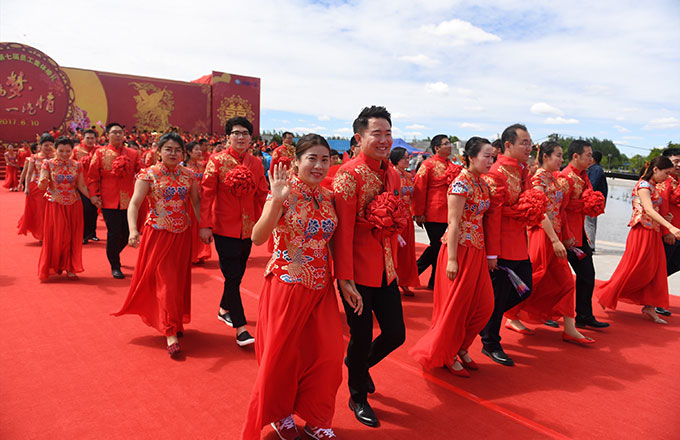
- Over 200 couples marry in Changchun group wedding
- Calligraphy tops other icons of Chinese culture, WeChat data shows