Remarks after an inspection tour of Jiangsu province and other places
March 2, 1983
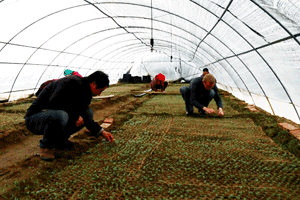
I recently travelled from Jiangsu to Zhejiang Province and from there to Shanghai. On this trip I found things were going very well. People were in excellent spirits. There were many new houses, there were plenty of consumer goods on the market, and cadres were brimming with confidence. Prospects are obviously bright for our modernization programme. There should be more detailed overall planning for quadrupling gross annual industrial and agricultural output by the end of the century. Every province and autonomous region and every municipality directly under the Central Government should have a specific plan, so that it knows exactly what to do. This includes backward regions such as Ningxia [Hui Autonomous Region], Qinghai [Province] and Gansu [Province]. We must help the provinces, autonomous regions and municipalities solve their most pressing problems and thus create the conditions that will enable them to fulfil their plans.
Gross annual industrial and agricultural output in the city of Suzhou has approached US$800 per capita. I asked comrades in Jiangsu what society was like at that level of output and what the prospects were for development? They said that many problems had been solved.
1. People had adequate food, clothing and other consumer goods, so that they no longer had to worry about their basic needs;
2. They had enough housing, with 20 square metres per person. Because of the shortage of land, many two- and three-storey buildings had been erected in small towns and villages;
3. There was basically full employment in cities and towns;
4. Rural people were no longer pouring into big cities;
5. Primary and secondary education had become universal, and funds were available for education, culture, sports, public welfare and other undertakings; and
6. People's ethical standards had risen, and the crime rate had decreased.
In the six years from 1977 to 1982, the gross annual value of industrial and agricultural output in Jiangsu Province doubled. If it continues to grow at this rate, it will double again during the next six years from 1983 to 1988. I asked comrades in Jiangsu how they had managed it. They said they had done two things. One was to rely on technicians from Shanghai. The other was to promote collective ownership, that is, to set up small and medium-sized enterprises. Many retired workers from Shanghai were recruited in Jiangsu. They are highly skilled, and will work for not much pay. They are ready to accept work that brings them a little extra income and a few rooms to live in, and they have played an important role in increasing production. Over the years comrades in Jiangsu have valued knowledge and intellectuals and have put them to good use. In a few cities in Jiangsu the technical level of production is no longer inferior to that in Shanghai.
The important thing now is to waste no time in launching projects that should be launched. War is not going to break out, so there is no need to fear it and no problem of risk. We have been worried about the possibility of war and have had to be on the alert every year. I think we overdid it. I don't think there will be war for at least the next ten years.
It is right to establish economic cooperation between developed and less developed areas. In my view, such an arrangement should not be confined to Shanghai and Shanxi Province. Nor should we remain locked in an experimental stage. If we always make pilot studies on specific problems, taking several years to resolve just a few of them, progress will be too slow. During the War of Liberation [1946-1949] Comrade Mao Zedong held that the Second Field Army and the Third Field Army should be combined in military operations. He said that combining the two field armies would multiply their strength not just by two but several times over. The same is true of economic cooperation. Even though we have yet to resolve many differences of views on this question, we should start to move on it right now.
In short, we must be absolutely clear about what we have to do. There is too much talk and not enough action.
It is very important to tap intellectual resources. In this I include training for workers and managers, which should receive more attention. In the next few years universities and colleges should be expanded -- by 50, if not 100, per cent. This is well within our capacity. It would not be hard to double enrolments in key universities and colleges, and there is no lack of teachers. The main problem is housing. I think we can afford to spend a little more on college buildings and dormitories. We should calculate how much it would cost.
While there is an overall shortage of intellectuals, in some places young and middle-aged intellectuals are finding it difficult to play a useful role. We must resolve to implement the policy towards intellectuals, which includes improving their living standards. The film A Middle-Aged Doctor is worth seeing. We old comrades can learn a lot from it. It will do us good.
(Made in Beijing to leading members of the Central Committee of the Communist Party of China.)
(From Selected Works of Deng Xiaoping, Volume III <1982-1992>)



- China issues guidelines to develop 'all-for-one' tourism demonstration zones
- Torrential rain triggers disaster in Southwest China
- Harvest time for wheat reapers in Shanxi
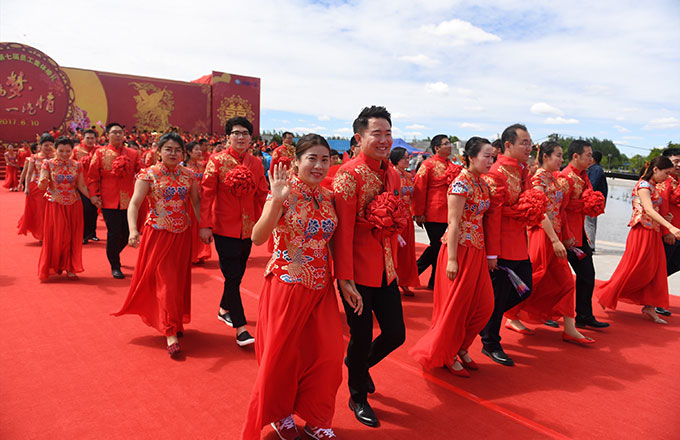
- Over 200 couples marry in Changchun group wedding
- Calligraphy tops other icons of Chinese culture, WeChat data shows