Let the facts speak for themselves
March 28, 1986
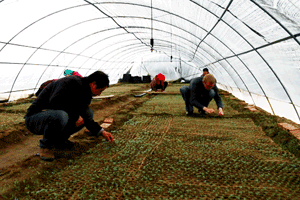
Our reform began in the countryside, and it has achieved initial success there. However, some rural areas are more developed than others. About 10 per cent of them, mainly the arid areas in the Northwest and some areas in the Southwest, have not yet lifted themselves out of poverty. It is our policy to let some people and some regions prosper before others, so that they can bring along the backward regions. The advanced regions have the obligation to help the backward. We keep to the socialist road in order to attain the ultimate goal of common prosperity, but it is impossible for all regions to develop at the same pace. We used to practise egalitarianism, with everyone "eating from the same big pot". In fact, that practice meant common backwardness and poverty, which caused us much suffering. The reform is designed, first and foremost, to break with egalitarianism, with the practice of having everyone "eat from the same big pot". It seems to me that we are taking the right path.
Some people don't like this policy. Our approach is to allow people to hold differing views and to let the facts speak for themselves. In the first year or two, people in some rural areas ignored the reform. They distrusted it and refused to carry it out. For one or two years they looked on from the sidelines. Then, when they saw that things were getting better in areas where the reform had been carried out, they began to follow suit. Here I am referring mainly to some leading cadres, not to the peasant masses. So in the beginning not everyone understood the policy. It will be accepted universally only when facts have shown it to be correct.
Right now we are carrying out all-round reform with the main emphasis on restructuring the economy in the cities. Some people are skeptical or worried, as was the case in rural reform at first. They want to wait and see. We allow them to be skeptical, because that is only normal. We are undertaking a tremendous endeavour, a great experiment, a revolution -- how could there not be skeptics? Even for the champions of reform, it is good to be a bit skeptical. Our approach here is the same: to let the facts speak for themselves; to let the progress of reform convince the skeptics.
The success of our modernization drive depends on two factors. The first is domestic: our adherence to the present policies of reform and opening to the outside world. If the reform is successful, it will lay a solid foundation for sustained development over the next few decades. The other is international: a lasting peaceful environment. We follow a foreign policy of opposing hegemonism and preserving world peace. We support those who help maintain peace and oppose those who make war and who seek hegemony. We are improving our relations with both the United States and the Soviet Union, the two superpowers, but we criticize them and vote against them if they do anything wrong. We don't ride in anyone else's car. Our independent foreign policy helps greatly to preserve world peace. The most important thing is that China's present policies, both domestic and foreign, must not be changed. I believe that if we keep to the present policies for several decades, China will develop.
We are working for both material and ethical progress. Our policy of opening to the outside world will inevitably bring into China some evil things that will affect our people. If we say the policy involves risks, this is the greatest one. We shall solve this problem by means of law and education. If we work hard, we shall find a solution. The people detest graft, bribery, theft and other dirty practices. I have no doubt that if we rely on the strength of the people, we shall be able to gradually eliminate those practices.
(Excerpt from a talk with Prime Minister David Lange of New Zealand.)
(From Selected Works of Deng Xiaoping, Volume III <1982-1992>)





- China issues guidelines to develop 'all-for-one' tourism demonstration zones
- Torrential rain triggers disaster in Southwest China
- Harvest time for wheat reapers in Shanxi
- Over 200 couples marry in Changchun group wedding
- Calligraphy tops other icons of Chinese culture, WeChat data shows