In everything we do we must proceed from the realities of the primary stage of socialism
August 29, 1987
China is developing its economy in three steps. Two steps will be taken in this century, to reach the point where our people have adequate food and clothing and lead a fairly comfortable life. The third step, which will take us 30 to 50 years into the next century, is to reach the level of the moderately developed countries. These are our strategic objectives and our high ambitions. It would be impossible for us to fulfil those aspirations without carrying out reform and opening to the outside world. The road ahead of us is still long and our tasks formidable, so we must all work hard and concentrate on developing the economy and expanding the productive forces.
In October of this year our Party will convene its Thirteenth National Congress. Basically, this congress will concentrate on the reform and the opening process. It will reaffirm the principles and policies formulated since the Third Plenary Session of the Party's Eleventh Central Committee and call for deepening the reform of the economic structure and carrying out a corresponding reform of the political structure. The Thirteenth National Party Congress will also add some younger members to the leadership of the Party and government, making it more energetic while ensuring the continuity of our policies.
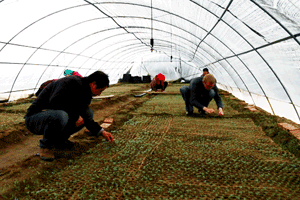
Have you been to our countryside? The real changes have taken place there, and some of them have exceeded our expectations. We had not found a good solution to the problem of surplus labour created by the implementation of the contracted responsibility system. For a long time 70 to 80 per cent of the rural work force was tied to the land, with an average of only about 0.1 hectare per person, and most peasants did not even have adequate food and clothing. Once we instituted the reform and the open policy and introduced the responsibility system, the number of people engaged in agriculture shrank. What about those who were made redundant? Ten years of experience have shown that we can solve this problem by encouraging villages and townships and individual peasants to develop a diversified economy and establish new types of enterprises. Rural industries have absorbed 50 per cent of the surplus work force. The idea of starting such industries was not put forward by the leaders of this country but by the villages and townships and the peasants themselves. Devolving authority to the localities and the people, which in the countryside means the peasants, is the height of democracy. This is an important component of the socialist democracy we talk about. At the same time, rural enterprises help greatly to promote the development of agriculture.
The reform of the political structure is a complex undertaking, and every measure we take will affect the interests of thousands upon thousands of people. So we have to proceed one step at a time, in a well-directed and orderly way. We cannot simply copy the system of the capitalist countries lock, stock and barrel, and we cannot allow bourgeois liberalization. For instance, we cannot abandon leadership by the Communist Party. Without the Communist Party there would be chaos, or at least instability. Under those conditions, any development would be impossible. We have had some experience with "great democracy" in the form of the "cultural revolution", which was a calamity. Our reform of the economic structure is being carried out under the leadership of the Party and in an orderly way; we cannot allow anarchy.
The Thirteenth National Party Congress will explain what stage China is in: the primary stage of socialism. Socialism itself is the first stage of communism, and here in China we are still in the primary stage of socialism -- that is, the underdeveloped stage. In everything we do we must proceed from this reality, and all planning must be consistent with it.
(Excerpt from a talk with Leonilde Jotti and Renato Zangheri, leaders of the Italian Communist Party.)
(From Selected Works of Deng Xiaoping, Volume III <1982-1992>)

- China issues guidelines to develop 'all-for-one' tourism demonstration zones
- Torrential rain triggers disaster in Southwest China
- Harvest time for wheat reapers in Shanxi
- Over 200 couples marry in Changchun group wedding
- Calligraphy tops other icons of Chinese culture, WeChat data shows