China will never allow other countries to interfere in its internal affairs
July 11, 1990
Ever since last year some countries have imposed sanctions on China. I think, first, they have no right to do so; second, experience has proved that China has the ability to withstand these sanctions. Our economic development has been affected to some extent, but not very seriously. In fact, the sanctions are gradually abating. One special feature of China's development is that it has proceeded under international sanctions for most of the forty years since the founding of the People's Republic. If there is nothing else we're good at, we're good at withstanding sanctions. So we are not worried or pessimistic about them; we take them calmly. Despite the trouble that has arisen in Eastern Europe and the Soviet Union, and despite the sanctions imposed by seven Western countries, we adhere to one principle: to maintain contacts and build good relations with the Soviet Union, with the United States, and also with Japan and the European countries. We have never wavered in this principle. China is magnanimous and is not upset by trifles like that.
China will never accept interference by other countries in its internal affairs. It was on the basis of our own conditions that we decided upon our social system, a system that our people endorse. Why should we accept foreign interference designed to change that decision? The key principle governing the new international order should be noninterference in other countries' internal affairs and social systems. It won't work to require all the countries in the world to copy the patterns set by the United States, Britain and France. There are many Islamic countries, making up one fifth of the world's population. In these countries it is absolutely impossible to introduce a so-called democratic system of the American type. The People's Republic of China, with another fifth of the world's population, will not adopt America's capitalist system either. The African countries too, through the Organization of African Unity, demand with one voice that no other country interfere in their internal affairs. This is the general trend throughout the world.
Given this background, if the Western developed countries insisted on interfering in other countries' internal affairs and social systems, it would lead to international turmoil, especially in the developing countries of the Third World, which need a stable political environment to lift themselves out of poverty. If there is political instability, how can they concentrate on solving the problem of food? Not to mention the problem of development. We must therefore take the Five Principles of Peaceful Coexistence as the norms for the new international political and economic order. Hegemonism and power politics, which have emerged in new form, cannot last long. Allowing a few countries to monopolize everything, as they have done for years, has never solved any problems, and it never will.
The conditions necessary for China to reach its development goal are a stable domestic environment and a peaceful international environment. We don't care what people say about us; what we do care about is to have a good environment in which to develop our country. We shall be satisfied if history proves the superiority of the Chinese socialist system. Whether the social systems of other countries are good or bad is not our business. After the events in Eastern Europe, I told some Americans not to rejoice too soon. The situation was complicated enough, the problems of Eastern Europe had not been solved, and it would be better for people not to provoke more trouble.
If China were in turmoil, can you imagine what it would be like? I don't think it would simply be the same as the ``cultural revolution'', when the older generation of Mao Zedong, Zhou Enlai and other prestigious leaders were around. Although the ``cultural revolution'' has been described as a full-scale civil war, there was no fierce fighting, no actual civil war. But now things have changed. If the situation deteriorated to the point where our Party and the state power couldn't function, with each faction controlling a part of the army, a civil war would indeed erupt. As soon as they seized power, the so-called fighters for democracy would start fighting each other. And if a civil war broke out, with blood flowing like a river, what ``human rights'' would there be? If civil war broke out in China, with each faction dominating a region, production declining, transportation disrupted and not millions or tens of millions but hundreds of millions of refugees fleeing the country, it is the Asia-Pacific region, which is at present the most promising in the world, that would be the first to be affected. And that would lead to disaster on a world scale.
So China must not allow itself to descend into turmoil; we have that responsibility to ourselves and to all mankind. Even responsible foreign statesmen would acknowledge that China must remain stable. Human rights and democratic rights are not related to this question. The only solution is peaceful coexistence and cooperation of all countries with different social systems on the basis of the Five Principles, not interference in other countries' internal affairs and provoking disorders. China has raised this question to alert everyone, to remind all countries to be careful when they decide on their policies towards China.
(Excerpt from a talk with Pierre Elliott Trudeau, former Prime Minister of Canada.)
(From Selected Works of Deng Xiaoping, Volume III <1982-1992>)
- China issues guidelines to develop 'all-for-one' tourism demonstration zones
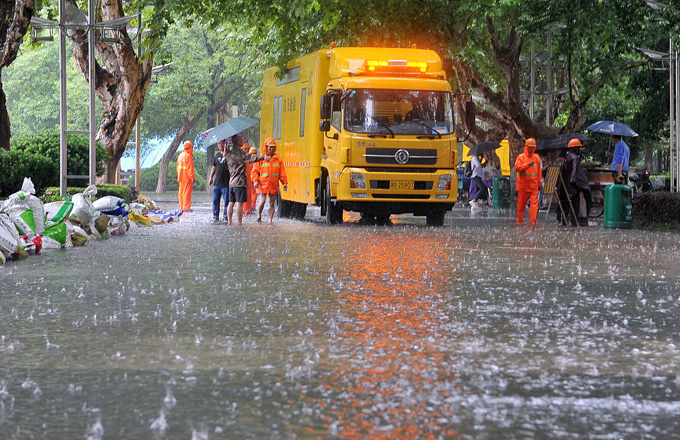
- Torrential rain triggers disaster in Southwest China
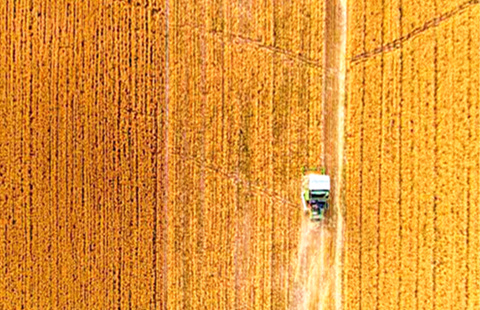
- Harvest time for wheat reapers in Shanxi
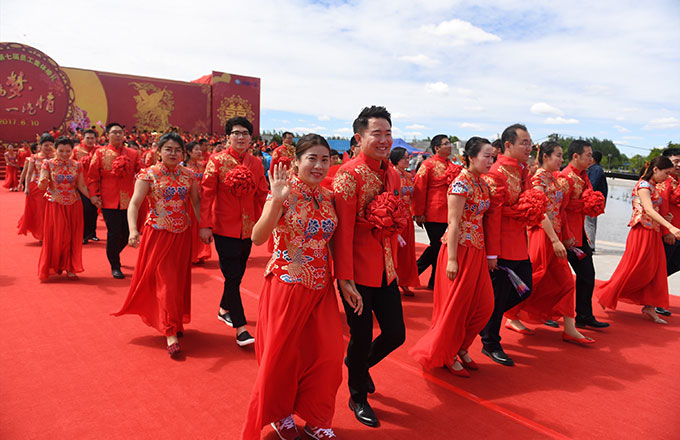
- Over 200 couples marry in Changchun group wedding
- Calligraphy tops other icons of Chinese culture, WeChat data shows