Reform critical to China's decade of success
BEIJING - As China awaits future government policies with the 18th National Congress of the Communist Party of China (CPC) on the horizon, it can review the great progress in political, economic and cultural spheres over the past decade.
Special:18th National Congress of the Communist Party of China
It is important to recognize that this has been, and will continue to be, bolstered by reform initiatives that have kept pace with the times.
From the bottom-up approach when China began to try out reform in the agricultural sector in 1978, China has become more confident in its policy readjustments since 2002.
Economically, China has made the knowledge-based economy more salient and championed a more sustainable and environmentally friendly development mode.
The country is in the process of changing its economic strategy -- it launched a 4-trillion-yuan ($640 billion) stimulus package after the global financial crisis in 2008 and moved handily from export dependency to development of a domestic market against the backdrop of a global decline in demand for Chinese goods.
Regarding foreign investment, China has reduced its bureaucratic regulations and state interventions that hampered investment from overseas, allowing the country to attain a level of openness that is rarely found among large and populous nations. China is now the second-biggest recipients of foreign direct investment in the world, with competition from foreign products in almost every sector of the economy.
Socially, the government has adopted more egalitarian and populist policies. It abolished agricultural taxes, subsidized health care, expanded the social insurance network and made basic education more accessible -- all measures aimed at enabling the public to benefit from economic prosperity.
Culturally, China is striving to strengthen its soft power. It has advocated creativity and reined in infringements on Intellectual Property Rights. The country has privatized cultural entities to increase their market competitiveness, sponsored the development of Chinese media and encouraged Chinese cultural products to "go global."
Zhang Weiwei, a senior research fellow at the Center for Asian Studies in Geneva and a visiting professor at China's Fudan University, believes China's reform, which he described as "steady and gradual," is a key feature of the "Chinese model" to which he attributes the nation's success.
The reform that China adopted was different from that of the Soviet Union, where the chosen "shock therapy" led to economic collapse, he says.
Such moderation, which focused on meeting the most pressing needs of the people and prioritizing economic reforms over political ones, is suited to China's national conditions although it is imperfect, he adds.
Success will follow for China's reform if it can successfully address social issues that include a wealth distribution imbalance and potential monopolies in the near future, according to experts.
A thorny issue in China's ongoing reform lies in the difficulty of limiting the power of the reformers themselves, says Xin Ming, a professor with the Party School of the Communist Party of China Central Committee.
Some organs and interest groups have resorted to legislation to legalize or strengthen their unreasonable positions, running counter to reform that has aimed at taking away their privileges, he adds.
It is almost certain that reformers will be challenged by powerful alliances of interest groups when pushing ahead with reforms that will have an impact on these subjects' interests, according to Wang Xiaoguang, a research fellow with the Chinese Academy of Governance.
Consensus is the premise for the success of reforms, particularly in China now, says Zheng Yongnian, director of the East Asian Institute at the National University of Singapore.
Common people's increasing participation in public affairs, which will supplement the government's role in decision-making, will be one critical element for China to build consensus among all social strata and have success reform in the years ahead.
- CPC won't rest on laurels in time of change
- Exhibition on China's progress opens in Beijing
- Beijing toughens road measures for CPC congress
- Train security heightened before Party Congress
- CPC expected to bridge gap by fair distribution
- New CPC session will mark a new era for HK's development
- China's rural achievements in the past decade
- CPC delegate is a shepherd to the herders




- Typhoon Merbok to hit southern China coast Monday night
- Subgroups of BRICS brainstorm at meeting
- From imitation to innovation: China's fashion industry gets tech boost
- Nobel laureate heads Chinese institute on economics, AI application eyed
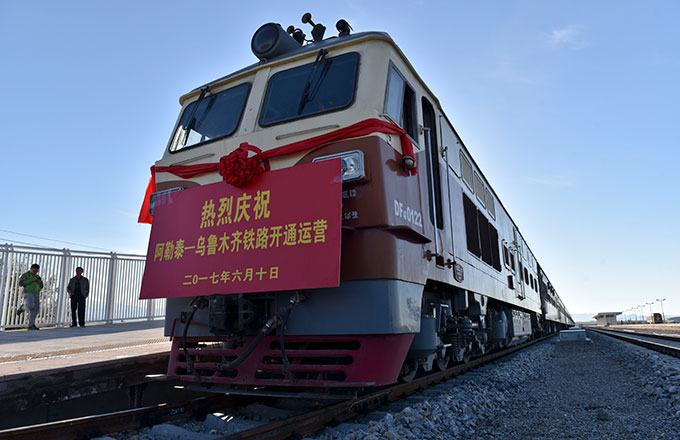
- Altay's isolation from railway network comes to an end