Q&A: What is the role of CPC's primary organization?
BEIJING - The 18th National Congress of the Communist Party of China (CPC) is being held in Beijing. Here are some basic facts about the CPC:
Q: What is the role of CPC's primary organization?
A: The primary Party organizations are "militant bastions" of the Party in the basic units of society, where all the Party's work proceeds and they serve as the foundation of its fighting capacity, according to the CPC Constitution amended and adopted in 2007.
Primary Party organizations are formed in enterprises, rural areas, government organs, schools, research institutes, communities, social organizations, companies of the People's Liberation Army and other basic units, where there are at least three full Party members.
In primary organizations, primary Party committees and committees of general Party branches or Party branches are set up as the work requires and according to the number of Party members, subject to approval by the higher Party organizations.
A primary Party committee is elected by a general membership meeting or a meeting of delegates, the committee of a general Party branch or a Party branch is elected by a general membership meeting, and candidates for these committees are nominated on the basis of extensively soliciting opinions from Party members and non-Party persons.
A primary Party committee has a tenure of three to five years, while that of a general Party branch committee or a Party branch committee is elected for a term of two or three years.
Main tasks of CPC's primary organizations are as follows:
1) To disseminate and carry out the Party's line, principles and policies, the resolutions of the Central Committee of the Party and other higher Party organizations, and their own resolutions; to give full play to the exemplary and vanguard role of Party members, and to unite and organize the cadres and the rank and file inside and outside the Party to fulfill the tasks of their own units.
2) To organize Party members to conscientiously study Marxism-Leninism, Mao Zedong Thought, Deng Xiaoping Theory and the important thought of Three Represents, study the Scientific Outlook on Development, study the Party's line, principles, policies and resolutions, acquire essential knowledge concerning the Party and obtain general, scientific, legal and professional knowledge.
3) To educate, manage, oversee and serve Party members; raise their overall quality; strengthen their Party spirit; ensure that they regularly participate in the activities of Party organizations, make criticism and self-criticism, and maintain and observe Party discipline; see that they truly fulfill their duties; protect their rights from encroachment; and improve management of Party members among the floating population.
4) To maintain close ties with the masses, constantly seek their criticisms and opinions regarding Party members and the Party's work, safeguard the legitimate rights and interests of the masses and do effective ideological and political work among them.
5) To give full scope to the initiative and creativity of Party members and the masses and to discover, nurture and recommend fine, talented people from among Party members and the masses and encourage them to contribute their skills and learning to reform, opening up and socialist modernization.
6) To educate and train the activists who apply for Party membership, attend to the routine work concerning the recruitment of new members and attach great importance to recruiting Party members from among those in the forefront of production and work and from among young people.
7) To see to it that Party and non-Party cadres strictly observe the law and administrative discipline and the financial and economic statutes and personnel regulations of the state and that none of them infringe on the interests of the state, the collective or the masses.
8) To encourage Party members and the masses to conscientiously resist unhealthy practices and wage resolute struggles against all illegal and criminal activities.



- Typhoon Merbok to hit southern China coast Monday night
- Subgroups of BRICS brainstorm at meeting
- From imitation to innovation: China's fashion industry gets tech boost
- Nobel laureate heads Chinese institute on economics, AI application eyed
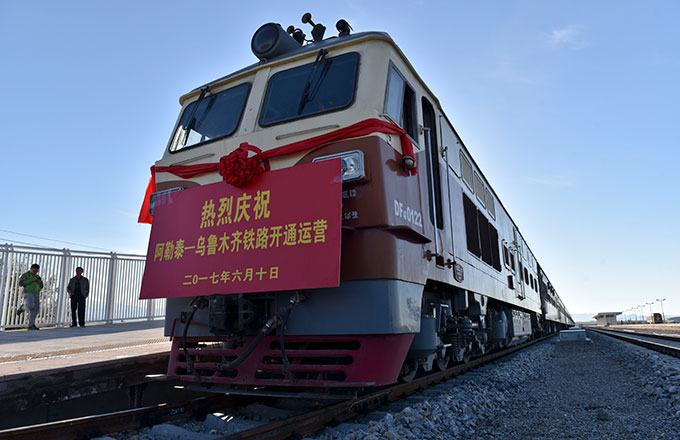
- Altay's isolation from railway network comes to an end