China's personal savings rose to a record 14 trillion yuan (US$1.7 trillion)
at the end of last year, mainly because people put aside more money to pay for
education, health care and housing, analysts said yesterday.
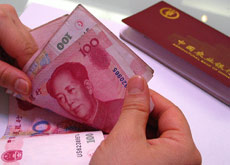
A resident counts
RMB banknotes at a branch of Agriculture Bank of China in Liaocheng, East
China's Shandong Province January 16, 2006.
[newsphoto] |
The People's Bank of China (PBOC),
the central bank, said on Sunday that savings reached 14.1 trillion yuan
(US$1.74 trillion), or more than 10,000 yuan (US$1,200) per capita.
The figure was 12.6 trillion yuan (US$1.56 trillion) for 2004.
Yet, even as people get richer, they have become more cautious in their
spending.
"People are forced to save for future expenditure," said Peng Longyun, a
senior economist with the Asian Development Bank's Resident Mission in China.
According to an earlier report by the Chinese Academy of Social Sciences,
education, housing and medical costs have become the "three mountains" weighing
on the shoulders of the Chinese people.
In addition, culture and tradition are also factors behind the high savings
rate.
"Compared to Americans, Chinese people are more inclined to save their money
in banks rather than spend it," said Qi Jingmei, a senior economist with the
State Information Centre.
The lack of sophisticated wealth-management services and products also
contributes to high savings.
"Wealth management in China is still in its infancy. Although people want to
invest, they don't have many channels." Qi said.
She added that services provided by banks for common people are particularly
limited, leaving them with no option but to save.
Public consumption contributed only 37.8 per cent to China's gross domestic
product in 2004, compared to 60 per cent in the United States.
Critics have noted that China's economy relies too much on investment, which
accounts for 48.1 per cent of its GDP.
The government has already announced tax policies to redress the balance
between investment and consumption, such as raising the threshold for personal
income tax.
Yet the country is unlikely to see a big surge in consumer spending in the
next few years, said Qi.
"Spending is individual behaviour. I am afraid the high saving rate will last
for 10 years," she said.
In the past decade, Chinese spent only 60 per cent of their income, compared
to nearly 80 per cent worldwide, according to the National Bureau of Statistics.
(China Daily 01/17/2006 page1)
