From July 1 it will be mandatory for all organ transplant operations in China
to be discussed with and approved by a medical science and ethics committee.
The measure is part of a new regulation that will play a vital role in
banning the sale of organs and putting a stop to practices that violate the
ethics and medical standards of organ transplants, officials said.
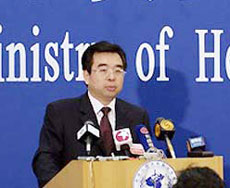
Mao Qun'an, spokesman
of the Ministry of Health. [moh.gov.cn] |
This is the first time a Chinese health authority has set up a special
committee and taken measures to help regulate organ transplants, Mao Qun'an,
spokesman of the Ministry of Health, said.
The ministry will set up a State-level committee of experts in management,
medical treatment, nursing, pharmacy, law and ethics to guide the country's
work, Mao said.
Medical institutes and hospitals at various levels will also be required to
organize their own committees to approve all organ transplants.
A key task of the committee is to ensure that the organs used for transplants
are voluntarily donated instead of being sold or randomly taken from people, Mao
said in an exclusive interview with China Daily.
Sources claimed that at least 2 million patients in China need organ
transplants each year, but only 20,000 transplants can be carried out because of
the shortage of donated organs.
At the same time, there are too many hospitals performing organ transplants,
and many of them are not qualified to do so.
Managers of many small hospitals invite doctors from other hospitals to carry
out one or two organ transplants and then claim they are able to provide the
service in order to attract more patients.
There are currently 500 hospitals in China conducting liver transplants.
There are only 100 hospitals performing the same operation in the United States.
The shortage of donated organs and the lack of supervision of hospitals has
led to many viewing transplant surgery as a cash cow, Huang Jiefu, vice-minister
of health, told agencies recently.
Many people have been enticed to profit from this situation by offering their
organs for sale.
In many hospitals, those patients with money or connections to managers or
doctors have greater sway and more chance of obtaining an organ sooner.
For example, while thousands of Chinese people are waiting in line for
operations, many foreigners have successfully gotten organ transplants in recent
years. Experts said that this is primarily because they have more money.
In western Europe a kidney transplant costs US$173,000, while in China
patients pay between 40,000 yuan (US$4,800) to 60,000 yuan (US$7,200) more
affordable for foreigners from developed countries, but a heavy burden for most
Chinese people, 80 per cent of whom have no medical insurance, official sources
noted.
Mao said that the new committee will supervise the application process for
organ transplants to ensure that available organs are given to the people who
need them most according to the waiting queue, rather than who can afford the
highest price.
Well-known actor Fu Biao, who died from liver cancer last year, had two liver
transplants in 2004 and 2005, but they only extended his life for a few more
months.
Mao said that there is little point in transplanting organs to a cancer
patient at the terminal stage and it is a waste of an organ to do so.
The July 1 regulation also brings a set of medical standards for organ
transplants in an effort to guarantee medical safety and prevent the waste of
limited organs.
Only Class-3A hospitals, China's top-ranking comprehensive hospitals, can
apply for registration if they have doctors with clinical organ transplant
qualifications, the related transplant equipment, a good management system and a
medical ethics committee.
The measure is aimed at preventing unqualified hospitals from performing
organ transplants. Medical institutions wanting to carry out transplants will
need to register with provincial-level health departments, he noted.
Shanghai Changzheng Hospital did 181 kidney and 172 liver transplants in
2005. Of these, nearly 30 had bad outcomes and were done by unqualified doctors,
according to Shanghai-based Life Week magazine.
The new regulation stipulates that medical institutions must get written
agreement from the donors or their relatives before the transplant, regardless
of whether the donors are ordinary citizens or executed criminals. And the
donors are authorized by the regulation to refuse the donation at the last
minute.
Many experts were expecting the regulation to recognize or approve the
concept of brain death in China to solve the problem of organ shortage, but this
was not the case. No law or regulation in China currently accepts the concept of
brain death, the moment at which a transplant is best performed.
The traditional Chinese attitude towards death, considered to be the moment
when a person's heartbeat and breathing cease, is also a big obstacle to the
promotion of organ donation.
With no law or regulation about organ donation in China, people often feel
confused and uncomfortable about donating organs.
As a result of this lack of legal guidance on organ donation, many
applications including those from executed criminals have been refused in many
places.
(China Daily 05/05/2006 page1)