After sinking to an eight-year low last year and being declared all but dead
by seasoned market watchers, the Chinese stock market has recently soared to a
level more than 50 percent higher than a year ago.
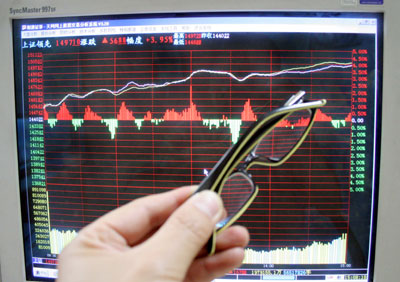
A stock investor monitors the stock trading
information at an office of a securities company in Hangzhou, East China's
Zhejiang Province May 8, 2006. [Newsphoto] |
The powerful rally is the longest sustained rise in share prices here in more
than five years, and it is offering a glimmer of hope to investors who were
crushed by a long-standing bear market that somehow existed in the midst of the
world's fastest-growing economy.
Market analysts say share prices in China are being swept up with other Asian
financial markets because of huge inflows of cash into the region. Moreover,
Asia's huge trade surpluses with the West are believed to be flooding into
financial markets here.
The Nikkei average in Tokyo is up 52 percent over the last year, and the
South Korean stock index is up 55 percent.
Share prices in Australia have risen 31 percent over the same period. The
Hang Seng index in Hong Kong is up 22 percent. And in India, some stock indexes
have soared over 95 percent.
Even shares in Pakistan, the Philippines and Vietnam are soaring.
But the most surprising jump has come in China, where share prices had fallen
by as much as 55 percent from their highs in 2001, despite the country's
sizzling economic growth.
"We're awash in liquidity," says Jing Ulrich, chairman of China equities at
J. P. Morgan. "Since I started covering China in the early 1990's, I've never
seen this level of interest."
Now, some market analysts say the rally could encourage a wave of mergers and
acquisitions in China and also set the stage for more important changes to
China's primitive capital markets.
Regulators announced here Monday that they would end a yearlong moratorium on
new stock listings on the Shanghai and Shenzhen Stock Exchanges, where over
1,400 state-owned companies are listed.
And while many analysts cautioned this week that stock prices here could sink
again, several experts said there were signs the market could rise even more.
"In China, bank deposits equal 160 percent of G.D.P.," says Ms. Ulrich at J.
P. Morgan.
"That's $3.6 trillion in the bank," she added. "Imagine if there was an
equity culture here and investors put just 1 percent of that money into the
stock market."
That would require a startling turnaround in attitudes among investors who
have long held suspicions that listed companies engage in insider trading, cook
the books or fabricate financial statements.
The plunging market has been devastating for millions of Chinese investors,
some of whom plowed their life savings into a market created only in the late
1980's. Some small investors have been furious with the government as their
savings evaporated. One man protested by dousing himself with gasoline and
setting himself on fire outside the offices of regulators in Beijing.
The Chinese government has moved aggressively in recent years to restore
confidence in the market.
It has introduced dozens of changes meant to support prices, including
allowing more foreign money to come into the stock market and announcing new
financial reporting standards.
Market sentiment has been so bearish over the last few years that even the
country's major banks have turned to Hong Kong to list their shares.
Analysts say this crippled the capital markets and made it more difficult for
state-owned companies to borrow, forcing them to turn to the state-owned banks.
"Last year 99 percent of the financing came from banks and one percent from
stocks and bonds, and that is a very unhealthy way of financing," said Michael
Pettis, an associate professor of finance at Beijing University.
Still, some analysts insist that China's stock market was overvalued even
when it hit rock bottom last year.
But financial experts say the more serious problem is that the market needs
structural reforms to lure a wider base of investors, attracting more long-term
investors and fewer speculators.
Foreign investors are being allowed to invest more and more in the Chinese
stock market. And that may have helped lure Chinese investors back in for the
current rally.
"I think there's still a lot of Chinese sitting on the sidelines waiting to
jump in," says Chang Chun, a professor at the China Europe International
Business School in Shanghai. "But that could also create another bubble."
Mr. Pettis at Beijing University said he believed that the present rally was
mostly speculative. Until significant structural changes occur, he predicted,
speculators will drive the Chinese market.
"We've seen this before," he said, noting that the Japanese stock market
rallied consistently after it began its steep decline at the end of the 1980's,
only to fall even more sharply the next time around. "If this turns out to be a
false rally," he said, "This wouldn't be the first time."
