Demolition blasts cause grave concern
By Jessie Tao (English News)Updated: 2007-01-09 17:21
|
|
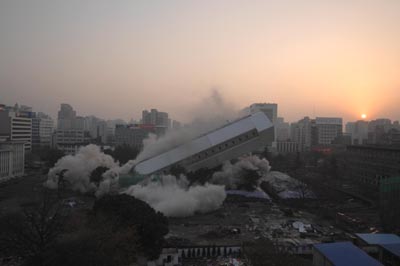

Within seconds after a string of explosions on January 6, the 22-storey teaching building on the campus of east China's Zhejiang University in the capital city of Hangzhou fell to pieces. Like the explosions did the building, the news bombarded the local headlines, but all for the wrong reasons, reported the China Youth Daily Tuesday.

The building, also the highest near the West Lake in east China's Zhejiang Province, was completed in 1993, covering a construction area of 21,110 square meters, and cost a total of 20 million yuan (US$2, 5 million), the paper wrote.
According to the designer, the building comprised a reinforced concrete structure, therefore more firm and secure than ordinary buildings, with a load capacity of 400 kilograms per square meter, as opposed to 150 kilograms for residential buildings and 200 kilograms for classrooms.
Then how came the demolition? It is reported that the demolition blasts took place only because the land it occupied had been transferred at a record price of 2.46 billion yuan (US$307.5 million), and the seller agreed to deliver a clear site by late January.
In fact, the demolition of the campus building was only one of the recent barrage of controlled blasts in the new year.
On January 3, a six-storey tower in downtown Guangzhou was pulled down because it did not fit into the new landlord's plans. It was first used in 1994.
Four days later, on January 7, the 24-storey Railway Plaza, which used to be a signature building in Qingdao, east China's Shandong Province, was dismantled to make way for an expansion of the local railway station. It was only 15 years old.
The tearing down of young buildings has aroused grave concern from people in various walks of life.
"Either from an economical or energy-efficiency point of view, buildings should not be built and soon torn down," a Hangzhou citizen said.
Experts say China's buildings generally stop functioning half way into their designed life span, though the PRC Code for Design of Civil Buildings stipulates important buildings and high-rises should last as long as 100 years, and ordinary ones 50 to100 years. They refer to the short-lived buildings as a waste of architectural resources and national wealth.
A news reviewer wrote on xinhunet.com, the web portal of the state media Xinhua News Agency, that tearing down new buildings reflects the government's lack of vision and scientific design in urban planning, which ends in unpredictable changes in urban construction.
The reviewer also lashed out at local government leader's blind pursuit of short-term benefits and superficial achievements through various "face projects" and the potential GDP growth, without considering the comprehensive benefits.
"In some cases, the large-scale construction projects are designated by a few policy-makers without consulting professionals, only to end in demolition when a new leader is appointed. Their indulgence in construction and demolition has landed the urban construction in a vicious cycle, and no one but the national treasury pays for the waste," the reviewer wrote.
| ||
|
||
|
||
|
|