CHINA> Latest News


|
CHINA> Latest News
|
|
Unified corporate tax sign of progress
By Xin Zhiming (China Daily)
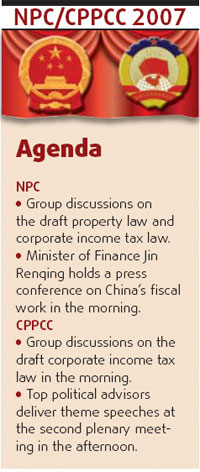
Updated: 2007-03-09 07:20 China yesterday formally proposed a unified corporate tax for overseas and domestic companies by submitting a draft law to the top legislature, the National People's Congress (NPC), during its ongoing annual session. Under existing corporate income tax laws, domestic companies pay 33 percent income tax, while overseas-funded firms pay 15 percent, which some economists say comes down to 11 percent after the many tax breaks they get. The proposed law aims to impose a flat 25 percent tax on both, and provide them with a level playing field. NPC deputies are scheduled to vote on the tax bill on March 16, the last day of the session, and if passed, the law will become effective from next year.
Economic and legal experts welcomed the move, saying the draft corporate tax law was a sign of major progress in the country's way of attracting overseas investment. A unified corporate income tax will promote fair market competition, China University of Politics and Law's senior law professor Li Shuguang said. The separate tax rates are against the World Trade Organization's principle of fair and equal treatment. And even after the change, China's overall corporate income tax would not be high compared to other economies either in the region or across the world, Li said. In fact, Minister of Finance Jin Renqing told NPC deputies yesterday that the 25 percent rate was lower than the average tax rate in 159 economies that had adopted a corporate tax regime and the average rate levied by 18 neighboring economies. After the enforcement of the new law, the finance ministry expects domestic firms to pay 134 billion yuan ($17.3 billion) less in taxes every year and overseas companies, 41 billion yuan ($5.3 billion) more. Overseas firms, however, will enjoy a five-year grace period, during which the new tax rate will be phased in. "This will minimize the impact on overseas firms," Li said. With a unified tax, China will no longer seek overseas investment by offering extra financial incentives as it had done for the past two decades. Instead, it will offer a more competitive business environment, including the rule of law. Having two sets of tax rates was a necessity for the country in the early days of its economic reform, said Lin Yifu, leading economist and member of the Chinese People's Political Consultative Conference (CPPCC) National Committee, the top political advisory body.
But the country has taken great strides on the economic front since then, and its market condition and capital reserves today are strong. "As a natural result," he said, "the time is ripe to have a unified tax system." A lower tax rate does not sustain investor confidence, rather a stable market. Ample human capital and healthy market potential are needed for that, Lin said. Peking University's senior economist Li Yining corroborated Lin, saying: "Foreign investors will consider multiple factors such as the investment environment and market potential. I believe they will increase their investment after the tax rate is adjusted." The tax law reform reflects China's efforts to build a consistent system to guarantee the stable and sound development of its market economy. Foreign investors have long complained against China's "disorderly and changeable" policies. Now the country is using the law to have an all-binding tax across the nation, Li Shuguang said. "It actually is good news for foreign investors because China is building a rule-based economy." The proposed law also stipulates a series of tax breaks to promote high-technology, environmental protection and energy-saving industries. Wu Jiao contributed to the story (China Daily 03/09/2007 page1) |


 China used the tax incentives then to attract investors from abroad because it had to build its market environment and suffered from a considerable lack of capital and foreign reserves, he said.