Wen: Stop shrine visits to improve ties
(China Daily)Updated: 2007-04-05 06:55
|
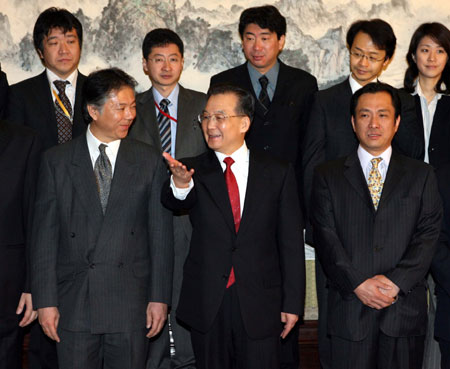
Premier Wen Jiabao meets with a group of Japanese
reporters in a joint interview with 16 Japanese news organizations in
Beijing April, 4. Premier Wen is scheduled to visit Japan from April 11 to
13. [Xinhua] |

Repeated visits by Japanese leaders to the controversial shrine where the country's war dead, including 14 Class-A war criminals of World War II, are honored have seriously hurt the feelings of the Chinese people, and undermined Sino-Japanese relations, Wen told journalists from 16 Japanese news organizations yesterday.
"I hope it will never happen again," he said.
Wen was interviewed by the Japanese media a week before his "ice-melting" trip to Japan, the first by a Chinese premier in the past seven years.

"We face opportunities and challenges" this year, which is the 35th anniversary of the normalization of China-Japan relations and the 70th anniversary of the "July 7 Incident" that marked the beginning of the War of Resistance against Japanese Aggression.
Wen hoped his April 11-13 visit to Japan would help "melt the ice" in bilateral relations. "I hope to reach consensus with Japanese leaders on major issues and improve bilateral ties."
The two countries, he said, should see history as a mirror to look into the future. He also hoped to have enough contact with the Japanese people to learn more about their country.
Wen will deliver a speech in the Japanese parliament during the trip, which will also take him to Kyoto. He will visit a university there, and "would like to play baseball with its students", he said.
China and Japan overcame a number of political obstacles last October when President Hu Jintao and Japanese Prime Minister Shinzo Abe met in Beijing and reached agreements that thawed relations.
"The two sides should handle relations from a strategic, long-term perspective," Wen said.
Abe's visit was too short, he said. So "during my trip, I will invite him to visit China again this year".
"Japanese leaders have extended several invitations to President Hu Jintao, and I believe he will visit Japan at a time suitable for both countries," he said.
Joint document
China and Japan will issue a joint document during his visit, Wen said.
"It will spell out the two countries' aspiration to build a strategic and mutually beneficial relationship, and the meaning and major tasks of this relationship. It will usher in a new era of China-Japan relations."
Leaders of the two countries "will also co-chair a meeting to start a high-level economic dialogue mechanism", Wen said.
The mechanism is a key step toward building strategic economic relations and will complement other cooperative mechanisms that are already in place.
The two countries should strengthen collaboration especially in the fields of energy conservation, environmental protection, hi-tech, small- and medium-sized enterprises, finance and information.
China will adopt an open attitude to economic and trade cooperation with Japan as long as it is based on mutual benefit and equality, he said.
Wen highlighted the key figures in developing bilateral economic relations. The volume of trade between China and Japan has increased nearly 200 times from $1.1 billion in 1972, when Sino-Japanese ties were normalized, to $207.4 billion in 2006.
Japan has invested about $58 billion in more than 30,000 projects in China,
according to official figures.
| 1 | 2 |  |
|
||
|
||
|
|