More bid farewell to Three Gorges
By Liang Chao (China Daily)Updated: 2007-04-16 14:34
Jiang Guolan, a 49-year old woman, is now living with her family in a two-storey house of 200 square metres in Pingyuan Village, in Fuling, a district within Chongqing Municipality.
Her family was resettled in the village, which is a new residential development started in the year 2000 for people being moved out of the reservoir area of the Three Gorges Project.
Her ancestral home has been inundated by the rising waters of the huge reservoir.
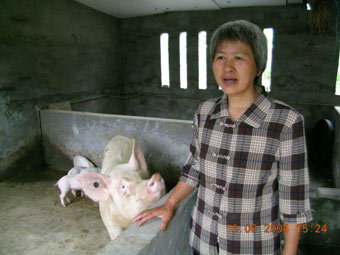 Jiang Guolan poses with the pigs her family raises in Pingyuan Village, Fuling District of Chongqing. [newsphoto] |
Jiang has two daughters, and they are working in a factory that produces woolen goods in Chengdu, the capital of Southwest China's Sichuan Province. Jiang says, "They also earn enough to support themselves."
Jiangs keeps five big sows in two pens on the hillside behind her house, which were built with the compensation payments from the project authorities for her family's 4 mu or 0.24 hectares, of land submerged in the reservoir area.
The government gives the displaced families 150 kilograms of grain per year as compensation for each mu, or 0.06 hectares, of land they have lost to the reservoir.
The Jiang's now have only one-third of the total amount of land they had before the reservoir project. On it they grow maize and plant vegetables used for making pickles, Fuling's most well-known product.
A methane gas tank that utilizes swine excrement was built beneath the family's pigsty and the gas is piped to the kitchen for cooking.
"This saves 150 yuan (US$18) worth of liquid gas per year that the family would otherwise have to buy for cooking," said Zhu Jie, deputy director of the Fuling Resettlement Bureau, who added that the richest families of the village are those running businesses, such as providing bus service.
To help the 121 relocated villagers settled down in their new village, the local credit co-operative granted loans of up to 10,000 yuan (US$1,200) per household in funding for planting cash crops, including fruit trees, helping them to raise such things as American nectarines.
Last year, the per capita net income of the newly settled villagers reached 3,010 yuan (US$362), over 400 yuan (US$48) more than the national average and an increased of 660 yuan ( US$80) over the figures for the previous year.
Jiang considers her family one of the lucky ones among the tens of thousands of people the project will eventually move from the reservoir area in Chongqing and Hubei Province.
Completed resettlement
One year ago, the 660-kilometre-long reservoir of the Three Gorges Project, the world's largest hydropower station, was successfully filled with water.
Started in 1993 and scheduled for completion in 17 years, in 2009, the reservoir will flood 632 square kilometres of valley, including 24,500 hectares of farmland with a current population of 844,100 people.
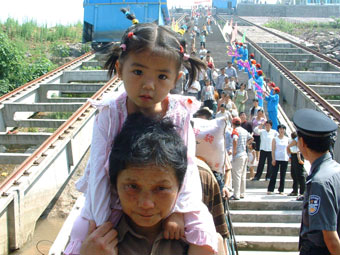 A woman carries a girl on her way to catch a ship transporting some 600 residents from Nanxi Town of Yunyang County in Chongqing on June 21. Most have resettled in Dongtai of Jiangsu Province. [newsphoto] |
More than 400,000 people are scheduled to be moved during the project's last two phases, beginning this year.
By 2009, the Three Gorges Project will have moved no less than 1.2 million urban and rural residents from their ancestral homes and farms, and relocated them in newly built towns and small cities along the banks of the Yangtze River, as the depth of the reservoir continues to climb towards its final figure of 175 metres.
About 85 per cent of the relocated population are from Chongqing, and the rest are from Hubei.
They are now living along the 660-kilometre-long banks of the reservoir, stretching from the dam site at Yichang in Hubei Province to Chongqing.
Most of the displaced people have moved directly up the mountains behind their villages, to new locations 40 metres or more above their inundated hometowns, and have settled down in their new locations to make a living.
But some 140,000 have moved to 10 other provinces or Shanghai municipality, leaving their native places forever.
According to officials from the State Council's Three Gorges Project Construction Committee (TGPCC), the reason for relocating villagers long distances from their birthplaces is not just the lack of sufficient farmland in the reservoir area, but also for the protection of the environment around the reservoir in years to come.
Last month, a group of 741 residents left their homes in Yunyang County, in Chongqing, to move to new homes in Sheyang County, in East China's Jiangsu Province.
This marked the beginning of the relocation of the last 23,400 people to be moved out of Chongqing to economically-developed areas.
In total, about 165,000 migrants from the Three Gorges reservoir area will be moved to other areas, including 10 other provinces and Shanghai municipality.
1 2 
|
||
|
||
|
|