China's tough-love panda plan
(time)Updated: 2007-04-23 15:30
http://www.time.com/time/magazine/article/0,9171,1612691,00.html?xid=rss-world
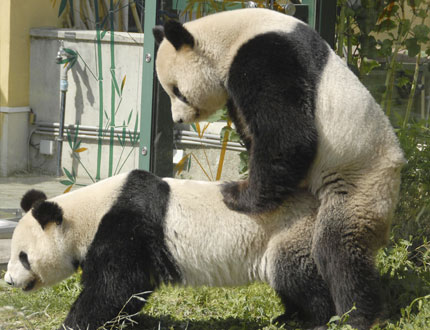 Panda couple Yang Yang and Long Hui copulate in the zoo in Vienna April 19, 2007, giving hope for the birth of a Panda cub in autumn, zoo officials said. The animals were transferred from China to Schoenbrunn Zoo in 2003, and are on loan to Austria by China for a period of 10 years. Picture taken April 19, 2007. [Reuters] |
Wu Gong is not the only one rejecting China's panda breeding program, in which scientists have deployed everything from panda porn (films of the animals mating) to Viagra (the drug didn't work) in their attempts to get the notoriously sex-averse animals to make whoopee. Last year, with 34 panda cubs born, was the best ever for China's artificial breeding program. But environmentalists now wonder how necessary the breeding is. Back in 1975, with the pandas near extinction, China set aside 10 nature reserves for the bears, covering almost 2.5 million acres. That move, plus years of global publicity for the panda's plight, has helped China's wild panda population grow to a stable 1,600 bears.
The health of the population also calls into question the center's practice of reintroducing captive-bred pandas into the wild. The fate of 4-year-old Xiang Xiang, a former Wolong resident, has added to the controversy. Having had his every need anticipated by a loyal band of caregivers, the baffled bear received the shock of his young life last spring. He was dropped into the middle of thick bamboo forest, making him the first giant panda bred in captivity to be released by Chinese scientists into the wild. Although he had received some survival training, Xiang Xiang soon found he had been left in a very rough neighborhood. In late December forest wardens noticed from his radio-collar tracker that he wasn't moving. The bear had been bitten by a wild panda in a fight for territory; Xiang Xiang was eventually found, treated and sent back into the wild.
Sadly for Xiang Xiang, the tough love backfired. In a subsequent encounter with a woods-wise cousin, he tried to escape by climbing a tree. Evidently that wasn't part of survival training: the bear fell and, from what rangers could gather, probably broke a leg. Rangers haven't been able to find Xiang Xiang, whose radio collar may have malfunctioned when he fell. Still, Zhang Hemin, director of the Wolong center, insists his charge had to be banished. "We did not want to keep Xiang Xiang because that would have shown our experiment had failed," he says.
Maybe producing pandas and then tossing them into the wild doesn't make sense. According to Jim Harkness, the former WWF chief in China, a range of factors drive the breeding program, notably "the myth that captive breeding will save the panda." The program is a source of national pride; plus there's the fuzzy economics: zoos donate money to China in exchange for the right to display pandas. In the U.S. four zoos, including the National Zoo in Washington, are each paying $10 million over a decade for their Wolong-bred bears.
Zhang denies that the breeding program is aimed at raising revenues. He notes
that the government restricts the number of overseas groups the Wolong center
can supply with animals, and says all donations are used to expand protected
areas and for research. And Zhang insists that reintroducing pandas into the
wild will help sustain populations over the long run. "It is not responsible for
anyone to declare that the experiment is pointless," Zhang says. Maybe Wu Gong
should put down that bamboo stalk. A less pleasurable ordeal could await him in
the wild.
|
||
|
||
|
|