Beijing: Few culinary choices for construction workers
By Zhang Xi (Chinadaily.com.cn)Updated: 2007-05-17 14:23
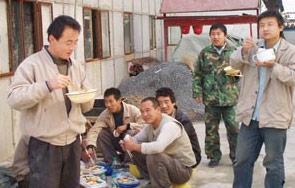
Beijing has more than 3,000 construction sites, staffed with over one million migrant workers. Where do these people have their meals every day?
 In
order to make sure they can have safe meals, the municipal government
introduced a regulation, indicating if a construction project costs at least 10
million yuan, covers an area of at least 5,000 square meters or lasts a minimum
of 60 days requires a canteen built onsite. For example, builders working on
Olympic Games venues can eat in their own canteens. But the situation is not as
ideal as the government's initial intention.
In
order to make sure they can have safe meals, the municipal government
introduced a regulation, indicating if a construction project costs at least 10
million yuan, covers an area of at least 5,000 square meters or lasts a minimum
of 60 days requires a canteen built onsite. For example, builders working on
Olympic Games venues can eat in their own canteens. But the situation is not as
ideal as the government's initial intention.
Canteen: good but expensive
At one construction site's canteen, migrant worker Zhang Youguang bought his lunch for 3.2 yuan. He spends 6-9 yuan on meals everyday. "The food quality is good but it's a bit expensive," said the father of two who came from eastern China's Jiangsu province. As the breadwinner, he has to send back 1,000 yuan from his 1,200 yuan monthly salary to support his family. So he feels having only 200 yuan left for food is near impossible in Beijing.
However, the director of this building project also has something to complain about. Pang Xuezhi said the meals are too cheap to make any profit, because they need to allocate a lot of money into food safety in the canteen.
"The municipal government has introduced a very strict regulation on food
quality on construction sites. A site will be severely punished for violating
this rule. So in order to cook safe meals, we bought stainless steel cookers and
ingredients from supermarkets, which cost us a lot of money, so the prices of
the meals cannot be any lower," explained Pang.
Illegal vendors:
dirty but cheap
Sichuan native Li Qiang is one of the people who sells meals to migrant workers just outside a large construction site in southern Beijing. Every afternoon he takes over 10 plastic basins of food he cooked himself to this area.
"I cook meals with lots of meat and oil, which attract workers," said Li proudly. Another reason for his popularity is the cheap price. A lunch with meat, vegetables and rice only costs three yuan. Which is why some workers opt to buy his food instead of obeying the construction sites' regulation of eating in the canteen.
A worker in the construction site surnamed Xu said he only spends 5-7 yuan everyday on lunch and dinner from these vendors, which helps him save about 50 yuan a month.
Although Li's food is very cheap, he can still make money by buying even cheaper ingredients from a farmers' market nearby, in which meat, fish, and rice are sold at very low prices. In order to get the best bargain, he even buys potatoes with green coloring on the skin, which is toxic.
"I don't have a hygiene license," added Li, "but those workers only care about the taste rather than the cleanliness."
Small restaurants: dirty but have long business hours
Small restaurants are often open around constructions sites but their sanitation conditions are far from desireable. For example, the window screenings of a restaurant in Chaoyang district are covered in grease and its 8-square-meter kitchen is a mess. Some plastic barrels are full of sewage water, the chopping boards and gas stove are greasy, and the ceiling is covered with flies. Not only that, there's a bed in the kitchen, indicating this is where someone lives as well.
The cooks are not wearing work clothes and some are even smoking. They use a dish cloth which is never been washed to wipe the stove.
Though not all small restaurants are with such terrible conditions, they cannot guarantee the safety of their food. However, these restaurants are still welcomed by migrant workers because of their long business hours and cheap prices.
An owner of such a restaurant said workers who finish work late often come at midnight for a five yuan meal. "Our business in the evenings is better than the afternoons," he added.
A worker named Li Wei said he knows about 50 people who dined in this restaurant and they do not mind the lack of cleanliness at all. But some workers did get diarrhea because of eating dirty food in other places. Another man called Xu Deliang sighed recalling his own experience. Having worked in the construction field for 15 years, he has been severely ill five times due to dirty food and gets diarrhea very often. "I have to eat garlic to prevent this problem everyday," he said.
Although many Beijing migrant workers know illegal vendors and small restaurants cannot guarantee their food safety, they choose to go there to save money. They come to Beijing to earn money so it seems they prefer more bills in their pocket rather than look after their health.
|
||
|
||
|
|