HK Basic Law 'guarantees democracy'
By Zhu Zhe (China Daily)Updated: 2007-06-07 07:03
|
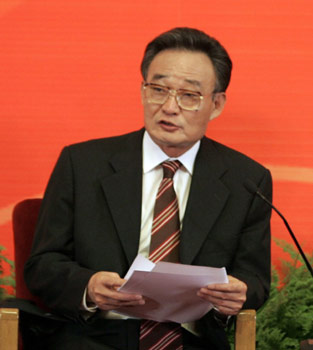
Wu Bangguo,chairman of the Standing Committee of the National People's Congress,delivers a speech during the seminar marking the 10th anniversary of implementing the Basic Law in Beijing June 6, 2007. [Reuters] |
The central government will continue to support Hong Kong in developing a democratic system that suits its conditions, but any reform must be gradual and in accordance with the Basic Law, top legislator Wu Bangguo said yesterday in Beijing.
Wu, chairman of the Standing Committee of the National People's Congress, the top legislature, made the remarks at a seminar marking the 10th anniversary of implementing the Basic Law.
| |||

Wu said events have proved, and will continue to prove, that the principle of "one country, two systems" is workable and feasible and the Basic Law is a sound law able to withstand the test of time. He emphasized that Hong Kong must uphold State sovereignty and ensure prosperity and stability while enjoying a high degree of autonomy.
Being an SAR directly under the central government, "Hong Kong's high degree of autonomy is not intrinsic, but authorized by the central government".
"It only has as much power as authorized by the central government. There is no so-called residual power."
But Wu said the central government will never interfere in affairs within the purview of the autonomy of the SAR.
Hong Kong Chief Executive Donald Tsang said at the seminar that the SAR has retained its international features, rule by law and various kinds of freedoms guaranteed by the Basic Law after its return to the motherland.
"With State care and assistance, we have strived to display our unique advantages and made significant achievements widely recognized by the international community," Tsang said.
The Basic Law has laid a solid foundation for Hong Kong's economic and social development and the improvement of people's livelihood, he added.
Former secretary of justice Elsie Leung added that to achieve the ultimate goal of universal suffrage, and maintain prosperity and stability in Hong Kong, it is necessary to have a clear understanding of the relationship between the central government and Hong Kong.
| Being an SAR directly under the
central government, "Hong Kong's high degree of autonomy is not intrinsic,
but authorized by the central government". Wu Bangguo |
Leung said Hong Kong has made gradual progress in democracy in accordance with the Basic Law over the years. Since its return to the motherland in 1997, the number of members in the Election Committee, which elects the chief executive, has grown from 400 to 800; and they are from different social strata and sectors.
In the Legislative Council, the number of directly elected seats has also increased from one-third in the first term to half in the third term.
The Basic Law itself is a result of broad participation of Hong Kong citizens as well, Wu said, pointing out that 23 of the 59 members of the drafting committee were from Hong Kong.
The full text of the draft law was made public twice for public comments. Different social strata, sectors and groups in Hong Kong came up with nearly 80,000 comments and proposals.
"In other words, each and every article of the Basic Law represents the broad consensus of Hong Kong society," Wu said.
(China Daily 06/07/2007 page1)
|
||
|
||
|
|