Economy grows at blistering pace
By Zhao Huanxin (China Daily)Updated: 2007-07-20 06:52
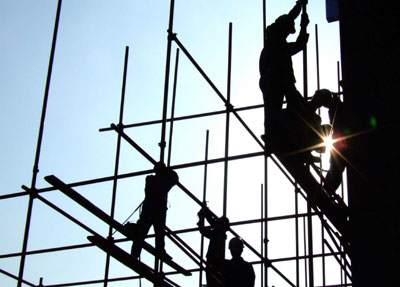 Chinese workers work at a construction site in Shanghai in this file photo. China's economy is expected to grow 10.9 percent this year after a 10.6 percent increase in 2006, a government think tank report said Wednesday. [newsphoto] |
The Chinese economy rose by 11.5 percent in the first half of 2007, continuing on a "sound and rapid" path which needs some "adjustment", officials and researchers said yesterday.
The gross domestic product (GDP) hit 10.68 trillion yuan ($1.39 trillion) in the first six months, growing 0.5 percentage points higher than a year ago, the National Bureau of Statistics (NBS) said in its quarterly release.
The GDP is expanding much faster than the year's target of around 8 percent, largely because industrial and taxation policies had spurred economic growth; and economies elsewhere in the world grew faster than expected at the onset of 2007, bureau spokesman Li Xiaochao said.
"We are keeping a close watch on what direction (China's) accelerated economic growth is taking," Li told a press conference. "But whether or not the economy is overheated is a complex issue that should be viewed from different angles."

Price hikes of foodstuffs, mainly grain, meat and fowl and eggs, contributed significantly to the rise of CPI, said Li. Food makes up a third of the CPI basket.
Lin Yueqin, an expert on macro-economy at the Chinese Academy of Social Sciences, said he believes the growth rate will be maintained for the full year.
"The country needs high growth to address issues such as unemployment," Lin said. "The crucial point is that development should consider energy and environment constraints and be based on an optimized structure."
For example, local governments should refrain from recklessly pursuing GDP growth by investing in sectors that guzzle energy and spew out pollution, he said.
The tertiary industry, where investment has been far less than in primary and secondary industries, should be further boosted, Lin said.
Li conceded that systemic and the structural problems still exist in the economy.
He said the country will strengthen macro controls, make efforts to adjust the economic structure, change the pattern of economic growth and deepen reform which will lead to the realization of sound and rapid growth.
The spokesman declined to say if the economic acceleration would increase the likelihood of the central bank raising interest rates again. He said it was up to the banking authorities to decide.
The People's Bank of China has raised the benchmark interest rate twice and has ordered lenders to set aside more reserves five times this year.
Li said economic growth, which used to rely on investment as well as exports, has seen some changes since the beginning of this year, when consumption, previously the weakest engine, is increasingly driving the boom.
In the January-June period, retail sales hit a decade high to grow by 15.4 percent year on year, 2.1 percentage points more than in the same period last year.
In contrast, exports grew no faster than last year, and investment in fixed assets such as factories and properties dropped by 3.9 percentage points in the same period to reach 25.9 percent, according to the bureau statistics.
"The changes in domestic demand are what we were expecting," Li said, attributing higher consumption to income rises and increased spending on automobiles and housing.
He downplayed media reports that suggest the country may overtake Germany to become the world's third largest economy by the end of this year.
Estimates of aggregate GDP vary depending on the exchange rates used and how China's growth is forecast, Li said.
"But one thing is certain: We are drawing nearer to Germany and the gap is becoming smaller."
According to the World Bank, German economy was valued at $2.9 trillion at the end of 2006.
(China Daily 07/20/2007 page1)
|
||
|
||
|
|