China's growth accelerates to 11.9%
(The New York Times)Updated: 2007-07-20 09:59
|
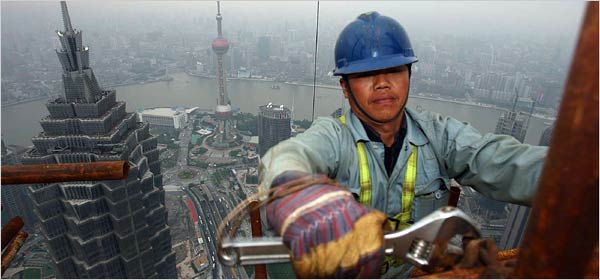
The construction of office buildings, here for the Shanghai World Financial Center, is one of the engines driving China¡¯s steep economic growth. [AP] |
HANGHAI, July 19 £ China said Thursday that its economy grew 11.9 percent in the second quarter, the fastest pace in more than a decade, and that inflation rose sharply last month, stoking fears that the nation¡¯s economy was overheating.
The explosive growth from the period a year earlier was fueled by a huge trade surplus, booming retail sales and heavy investments in new factories, roads, bridges and real estate projects.
Analysts say that the authorities in Beijing are under mounting pressure to curb the trade surplus and ease pressure on the economy by increasing interest rates or allowing the currency, the yuan, to further appreciate against other currencies.
¡°They do need to tighten, but the question is how,¡± said Frank F. X. Gong, chief China economist at JPMorgan Chase. ¡°Aggressively hiking interest rates is not the answer.¡±
The government¡¯s economic statistics continued to startle analysts, who are frequently required to revise their growth estimates in a country where all major cities seem to be in the midst of building booms.
For the first half of the year, China said its economy grew 11.5 percent, far outpacing analysts¡¯ and government projections after two years of double-digit growth. The government had forecast that the economy would grow about 8 percent this year and had promised moves that would help ease the country¡¯s widening trade surplus.
But economic growth is stronger than ever, and the trade surplus surpassed $112 billion in the first half of 2007, up about 85 percent from the period a year earlier.
In Washington, members of Congress are trying to put greater pressure on China to revalue its currency and import more American goods to reduce the two countries¡¯ trade gap.
China has been reluctant to move too quickly to lift the value of the currency, fearing the effect on businesses, and the government has not succeeded in reducing its trade surplus, particularly with the United States.
Another concern was underlined Thursday when Beijing announced that inflation had reached its highest level in years. China¡¯s index of consumer prices jumped 4.4 percent in June, almost entirely from rising food prices.
The prices of eggs and pork have increased more than 20 percent in the last year, largely because of tighter grain supplies and the outbreak of a swine ailment called blue-ear pig disease, the government said. The disease is also known as porcine reproductive and respiratory syndrome.
Many analysts say that inflationary pressure may be even greater when measured by a broader range of goods, and that this could signal real problems for the country, particularly if food prices continue to rise.
¡°This is not benign,¡± said Hong Liang, an economist at Goldman Sachs. ¡°In a developing country, this gets back to wages very quickly.¡±
The problem remains how to tame China¡¯s growth, a boom that began at less steep rates 20 years ago.
No major economy in the last century has grown at the pace now under way in China. The 11.9 percent growth in the second quarter was the fastest since 1995, when China said its output increased 12.5 percent. China is on pace to overtake Germany this year as the world¡¯s third-largest economy, behind the United States and Japan.
¡°Even if we are very bullish on China,¡± Ms. Hong at Goldman Sachs said, ¡°if they grow above 10 percent, there¡¯s going to be a problem.¡±
The government has tried dozens of measures in the last few years, including interest rate increases to slow the economy, moderate export growth and tame a wild stock market. But most have either failed or succeeded only moderately.
Mr. Gong at JPMorgan said China was already signaling that it would allow the yuan to appreciate more quickly in the second half. He said China should import more agricultural products from the United States, which could help ease the trade deficit and also help slow rising food prices.
Ms. Hong, however, expressed worries about an economy growing at an ever-faster pace when measured month to month. ¡°The government needs to tighten policy and slow the economy,¡± she said. ¡°Hopefully they can find some new tricks.¡±
|
||
|
||
|
|