Foreign media enjoy greater access
By Li Xing and Su Qiang (China Daily)Updated: 2007-08-03 06:45
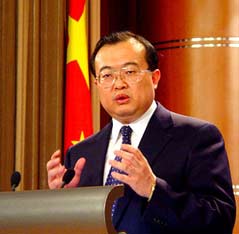 Liu Jianchao  |
"We are encouraged to see an increasing number of reports by foreign journalists, which now cover every aspect of our society," Liu Jianchao, director-general of the Information Department of the Foreign Ministry, told China Daily in an exclusive interview yesterday.
"We are also encouraged to see that the new regulations have been widely welcomed and followed by foreign journalists, either staying in, or just making a brief visit to, China."
He was referring to the Regulations on Reporting Activities in China by Foreign Journalists during the Beijing Olympic Games and the Preparatory Period, which took effect on January 1.
According to the regulations, foreign media professionals enjoy wide and free access to report from China. "China has followed up on its pledge to facilitate the work of foreign journalists in China," he said. "They can do interviews as long as they get the permission of interviewees.

Liu cited a few cases in which related central and local government bodies have made tremendous efforts to ensure "overall and accurate" implementation of the new regulations.
China Customs has simplified procedures to enable foreign journalists clear broadcasting equipment faster than before. All Chinese embassies and consulates have speeded up visas applications, he added.
The Beijing Organizing Committee for the Games of the XXIX Olympiad has also done a lot to smooth the way for international media to cover Beijing's preparations for next year's Games.
Many departments in both central and local governments have set up spokesperson systems, which give quicker response and more information to journalists' enquiries.
The Information Department of the Foreign Ministry even set up a round-the-clock hotline answering questions from foreign journalists. "We are trying to help them at the earliest time, even at midnight," Liu said.
A foreign journalist once called from a village where he said he was stopped by a village leader. "As soon as we received the call, we contacted the local government and enabled the journalist to accomplish his work," he said.
"There have been fewer complaints from the foreign media," Liu said. Instead, he and his fellow officers have been swamped by constant positive appraisals from the foreign correspondents on the far-reaching significance of the regulations.
"The regulations have helped create a better environment for foreign journalists to cover their stories in China in a more comprehensive, objective and balanced way and enable their audiences and readers to understand what is happening in China," Liu said. They are particularly significant as the Olympics is only one year ahead.
As evidence of growing interest and confidence from the international media, Liu cited a sharp increase of resident foreign correspondents in China since the year's start. The contingent now numbers 705 from 351 media organizations based in 53 countries, compared to 606, 315 and 49 seven months ago.
Meanwhile, some 2,060 foreign journalists came to China on reporting tours.
While expressing his own confidence in implementation of the regulations, Liu acknowledged that it was unrealistic to expect that the regulations be implemented without glitches.
"The regulations' full implementation needs close coordination among different government bodies and it takes time for local governments and organizations to fully understand the terms of the regulations," he said.
While foreign media workers have the freedom to cover China, they must still abide by the Chinese laws and live up to professional standards.
China will continue to provide an open environment for foreign journalists, but it is essential that they establish mutual trust and win the confidence of the Chinese side, he said. "That way, more and more Chinese will get used to being interviewed by foreign media."
Liu stressed that goodwill and constructive suggestions from the foreign media will always be welcome, but the communication should work both ways. "We are listening to them, therefore, at the same time, I hope they also listen to us so that China can be reported in a more balanced and objective way," he said.
"We look forward to receiving journalists from across the world here in Beijing in 2008. I am sure the foreign press in China will enjoy an even better working environment and have more access to information in the future," Liu said.
(China Daily 08/03/2007 page1)
|
||
|
||
|
|