Policy changes pose a challenge
Updated: 2007-09-06 06:31
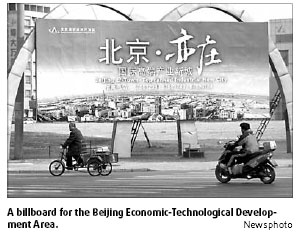
Each morning at around seven o'clock, outside the World Trade Center, a landmark in Beijing's central business district, a crowd can be seen waiting for the shuttle bus to Yizhuang, located at the southeast corner of the city, now better known as the Beijing Economic-Technological Development Area (BDA).
Each time a bus comes, the quickest on their feet squeeze in and start the 30-minute journey. The rest will have to wait another 15 minutes.
Bad traffic is a headache for officials of the BDA Administrative Committee, but a good sign for the general development of the area it's a reflection of the fact that the once-obscure village has become a bustling part of the capital after 15 years of development resulting from favorable policies.
Established in 1992, BDA is now home to over 2,000 enterprises. It had attracted nearly $3 billion in foreign investment by the end of 2006.
Everything went well until recently, when people began to find that some of the favorable conditions in the area were vanishing: rising labor costs, limited land resources, and above all, the new tax law to take effect from next year.
With the introduction of the new law to equalize corporate tax rates paid by local and overseas companies, over 500 foreign enterprises in the area will largely lose their favorable treatment.
Chinese companies have been taxed up to a 33 percent rate while foreign enterprises have paid as little as 15 percent. Enterprises in BDA can get even more favorable treatment, including some tax-free policies.
The unified tax rate will influence some enterprises, according to Zhao Xinxin, deputy director of the BDA Administrative Committee. The higher tax rate may drive away companies whose profit margin is small and need to see returns within a short time.
"That is a reality we have to face," says Zhao, "and we have to work out new favorable policies and provide better services to enterprises to attract investment."
China will continue to offer favorable tax rates to "low-profit enterprises" and to investors in hi-tech projects, according to former Finance Minister Jin Renqing. For Zhao Tong, general manager of China operations for Japan-based SMC Corp, a pneumatic components manufacturer, the negative impact from increased taxes and rising labor costs is relatively trivial compared to the vast potential of the Chinese market.
The equal corporate tax rates make sense to him, because "it is an adjustment of policy as China develops". China's economy is booming and the enormous market is attractive. So enterprises like SMC will not leave simply because of the increasing tax rate, Zhao says.
Along with low tax rates, enterprises have been attracted by the investment environment in the area. Fifteen years of development have made the BDA a base for high-profile manufacturers Nokia, 3M and Benz-DaimlerChrysler. The main task of the BDA commission used to be to "appeal for investment". Now they select from many eager applicants.
One of those is China Crystal Technologies Co Ltd, a manufacturer providing raw materials for SMC - which moved to the BDA last year because its client was there already. Neighboring clients means that they can save transportation expenses and better understand the market, said Pu Junpeng, general manager of the company.
But there is something that worries Zhao Tong from SMC, the stability of policy. As a manufacturing firms, they need to import advanced equipment to keep high productivity. That equipment was tax-free 15 years ago when they first moved to the area, but things changed recently when it was removed from the favored list.
"The government encourages the import of advanced technology," says Zhao, "but they now charge tax on that basic equipment which is key to making advanced products."
As a result of the additional tax on that manufacturing equipment, Zhao's company faces a dilemma either to keep out-of-date equipment to avoid additional taxes or to pay the tax and import more.
To make the decision, Zhao needs to calculate profit margins and make sure that the policy will remain the same for a few years.
"Our investment strategy will not change due to small things like labor costs, land resources, or tax rates," he says. "But we really need stability in policy-making to strengthen our confidence."
(China Daily 09/06/2007 page45)
|
|
|
||
|
||
|
|
|
|