Private firms propel innovation
Updated: 2007-09-06 06:26
If you think China only produces low-tech, cheap stuff, think again!
Beijing's Water Cube, the venue for aquatic sports at the 2008 Olympics, will soon be equipped with a 2,000 square meter LED screen. The screen, one of the largest in the world, will ensure you won't miss any of the action even if you don't have a ticket.
The producer of the screen is a 15-year-old private company from Northeast China's Liaoning Province.
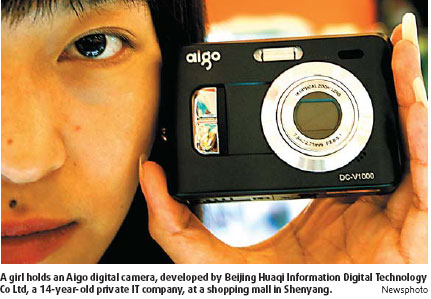
Have you ever got confused when watermarking your digital photos with downloaded software? If you are not tech-savvy, try a digital camera with a device that watermarks your photos when they are taken.
The technology, the world's first to combine digital watermarking and photography, has been developed by Beijing Huaqi Information Digital Technology Co Ltd, a 14-year-old private IT company in the capital's Zhongguancun area.
Private enterprises are playing an important role in helping the country transform into "an innovative nation", a target set by President Hu Jintao for the next 15 years.
The private sector has become an important engine of China's economic expansion. The nation's private enterprises now account for 66 percent of the country's gross domestic product (GDP) and 71 percent of its tax revenues. They also provide 75 percent of employment.
But more than that, the private sector has become the backbone of China's technological innovation, providing 66 percent of the country's patents and 82 percent of new product development over the past 20 years, according to figures from the Ministry of Science and Technology.
Among the 310,554 patents applied for by companies in China last year, 41 percent came from private firms, with State-owned enterprises only contributing 23 percent and overseas-invested companies accounting for 12 percent, according to a survey by the State Intellectual Property Office.
"Private enterprises have become the most vigorous part of China's innovation campaign and an important driving force to build an innovative nation," Huang Mengfu, chairman of the All-China Federation of Industry & Commerce, was quoted as saying earlier this year by China Business Times.
China is taking an important step, from "Made in China" to "Invented in China". It plans to become an innovative nation in the next 15 years and a global power in science and technology by the middle of the century, according to the national guideline on medium- and long-term scientific and technological development (2006-20), which was issued by the State Council in February. The plan is expected to increase the proportion of China's GDP spent on research and development from today's 1.3 percent to 2.5 percent by 2020.
After all, inventing products is what China used to do. China is the country that gave the world gunpowder, paper and the compass. But in recent centuries, its inventions seemed to dry up. Although more than two decades of rapid economic growth has considerably enhanced China's global position, China has only won the race to be the factory of the world. Since such a title puts greater pressure on the country's resources and environment, moving up the value chain has become inevitable.
"Many Chinese private enterprises are born out of innovation," says Zhang Benzheng, managing vice-president of Beijing Non-governmental Science-Technology Entrepreneurs Association.
Transformation
When China started introducing economic reforms, private enterprises mushroomed and prospered under the shadow of State-owned enterprises by taking advantage of their low costs and flexibility. But as China's market economy matures over the years, such advantage may gradually disappear.
"They can no longer rely on low price strategies because every enterprise in China is facing the challenge of rising costs, from labor to raw materials and from land to electricity," says Bao Yujun, president of the All-China Society of Private Economy Research.
Another challenge is the increasingly intensifying competition brought about by globalization, says Gao Xudong, a researcher with the Research Center for Technological Innovation of Tsinghua University.
"Today private enterprises not only have to compete with State-owned companies, but also with foreign companies," Gao says.
(China Daily 09/06/2007 page60)
|
|
|
||
|
||
|
|
|
|