Apart from the Communist Party of China (CPC), there are eight democratic parties in China. Multi-party cooperation and political consultation under the leadership of the CPC is the basic political system in China.
The multi-party cooperation system in China differs from the single-party system practiced in some socialist countries and also fundamentally varies from the multi-party or two-party system in some capitalist countries. It has its own prominent characteristics.
First, the CPC is the sole party exercising political leadership in this system of multi-party cooperation. Organizationally independent, the CPC and the democratic parties are totally equal under the Constitution, but politically, the latter are subject to the leadership of the former. The leading role of the CPC has been generally accepted by various parties and people across the country after decades of practice. The CPC's leadership over other parties features political leadership focusing on political principles, political orientation and major policy decisions.
Second, under the leadership of the CPC, the democratic parties maintain close cooperative ties with the CPC politically. Though a ruling party, the CPC does not arrogate political power to itself. In a general sense, the democratic parties exist neither as political opposition forces nor as parties out of office that pit their wits against the ruling party like those in multi-party countries. The relationship between these parties and the CPC is based on political cooperation rather than political competition aimed at assuming State power. In this cooperative political relationship, the CPC is at the helm of the State while the other parties jointly participate in the administration of State affairs.
Third, a consensus on socialism is the political foundation of the multi-party cooperation system. Since its founding, the CPC has consistently taken socialism (communism) as the objective it strives toward. Through years of struggle and practice, the other parties have gradually forsaken the old democratic republicanism and accepted the socialist economic system and the democratic republic. This consensus reached by both the CPC and these democratic parties has formed a solid political foundation for multi-party cooperation.
Fourth, the guiding principle of multi-party cooperation is longterm coexistence and mutual supervision, treating each other with full sincerity and sharing weal and woe. This is the ideological foundation of multi-party cooperation. It helps promote mutual supervision and political democracy, and also stabilizes and strengthens the multi-party political system.
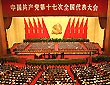
Finally, forms of cooperation between the CPC and other parties are diverse. For instance, members of the democratic parties are selected and appointed to leading posts in the State power structure. Their representatives are invited to attend the CPC congress as non-voting delegates and their opinions are solicited through various symposiums and cordial discussions. The Chinese People's Political Consultative Conference (CPPCC) is the most important organization of all those serving as a channel and arena for cooperation between the CPC and other parties.
By the end of 2003, China's eight non-Communist parties had more than 600, 000 members.
Statistics show more than 140, 000 of those members had been elected as deputies to people's congresses at various levels. More than 8, 000 of them held leading posts in governmental and judicial departments above county-level.