BEIJING -- China will promote conservation culture while moving to build a moderately prosperous society in all respects, said Hu Jintao in a political report to the national congress of the Communist Party of China (CPC), which is believed to be the first time that China calls for conservation culture in a keynote political document.
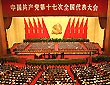
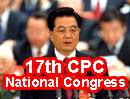
"(We will) promote a conservation culture by basically forming an energy- and resource-efficient and environmentally-friendly structure of industries, pattern of growth and mode of consumption," said Hu at the start of the 17th CPC National Congress, a five-yearly important political event.
"Awareness of conservation will be firmly established in the whole of society," Hu said.
Hu added that China will have a large-scale circular economy and considerably increase the proportion of renewable energy sources in total energy consumption, bring the discharge of major pollutants under effective control and notably improve ecological and environmental quality.
Hu said China's economic growth is realized at an excessively high cost of resources and the environment, before listing other difficulties and problems that hinder China's development.
"We must give prominence to building a resource-conserving, environment-friendly society in our strategy for industrialization and modernization and get every organization and family to act accordingly," Hu said.
In fact, the Chinese government has mentioned conservation culture in the mid-1990s. In 1999, Wen Jiabao, then vice premier, said "the 21st century will be a century of conservation culture."
However, many environmental protection and energy saving measures were not properly implemented due to various reasons.
A report released last month by the national environment watchdog said China's overall environmental situation is still "serious" with frequent pollution accidents affecting the quality of life for many people. Last year, 842 pollution accidents were reported, including 482 water pollution cases, 232 air pollution cases, 45 cases caused by solid waste, 10 in the ocean and six involving noise and vibration damage.
The country's discharges of sulfur dioxide in 2006 reached 25. 89 million tons, a year-on-year increase of 1.5 percent, the report said.
In September last year, two chemical plants in central China's Hunan Province illegally discharged a highly toxic arsenic compound into a tributary of China's second largest freshwater lake Dongting, leading to the suspension of water supplies to at least 80,000 local residents for a week.
A severe algae outbreak in Taihu, the third largest freshwater lake of the country, at the end of May this year triggered a scare after the sudden outbreak of the stenchy algae cut tap water supply to more than one million residents in Wuxi, a city in eastern Jiangsu Province.
Hu's remarks aroused instant attention of delegates to the CPC congress and observers of China.
Pan Yue, vice director of the State Environmental Protection Administration (SEPA) and a delegate to the Party congress, said he noticed that Hu has ranked the promotion of conservation culture as one of "the new and higher requirements" in building a moderately prosperous society, and that every organization and family shall be involved in the drive.
"It fully reflects the importance of conservation culture to the Chinese nation," the senior environmental official said.
Wang Zhigang, a delegate to the CPC congress, said: "I think the conservation culture is part of the concept of harmonious society. The development of society must be based on conservation culture."
European countries are more and more aware of the role of China in addressing environmental issues. Pollution and climate change are global issues that cannot be solved without China, said Federico Rampini, chief correspondent of the Beijing office of the Italian newspaper The Republic.
"It is a very good development that the environmental topic is included in the report. It shows the Chinese Communist Party has put environmental issues to a very important position on its agenda," said Rampini who has worked in China for four years.
Lars Moerking, a reporter of German newspaper Our Time, said: "I am quite interested in the environmental topic that mentioned in the political report."
Han Qingxiang, professor with the Party School of the CPC Central Committee, said the concept of conservation culture is an introspection of environmental deterioration in the relation between human and nature, and it advocates a harmonious relationship between human and the nature by forming a resource- efficient, environmentally-friendly and sustainable structure of industries.
Han said that material and spiritual civilizations are the basis and precondition of conservation culture and in turn conservation culture will help enhance material and spiritual civilizations.
Nowadays local governments and enterprises who used to seek economic returns only and take a blind eye to environmental conservation and energy saving are often widely criticized, while those with good conservation efforts such as the government of south China's Guangdong Province are applauded.
Guangdong began in late 1990s to accelerate industrial restructuring and put energy-efficient services and new and high-tech sectors high on its development agenda.
In the first half of 2006, the national per-unit energy consumption went up 0.8 percent on average, but the indicator in Guangdong, a province known for the manufacturing industry, went down 2.5 percent. In the entire year of 2006, the province's per- nit energy consumption decreased 2.93 percent in comparison with that in 2005.