China's Space Activities in 2006
II. Progress Made in the Past Five Years
From 2001 to 2005, China's space industry has developed rapidly, making many achievements. A group of research and development and testing bases of the advanced world level has been built, and the system of research, design, production and testing has been further improved, markedly enhancing the country's basic capabilities in space science and technology. With breakthroughs in important key technologies, the overall level of China's space technology has been improved remarkably. Having made a historic breakthrough in manned spaceflight, China has embarked on a comprehensive lunar exploration project. Space application systems have taken shape, the range of application has been further expanded, application benefits have been noticeably enhanced, and important achievements have been made in space scientific experiments and research in this regard.
Space Technology
1. Man-made satellites. Over the past five years, China has independently developed and launched 22 different types of man-made satellites, upgrading its overall level in this field markedly. On the basis of the four satellite series initially developed, China has developed two more satellite series, to bring the total to six -- the recoverable remote-sensing satellites, "DFH" (Dongfanghong, or The East is Red) telecommunications and broadcasting satellites, "FY" (Fengyun, or Wind and Cloud) meteorological satellites, "SJ" (Shijian, or Practice) scientific research and technological experiment satellites, "ZY" (Ziyuan, or Resources) Earth resource satellites, and "Beidou" (Plough) navigation and positioning satellites. In addition, the oceanic satellite series will come into being soon. China has speeded up the implementation of the plan to establish "a constellation of small satellites for environment and disaster monitoring and forecasting." Research and development of the payload of some new, high-performance satellites have been successful, and many application satellites have begun regular operation. The Fengyun I and Fengyun II meteorological satellites have been listed by the World Meteorological Organization in the international satellite series for meteorological services. Important breakthroughs have been made in key technologies related to the common platform for big geostationary orbit satellites. Periodical achievements have been made in the research and development of large-capacity telecommunications and broadcasting satellites. Substantial progress has been made in the research and development, and application of small satellites.
2. Launching vehicles. Over the past five years, "Long March" rockets independently developed by China have made 24 consecutive successful flights, and their major technological functions and reliability have been notably upgraded. From October 1996 to the end of 2005, "Long March" rockets made 46 consecutive successful flights. Important breakthroughs have been made in key technologies of the new-generation launching vehicles. Research and development of the 120-ton thrust liquid-oxygen/kerosene engine and the 50-ton thrust hydrogen-oxygen engine are proceeding smoothly.
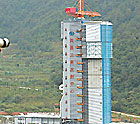
3. Launching sites. The construction of three launching sites at Jiuquan, Xichang and Taiyuan, has made new progress, and their comprehensive test and launch capabilities have been enhanced. Various launching vehicles, man-made satellites, unmanned experimental spacecraft and manned spacecraft have been successfully launched from the three launching sites many times.
4. Telemetry, tracking and command (TT&C). The overall performance of the country's TT&C network has been improved and expanded. It has provided TT&C support to man-made satellites traveling in different orbits, and to unmanned experimental spacecraft and manned spacecraft during launch, operation in orbit, return and landing.
5. Manned spaceflight. On November 20 and 21, 1999, China launched and retrieved the first "Shenzhou" unmanned experimental spacecraft. It then launched three more "Shenzhou" unmanned experimental spacecrafts not long afterwards. On October 15 and 16, 2003, it launched and retrieved the "Shenzhou V" manned spacecraft, China's first of its kind. Having mastered the basic technologies for manned spacecraft, China became the third country in the world to develop manned spaceflight independently. From October 12 to 17, 2005, the "Shenzhou VI" manned spacecraft completed a five-day flight with two astronauts on board. This was the first time for China to have men engage in experiments in space, another major achievement in the sphere of manned spaceflight.
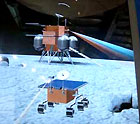
6. Deep-space exploration. Advance studies and engineering work of the lunar-orbiting project has been conducted, making important progress.
Space Application
1. Satellite remote-sensing. The fields and scale where satellite remote-sensing is used have been constantly expanded. Breakthroughs have been made in a large number of key application technologies; infrastructure facilities have been strengthened; the technological level and operational capabilities of the application system have been notably improved; and a national satellite remote-sensing application system has taken shape. China has built and improved the National Remote-Sensing Center, National Satellite Meteorology Center, China Resources Satellite Application Center, National Satellite Oceanic Application Center and China Remote-Sensing Satellite Ground Station, as well as satellite remote-sensing application and certification institutes of relevant state departments, provinces and cities. An optical remote-sensing satellite radiation caliberation station has also been completed and put into operation. Many remote-sensing products and services are provided by using data resources obtained from observation of the Earth by both Chinese and foreign satellites of multiple wavelengths of wide scope and long duration. Satellite remote-sensing application systems have been put into regular operation in many important fields, particularly in meteorology, mining, surveying, agriculture, forestry, land mapping, water conservancy, oceanography, environmental protection, disaster mitigation, transportation, and regional and urban planning. They are playing an important role in the nationwide land resources survey, ecological construction and environmental protection, as well as in major state projects, such as the South-North Water Diversion Project, the Three Gorges Project and the Project to Transmit Natural Gas from West to East.
2. Satellite telecommunications and broadcasting. Satellite telecommunications and broadcasting technologies are developing rapidly, their application is becoming more extensive and an application industry in this field has taken initial shape. By the end of 2005, China had more than 80 international and domestic telecommunications and broadcasting Earth stations, and 34 satellite broadcasting and TV link stations. Dozens of departments and some large corporations have established altogether some 100 satellite specialized communication networks and more than 50,000 Very Small Aperture Terminals (VSAT). The development and application of satellite radio and TV broadcasting services has increased the coverage and improved the quality of the programs all over China, particularly in the vast countryside. Satellite telecommunications and broadcasting technologies play an irreplaceable role in the projects "to give every village access to broadcasting and TV" and "to give every village access to telephones." A satellite tele-education broadband network and a satellite tele-medicine network have been established. As a member of the International Maritime Satellite Organization, China has established a maritime satellite communication network covering the whole world, ranking it among the advanced countries in the application of international mobile satellite communication.
3. Satellite navigation and positioning. China has implemented several major related projects, one of which is called "industrialization of satellite navigation and positioning applications." By employing domestic and foreign navigation and positioning satellites, China has made great progress in the development, application and services of satellite navigation and positioning technologies. The range and fields where satellite navigation and positioning are applied are being continuously expanded and the size of the national market for satellite navigation and positioning doubles every two years. Satellite navigation and positioning technologies have been widely used in transportation, basic surveying and mapping, project surveys, resources investigation, earthquake monitoring, meteorological exploration, oceanic surveys, and so forth.
Space Science
1. Sun-Earth space exploration. In cooperation with the European Space Agency (ESA), China has carried out the Double Star Satellite Exploration of the Earth's Space Plan. Together with the four space exploration satellites of the ESA, China's satellites completed the world's first joint, synchronous six-point exploration of the Earth's space, obtaining important data. Advance research into exploration of the lunar and the solar systems was also conducted.
2. Micro-gravity scientific experiments and space astronomical observation. China has carried out many items of experimental research in such fields as space life science, space materials science and micro-gravity science by using the "Shenzhou" spacecraft and recoverable satellites. It has also conducted trial tests of mutant crop breeding and high-power astronomical observation in space, and scored important achievements.
3. Space environment research. China has conducted research into space environment monitoring and forecasting, and made important progress in the observation, reduction and forecasting of space debris. It now has the ability to make forecasts of the space environment on a trial basis.