Promise to improve forex management
Updated: 2007-10-24 07:26
China will further improve the management of the country's massive foreign exchange reserves and satisfy trade and investment needs of domestic firms and individuals, China's top foreign exchange regulator pledged.
|
|
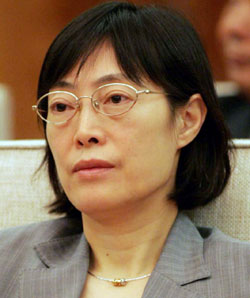
"We'll ensure the safety and liquidity, while improving the profitability of the country's foreign exchange reserves," Hu Xiaolian, administrator of the State Administration of Foreign Exchange (SAFE) told China Daily on the sidelines of the 17th National Congress of the Communist Party of China.
Hu promised to expand in an orderly manner the channels for capital outflow, in which qualified domestic institutional investors (QDII) is a part. "The quota for both QDII and qualified foreign institutional investors (QFII) will continue to be increased," she said.
During the Sino-US Strategic Economic Dialogue in May, China promised to triple the QFII quota to US$30 billion, providing foreign players more capital to buy domestic stocks which are currently off-limits to foreigners except QFII.
So far this year, the SAFE has granted more than US$30 billion to domestic banks, insurance firms and investment funds for overseas investment. But the actual outflow is far less than that amount.
Capital outflow is a way to improve the imbalance in China's international payment. In September, the country's trade surplus jumped 56 percent from a year earlier to US$23.9 billion, putting the figure for the first nine months of 2007 to US$185.65 billion, an increase of 69 percent year-on-year.
The huge influx of cash sent China's foreign exchange reserves to US$1.43 trillion by the end of September, further consolidating its position as having the world's largest foreign exchange reserves.
Some western countries claimed that was a result of an undervalued yuan and have been piling up pressure for China to quicken the revaluation of the yuan.
However, Hu disagreed, saying that was caused by both global and domestic situations. "Appreciation [of the renminbi] alone can not solve the problem," Hu said, citing President Hu Jintao as saying that comprehensive measures will be adopted to maintain a basic equilibrium in the balance of payments.
She added China has made tremendous efforts to address this issue and prefers to sort things out by getting to the root cause.
She promised more openness from the Chinese side and pledged to hold more talks with the international community on this issue. "Talks and mutual understanding are needed to end conflicts," she added.
Hu's remark is in line with vice central bank governor Wu Xiaoling, who is heading a Chinese delegation to the International Monetary Fund and World Bank meetings in Washington amid rising pressure by the United States and some European countries for China to quicken the revaluation of the yuan.
"Moving the exchange rates in the absence of economic restructuring policies will hurt China," Wu told a forum at the Peterson Institute of International Economics.
"Since China is one of the driving forces of the global economy, this will accordingly hurt the global economy," adding that these actions "show the responsibility of China as a large emerging market."
"We believe the exchange rate plays only a limited role in balancing the international trade and reducing the trade surplus," Wu said.
Zhou Xiaochuan, China's central bank governor also expounded on the country's foreign exchange regime on Thursday during a press conference. The market will play a bigger role in determining the exchange rate of the yuan and full convertiblility of the yuan will eventually be realized, Zhou said.
By the end of September, the yuan has risen 10.19 percent in value against the US dollar since July 2005 when China scrapped the peg to the greenback. In August, regulators allowed the yuan to go up or down 0.5 percent each day along a midpoint, up from the previous 0.3 percent, paving the way for greater flexibility.
Direct individual investment in overseas stocks
Responding to suggestions on the addition of more geographic regions or financial institutions to the pilot scheme that will allow individuals to make direct investment in the overseas stock market, Hu Xiaolian said authorities are considering the possibilities.
In August, the SAFE announced that direct investment could be made through Bank of China branches in North China’s Tianjin Municipality.
Analysts said that China may add other regions where the financial sector is relatively developed, or where individuals have a big investment demand, to the pilot scheme. Other financial institutions with competitive edges may also be included into the trial.
"Relevant departments are actively improving details of the program, operation process and formulating management rules. Related institutions are also making full preparations in technical systems, personnel, legal documents, and investors' education," Hu said.
Asked whether China will set a threshold for individual investment, as well as a ceiling on the total amount invested through the scheme, she did not confirm and reveal any specific numbers.
"All this has to start from China's current situation," she told China Daily. "After all, it involves an overseas market and a new investment method, and will have far-reaching impacts."
Declining to disclose when the project will be formally launched, Hu explained preparations are underway. "We have to combine the satisfaction of investors' demand with an effective management of risks,"she said.
Major Events in Foreign Exchange Management:
-- Granting an annual quota of $20,000 to individuals for the purchase of foreign exchanges under current accounts in 2006, before raising the ceiling to $50,000 this year.
-- Allowing domestic enterprises to keep the foreign exchange under the current accounts
-- Lifting quota limits on overseas investment by domestic enterprises in 2006
-- Launching the QDII in 2006, after starting the QFII in 2003.
-- Releasing rules on the issuance of yuan-denominated bonds by international development institutions in 2005.
-- Scrapping the peg to US dollar in July 2005.
-- The China Investment Company was formally launched in September to make a more profitable use of forex reserves.
|
|
|
||
|
||
|
|
|
|