China's first lunar probe, Chang'e I, successfully completed its first braking at perilune and entered the moon's orbit Monday morning, becoming China's first circumlunar satellite.
|
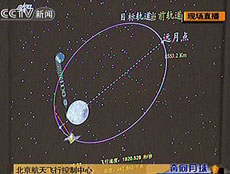
Chang'e-I successfully completed its first braking at perilune and entered the moon's orbit Monday morning, becoming China's first circumlunar satellite.
A video simulation of Chang'e I
|
Chang'e I, following the instructions of the Beijing Aerospace Control Center (BACC), started braking at 11:15 am at a position around 300 km away from the moon and entered the moon's orbit at around 11:37 am after completing the braking, according to the BACC.
"It turns the satellite into a real circumlunar one, marking a new milestone in China's aerospace history and also the first move of the country's deep space explorations," said Sun Laiyan, deputy head of the Commission of Science Technology and Industry for National Defense.
"So far, each step in the lunar probe project has been completed almost perfectly," Sun said.
Wang Yejun, chief engineer of BACC, considers the first braking just in time to decelerate the probe, enabling it to be captured by the lunar gravity.
"The first braking at perilune is a key moment in the long journey of Chang'e-1," Wang said.
The speed of Chang'e I reached about 2.3 km per second when it started braking. It would likely fly away from the moon if the braking was too early, or it would crash into the moon if the braking was too late, scientists explained.
After the braking, the probe's speed was slowed down to 1.948 km per second and is now traveling along a 12-hour elliptical moon orbit, with a perilune of about 200 km and an apolune of about 8,600 km.
"The orbit that Chang'e I is now moving on fully tallies with the one we have designed and the speed is within a normal range," said Ji Gang, an engineer of monitoring and controlling branch of the moon probe program.
The probe is expected to brake for another two times in the following two days, which will slow down its speed first to 1.8 km per second to help it enter a 3.5-hour orbit and then to 1.59 km per second to make it enter a 127-minute round orbit, where it is supposed to start "working" formally.
Chang'e I will then stay a year in the round orbit, which is 200 km from the moon's surface, for scientific explorations.
Chang'e I, named after a legendary Chinese goddess who flew to the moon, blasted off on a Long March 3A carrier rocket on October 24 from the Xichang Satellite Launch Center in southwestern Sichuan Province.
The probe completed its fourth orbital transfer on October 31, which shifted it to the earth-moon transfer orbit and pushed it to fly to the moon "in a real sense". Then it flied another 114 hours to arrive at the perilune 200 km away from the moon.
It was previously moving around the earth and experienced three orbital transfers, which lifted it up first to a 16-hour orbit with an apogee of 50,000 km, then to a 24-hour orbit with an apogee of 70,000 km and next to a 48-hour orbit with an apogee of more than 120,000 km.
On November 2, BACC successfully carried out an orbital correction for Chang'e I to ensure that it traveled on the pre-set orbit.
A second orbital correction scheduled for November 3 was called off because it was "unnecessary" -- Chang'e I had been running accurately on the expected trajectory, a BACC scientist said.
The 2,350-kg satellite carried eight probing facilities, including a stereo camera and interferometer, an imager and gamma/x-ray spectrometer, a laser altimeter, a microwave detector, a high energy solar particle detector and a low energy ion detector.
The ultraviolet image sensors, put into actual use on a satellite for the first time, has begun working since October 30 to collect information on both the earth and the moon.
Chang'e I is expected to relay the first picture of the moon in late November.
It will fulfil four scientific objectives, including a three-dimensional survey of the Moon's surface, analysis of the abundance and distribution of elements on lunar surface, an investigation of the characteristics of lunar regolith and the powdery soil layer on the surface, and an exploration of the circumstance between the earth and the moon.
China's lunar orbiter project has cost 1.4 billion yuan (US$187 million) since research and development of the project was approved at the beginning of 2004.
The launch of the orbiter kicks off the first step of China's three-stage moon mission, which will lead to a moon landing and launch of a moon rover at around 2012. In the third phase, another rover will land on the moon and return to earth with lunar soil and stone samples for scientific research at around 2017.
China carried out its maiden piloted space flight in October 2003, making it only the third country in the world after the former Soviet Union and the United States to have sent men into space. In October 2005, China completed its second manned space flight, with two astronauts on board.
The launch of Chang'e I came shortly after Japan launched its first lunar probe, Kaguya, in mid-September, while India is planning to send its own lunar probe into space next April, sparking off concerns of a space race in Asia.
But Luan Enjie, chief commander of China's lunar orbiter project, said that "China will not be involved in moon race with any other country and in any form."
"China will, in pursuing its policy of peaceful use of airspace, share the achievements of the lunar exploration with the whole world," he told Xinhua.