US boosting knowledge of TCM
Updated: 2007-12-26 07:41
The National Center for Complementary and Alternative Medicine is part of the National Institutes of Health. Its role is to explore complementary and alternative healing practices in the context of rigorous science. While in Beijing early this month, I had experiences that added to my instinct that there is value to be gained in understanding traditional Chinese medicine (TCM) better.
|
|
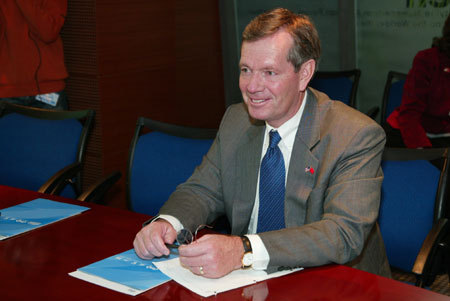
The first experience was meeting the new Minister of Health for China, Chen Zhu. He brings a reputation as a world class scientist to his post. In addition to our meetings at the Strategic Economic Dialogue, Chen and I had breakfast on December 12. It gave us an opportunity to talk about areas of cooperation. It also provided a chance for me to get to know him on a more personal level.
I asked Chen to tell me more about his youth. He told me that despite having parents who were both physicians in urban areas, during the difficult days of the "cultural revolution" (1966-1976), Chen was required by the government to live in very poor areas of China, working on the land until his adolescence. Those experiences clearly gave him sensitivity to the plight of the poor and underserved. During that time he taught himself English by comparing the English and Chinese versions of Mao's Red Book. He later became a physician and medical researcher of some renown, becoming a member of the National Academy of Sciences in France and China.
When he was in medical school, Chen learned Western medicine and traditional Chinese medicine techniques which he had observed as a boy in the countryside. He described how an insight he gained from traditional Chinese medicine unlocked a major discovery in developing response for a form of leukemia. He had a hunch, based on what he knew of Chinese medicine, that arsenic could play a productive role in treatment. Turns out, he was right.
I visited a museum at the Beijing University of Chinese Medicine devoted to recording the history of TCM. On display are many of the different botanical, animal and mineral substances used in treatment. Each of the components in the collection was displayed in a clear jar with a short description.
I asked the curator how discoveries had typically been made and recorded. She explained that most of them had come because of the connection between medicine and food. People were constantly looking for ways to nourish themselves. They found that eating certain things had additional benefits beyond just satisfying their hunger.
Walking through the museum, I found myself thinking what a remarkable earth we live on that can produce so many varieties of vegetation. Surely each one of them has a molecular structure with active ingredients capable of affecting the human body in different food. We turn to these plants for our nourishment; why not for our healing?
I then went to a clinic at the medical school where students were examining patients using TCM methods. I watched acupuncture therapy being applied. I sat in with a doctor and three students who interviewed and examined a patient who had been referred by a local hospital.
He carried with him pictures of the inside of his stomach taken by a scope of some kind at the hospital. I watched the convergence of Western medical science and traditional Chinese medicine as the doctor looked at the scoped photos and then examined the patient's tongue for clues. His examination was concluded by carefully feeling the patient's pulse.
At the medical school, they teach both Western medicine and TCM. Apparently it takes many years of practice before a doctor is able to practice TCM. Much of it is learned from experience.
When the examination was complete, the doctor dictated a TCM prescription which was filled at the pharmacy. The pharmacist had eight or 10 prescriptions being completed at once on the counter in front of him. Each one was the aggregate of several small piles of plant leaves, bark, seeds, flower petals and minerals. The patient takes them home, and following instructions either boils them, drinking the broth, fries them for eating or grinds them into another form for ingestion.
I want to be clear here. I am not advocating a substitution of TCM for the Western style treatment we receive in the United States. I would observe that in the US, a doctor develops his/her diagnosis based on similar techniques. They take vital signs, ask for a medical history and seek to understand the nature of the patient's complaint and its source. In many cases they would also offer a prescription which comes in a small plastic bottle containing tablets of processed elements of the earth, generally in the form of processed chemicals held together and colored by other chemicals.
Elsewhere on my blog you will find entries about personalized medicine where patients get treatments customized for their use. The TCM approach to treatment seems less precise in some ways but the prescribed medical treatment in many ways is more personalized.
One more thing; I do not know exactly, but I am guessing the total cost of the elements for any one of the TCM prescriptions would have been under a dollar. When I was in western China a year ago, I came to understand better why that is significant. If a nation is responsible for providing health care to 1.3 billion citizens, on an average of $6 to $12 a year, , they probably will not be able to afford many brand name pharmaceutical products. It should also be noted that the mortality and morbidity results in China and the US are not all that different.
Through the National Center for Complimentary and Alternative Medicine, and a number of other institutions within the US, researchers are working to find ways to understand TCM better. We need to do more of that. Andy Von Eschenbach, the Commissioner of the United States Food and Drug Administration, and Director of the National Institutes of Health, Elias Zerhouni and I have been discussing a trip to China next year to increase the levels of collaboration.
Chen and I agreed to actively explore ways we can work together applying rigorous science to traditional Chinese medicine. More science-based understanding could lead to a convergence of real value.
The author is United States secretary of Health and Human Services
|
|
|
||
|
||

|
|
|
|