A visit of great importance and expectations
Updated: 2007-12-27 07:24
The China-Japan Treaty of Peace and Friendship was signed 29 years ago. The Japanese prime minister then was Takeo Fukuda. Tonight, his elder son Yasuo Fukuda is scheduled to land in Beijing on his first official visit to China as Japan's prime minister.
|
Premier Wen Jiabao greets Japanese Prime Minister Yasuo Fukuda on the sidelines of high-level ASEAN meetings in Singapore in November. File photos |
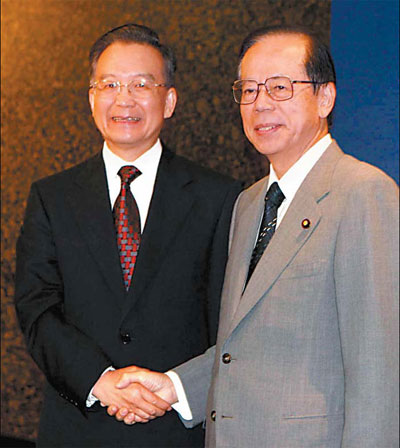
Fukuda's visit is very important for both the countries, and he will meet with President Hu Jintao and top legislator Wu Bangguo, apart from having extensive talks with Premier Wen Jiabao. In an interview with Xinhua and other Chinese media in Tokyo on Tuesday, the Japanese prime minister said his discussions with Chinese leaders would focus on building strategic and mutually beneficial ties that would help develop the region.
"I expect to further promote the development trend of Japan-China ties so that they can move even faster next year and reach a higher stage," Fukuda said.
Relations with Japan got a shot in the arm when former prime minister Shinzo Abe visited China in October last year. In fact, China was the first country he visited after assuming office, breaking the ice in a five-year diplomatic standoff. His predecessor Junichiro Koizumi's frequent visits to the Yasukuni Shrine, which honors Japanese war dead including 14 World War II class-A criminals, had soured bilateral ties.
Premier Wen reciprocated Abe's gesture with an ice-thawing visit to Japan in April. In the first address by a Chinese leader to the Japanese parliament in 22 years, Wen said the future of bilateral relations was bright. China wants to raise Sino-Japanese relations to a new high and realize the goal of "peaceful coexistence, friendship for generations, mutually beneficial cooperation and common development", Wen said.
Echoing Wen's thought, Fukuda told journalists on Tuesday: "Bilateral ties have become increasingly complementary, and one cannot do without the other." Sound Japan-China ties will not only benefit the two countries, but also play an important role in maintaining peace and prosperity in the Asia-Pacific region. "The two peoples share a great responsibility for the (development of the) region and should make joint efforts" to that end.
Japan's Seven Bank President Takashi Anzai says: "Strengthening ties with China and Asia is extremely important for the economic growth of Japan, which has entered a time of a population decrease and an aging society." The two neighbors share a lot in common on issues vital to sustainable growth and people's health, such as energy saving and environmental protection.
"Without exaggeration, the growth of Asia, and even the future of the world, hinges on whether the connections between Japan and China can expand and move forward," Anzai says. "Prime Minister Fukuda is working hard, bearing in mind this historic mission."
In a tight but effective itinerary, Fukuda will visit a development zone in coastal Tianjin, where Japanese businesses such as Toyota and Sumitomo Mitsui Banking Corporation have invested billions of yuan. Confucius's hometown, Qufu, in Shandong Province, is also on his itinerary - and it reflects the close cultural bond between China and Japan. In fact, he has been quoted as having said he is looking forward to the trip to the philosopher's birthplace, a place that appeals to Chinese and Japanese both.
"Fukuda's visit to Confucius's hometown will give an impetus to cultural exchanges between the two countries," Beijing-based researcher on international relations Wang Yusheng says. "A genuine understanding of and practising Confucianism will help enhance mutual political trust and understanding, and help the healthy development of bilateral ties," says Wang, who has had extensive contacts with his counterparts in Japan over the past year.
Fukuda's clear-cut policy on China distinguishes him from Koizumi, who disregarded Beijing's protests against his Yasukuni visits, and Abe, who later adopted an ambiguous stance, says Jin Xide, senior Japanese studies scholar with the Chinese Academy of Social Sciences.
In a recent interview with CNN, Fukuda said he disagreed with the "China threat theory", saying Beijing has no aggressive intentions. On the contrary, he thinks China's development offers a good opportunity to Japan and the rest of the world.
He cleared his stance on the Yasukuni Shrine during his election campaign, saying he would not visit it.
That Fukuda visited China as Japan's Chief Cabinet Secretary despite the soured relations in 2003 (due to Koizumi's visit to the shrine) shows the importance he attaches to Beijing. He went to the extent of resigning from Koizumi's cabinet in May 2004 because he thought the then prime minister was moving in the wrong direction with its China policy. "It's imaginable how much Fukuda wanted to stop the deteriorating Japan-China relations at that time," says Anzai.
As Japan's prime minister, Fukuda's China policy is part of his active Asia strategy that propounds "the strengthening of Japan-US alliance and Asian diplomacy will resonate and bring about a synergistic effect". Anzai believes that Fukuda's diverse experience and steady personality has shaped his "superb sense of balance" in politics that enables him to not only navigate through treacherous domestic politics, but also win support for his diplomatic policies.
"Despite the demands of and pressure from citizens and cliques, Fukuda can always get overwhelming support for his China and Asia policies, and there has not been a situation where people's views have been divided like in Koizumi's and Abe's times," he says.
Fukuda began his political career when he was in his fifties. He quit his job in the petroleum industry and became the secretary of his father Takeo Fukuda. Fukuda Sr. was engaged in drafting and negotiating the China-Japan Treaty of Peace and Friendship in 1978 and developed close friendship with the Chinese leaders.
Former Chinese ambassador to Japan Fu Hao was surprised when Fukuda Sr. greeted him in Chinese at their first meeting in 1977. But the then Japanese prime minister explained that he had learned the language for eight years. The atmosphere instantly became cordial, and the two talked like old friends about Chinese culture. Fukuda Sr. even told Fu that his name had been derived from Chinese ancient works.
Fu was assured of Fukuda Sr.'s sincerity in signing a bilateral peace treaty. "One of his major moves was to designate then Chief Cabinet Secretary Sunao Sonoda, an active supporter of the treaty, as foreign minister," recalls Fu. "Considering his family history, Yasuo Fukuda does have deep ties with China. And his view of China and Asia may be related to his mature and stable personality," says Asahi Shimbun opinion editor Yoshibumi Wakamiya.
But it would be wrong to label the Fukuda family "pro-China" because realpolitik, rather than personal ideas, forces many of the decisions, says Wakamiya, whose recently published book, Reconciliation and Nationalism, analyzes Japan's Asian diplomacy after World War II. Wakamiya says Japanese favor Fukuda's China policy because they had become weary of Japan's thorny relations with its neighbors under Koizumi.
"Though his China policy was not the direct reason of the prime minister's victory in the election, it definitely was reassuring to the people," he says.
A recent Japanese foreign ministry poll shows 80 percent of Japanese support improving China-Japan relations.
"If the remaining issues such as the dispute over East China Sea gas fields can be resolved and bilateral relations improve substantially, Prime Minister Fukuda's clout (at home) will grow," he says.
And Fukuda's policy is aimed at finding solutions to the problems. Fukuda told the Chinese media on Tuesday that he expected to discuss bilateral ties, climate change, the nuclear issue on the Korean Peninsula and the exploration rights in East China Sea gas fields. The Chinese foreign ministry responded the same day, saying it will continue the negotiations.
Will Fukuda, with his "superb sense of balance", be able to expand common grounds with China and handle the touchy issues tactfully? The world would be watching. "What new elements will he incorporate into the 'strategic and mutually beneficial' China policy initiated by Abe? In short, what will Fukuda do with China?" is the vital question, says Jin Xide, of the Chinese Academy of Social Sciences.
(China Daily 12/27/2007 page12)
|
|
|
||
|
||
|
|
|
|