China vows to ensure supply, stable prices of farm produce
Updated: 2008-01-31 16:11
BEIJING -- The Chinese government has vowed to ensure a steady supply of farm produce, which has been threatened by the heavy snow that has fallen since mid-January, the worst in five decades.
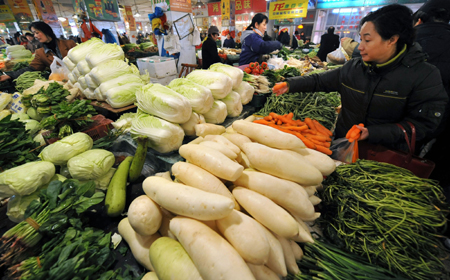 A woman selects vegetables at a vegetable market in Nanchang, East China's Jiangxi Province, January 29, 2008. [Xinhua]
|
Ongoing Short Supply
Southern regions where farmers grow crops over the winter were stricken severely by the bad weather, Chen Xiwen, director of the office of the central leading group on rural work, said on Thursday.
"The blow was especially hard to life and production in rural areas, as infrastructure facilities there were relatively weaker," he said.
"The blizzard disaster in the south would have a severe impact on winter crops," Chen told reporters, "and the impact on fresh vegetables could be catastrophic in certain areas."
Cole and other vegetables, oranges and wheat, in particular, suffered severely from the snow, according to the Ministry of Agriculture (MOA).


"But considering that most of the winter grain crops are grown in the north, the supply of grain, pork and edible oil nationwide largely remains intact," said Chen, who added that edible oil crops in the middle and lower reaches of the Yangtze River were "seriously" affected.
A total of 105 million mu (7 million hectares) of farmland, mainly located in the middle and lower reaches of the Yangtze River, was hit by the snow. Among these, about 11.3 million mu lost all of their output to the bad weather.
The husbandry industry that backed up diary and meat supply was under pressure from low temperature and less feed and drinking water. The savage winter weather had killed 874,000 pigs, 85,000 cattle, 459,000 sheep and 14.4 million poultry, said Chen Weisheng in charge of husbandry with MOA.
The already tightened supply was further stretched by disrupted transportation, which was also caused by continuous snow and sleet over much of China.
The public has started to feel the pressure as vegetable prices escalated across the country due to short supply. In Changsha, Wuhan and other hard-hit cities in the southern, central and eastern regions, vegetable prices have more than doubled. Areas not affected by snow, such as Beijing and the southern Guangdong province, have also seen price rises.
"Greenhouse vegetables sold in Beijing relies relatively on transport from the south. There were more than 10 trucks with a load of 20 tons before, now there's only one or two coming because of the snow. When a truck comes, we all swarm to it however high the price is," said Huang Tianlu, a 45-year-old wholesaler at Xinfadi market, the largest farm produce market in Beijing.
Zhuang Jian, senior economist with the Asian Development Bank mission in China, said rising prices, forced up because of supply disruption caused by the rare snowstorms, would definitely affect the inflation rate.
"I believe the CPI for January will hit around seven percent," he said. However, the bad weather would only be a short-term factor.
"The heavy winter snow would have a more immediate impact on farm produce and grain production," he said, "and the impact would be more apparent in a longer term."
More to Come?
"As for the impact on the whole year's grain production, we still have to wait and see. We are not sure how long the storms would last or whether they would move to the north," Chen Xiwen told reporters.
The national meteorological bureau said on Thursday that another round of low temperatures, along with snow and ice, would hit southern regions starting from Thursday.
Some parts of Tibet, Yunnan, Wuhan, Hunan, Jiangxi, Zhengjiang, Jiangsu and Anhui, most of which had already been badly stricken by snow, would see further heavy snow, the bureau said.
Parts of Guizhou, Hunan and Jiangxi would also have icy rain, and some areas of the lower reaches of the Yangtze River as well as southern China could expect rainstorms, it said.
However, it said that this time, fewer areas would be affected by the bad weather and the impact of the snow and ice would be less severe.
"If the storms worsen or expand into the north, agricultural production will be seriously affected," Chen said.
Fighting All Out
In order to protect agriculture, which is "still the weakest link" in national economy, the Central Committee of the Communist Party of China (CPC) and the State Council, or China's cabinet, jointly issued the first document of this year.
One of its aims was to ensure stable prices of agriculture products, which would prevent China from slipping deeper into the predicament of high-flying inflation.
To stabilize food prices, Chinese economic planner, the National Development and Reform Commission, reassured on Thursday that temporary price control measures have been implemented in all 31 provinces and municipalities on the Chinese mainland by January 26. The policy limited price hikes of daily food and necessities such as meat, eggs and liquefied petroleum gas.
An amount of 100 million yuan (about 13.9 million US dollars) was put in place for disaster relief, and agricultural experts were sent to disaster-stricken areas, said Wang Shoucong, a senior official with the MOA.
China harvested 500 billion kilograms of grain in 2007, achieving production growth for the fourth year in a row. But Agriculture Minister Sun Zhengcai said the output still failed to meet domestic demand for the year, and the country was forced to impose duties on grain powder at the start of year 2008 to limit export and ensure domestic supply.
"We should vigorously ramp up oil production, encourage cotton and sugar production; we should do a good job to guarantee staple food production, including meat, poultry, eggs, milk and vegetables; we should reinforce agriculture standardization and guarantee safety of agriculture products," Chen said.
To combat the difficulties in balancing the supply and demand of farm produce, the government has decided to invest more funds in the countryside this year as part of its efforts to boost agricultural development and narrow the widening urban-rural gap, said the first document.
Official statistics show that over the past decade, Chinese per-capita grain supply decreased from 412 kg in 1996 to 378 kg in 2006.
The low prices of farm produce have reduced the farming population, which means fewer people produce grain and more people who only consume. Meanwhile, 210 million of the 900 million rural population have begun to work for urban and township enterprises.
"The prices of agriculture products should be kept at a reasonable level, which would ensure that farmers get enough profits, and at the same time remain affordable to consumers," Chen said.
|
|
|
||
|
||
|
|
|
|