
China must prepare for new challenges
Updated: 2008-03-28 07:21
China's foreign policies have achieved much success in the past two years, but it still faces a diverse range of new challenges.
Driven by the growing economic ills of the United States and China's unbalanced economic development, the Sino-US trade row has mainly been characterized by the unfavorable trade balance of the US. It has also been increasingly politicized amid efforts to convince the American public that "China is the world's factory" and "China practices unfair trade".
The China-US strategic economic dialogues since late 2006 have achieved some positive results but are apparently not nearly enough to stop protectionist forces in the US criticizing China.
Meanwhile, trade frictions between China and the European Union (EU) have also increased noticeably in recent years, as protectionists in the EU seem determined to upstage and pressure China over trade issues just like their American counterparts.
Also, the safety issue of made-in-China products and rising concerns over such emerging problems as the weak US dollar, soaring oil prices and China's inflation have all played their part in further complicating the Sino-US trade situation.
One of the major issues brought to prominence last year and expected to influence policy-making throughout the world for years to come - climate change (and the even broader topic of environmental protection) - has found its way to the top of international political agendas.
China, already tasting the bitter fruit of environmental destruction as a result of unbalanced economic development in the past three decades, has been put in the spotlight and growing pressure over environment issues. This is despite increased efforts by the Chinese government to better protect the environment and willingness to shoulder a reasonable share of related responsibilities as a member of the international community.
In the meantime, some non-government groups as well as governments elsewhere are trying to derail China's commitment to holding a successful Olympic Games this year. Political, psychological and media pressure is being put on the host nation.
Similarly the Tibet issue and the Dalai Lama, the separatist spiritual leader for carving Tibet out of China, has made headlines these days as their political means to embarrass and demonize China and to serve their own international and domestic political agendas.
It is worth serious thought that what China is faced with first and foremost is not governments of other sovereign countries, but problems caused by certain lawmakers, trade groups, consumers, non-government organizations such as trade unions, single-issue pressure groups and media entities, and even a few individual celebrities.
Compared to the traditional international relations system, which has about 200 members only, these scattered action groups and individuals of different stripes are spread out and impulsive. They constitute a challenge to China more difficult to deal with because of the development of the so-called "global citizens' community", which is driven by fast-evolving telecommunication technology, flow of information, individual contacts and values.
In the areas of geopolitics, military affairs and foreign relations, where traditional mechanisms still rule, China seems to be confronted by a situation where a variety of troubles are emerging at an accelerated pace. One example can be found in the "China (future) military threat theory" being hyped by all kinds of forces out of misunderstanding or misinterpretation.
Another development worth our attention is the "diplomatic counter attack" waged by the US to increase its influence in East Asia, which has achieved considerable progress in recent years.
It shows that, even though the anti-terror drive, the Middle East and Near East issues remain the focus of Washington's foreign policy, there is no reason to believe the US still cannot pull itself out of the post-September 11 state of "no time to mind East Asia".
This is because there are alternative resources the US can mobilize for its interests in the East Asia, which means it can "fight on both the western and eastern fronts" if it has the strategic intent to do so.
China's East Asia diplomacy, meanwhile, has been concentrating on some new tasks in recent months after a series of major achievements in the preceding years. The new missions include resolving the Korean Peninsula nuclear issue, maintaining our relations with the Democratic People's Republic of Korea (DPRK) while developing ties with Republic of Korea, taking the improvement of China-Japan ties "to the next level", joining efforts to improve the situation in Myanmar and pushing forward the formation of an East Asian multilateral economic cooperation system, all of which are anything but easy.
The development of foreign trade, ecology, global citizens' society and diplomacy may hold the basic elements to some new long-term trends. Since the 16th National Conference of the Communist Party of China put forth the concept of "the window of strategic opportunity" more than five years ago and the "peaceful development" theory afterward, some new dynamics have very likely taken shape or were taking shape in the general political trend of the world.
Faced with such new dynamics and existing ones, China must not be complacent over the past achievements but continue to forge ahead in exploring, experimenting, examining and adjusting our approaches with the same strategic cultivation that put the nation on the path of reforms and opening to the outside world.
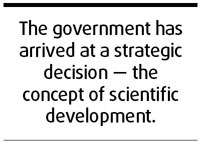
On this note, the Chinese government has already arrived at an excellent strategic decision - the concept of scientific development. It is designed to address the common source of most of the internal and external problems by phasing out the ill-balanced development pattern. Once this task is accomplished, China will be able to reach even greater heights in world politics.
The author is a professor with the School of International Relations of Renmin University of China
(China Daily 03/28/2008 page8)
|
||
|
||
|
|
|
|