
Decades marked by massive leaps forward in education
Updated: 2008-04-11 10:12
In Old Tibet, there were three types of schools: schools within monasteries, government-run schools and family-run, private schools.
Most students at the schools were children of aristocrats, monks who were also officials and rich businesspeople. More than 90 percent of the population was illiterate or semi-literate.
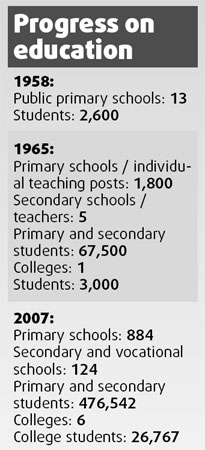
Today, an educational system is in place comprising pre-school; primary, secondary and specialized secondary education; polytechnic, vocational and adult education; and higher education. As of last year, there were six colleges, seven vocational schools, 117 middle schools and 884 primary schools.
|
|
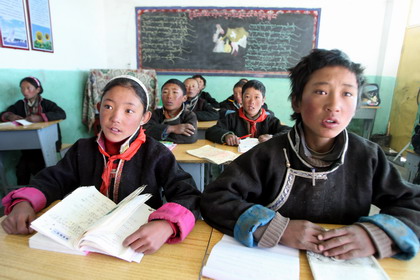
More than 98 percent of school-aged children attended classes, and most were children of Tibetan or other ethnic minorities. Today, about 530,000 students attend school in the autonomous region, a fourfold increase over 1985. From 1990 to last year, the illiteracy rate among young adults and the middle-aged fell from about 70 percent to less than 10 percent.
The central government has substantially increased investment in modern schools since the 1980s. And between 2002 and last year, the government earmarked 8.22 billion yuan to expand education in the region.
The government has also adopted many preferential policies. Some of these include subsidizing education for ethnic Tibetan students from primary school through college; supplying free food, clothing and accommodation to some ethnic Tibetan primary and secondary school students; and opening middle schools or classes for Tibetans elsewhere in China, where students can receive better education.
Educational per-capita subsidies for children of Tibetan farmers and herders have increased from an average of 353 yuan 22 years ago to an average of 1,450 yuan last year.
Since 1984, when the first Tibetan school was opened in Beijing, about 20 provinces and municipalities have established such schools or classes, from which about 15,000 Tibetans have graduated. The central government is responsible for their everyday expenditures, such as transportation, accommodation, clothing and medical care.
The autonomous region has assigned great importance to the study of the Tibetan language. Nearly every Tibetan child can take classes in Tibetan in all primary and middle schools.
|
||
|
||
|
|
|
|