
Quake no big hurdle to economic growth
Updated: 2008-05-29 13:28
The May 12 earthquake in Sichuan province has caused big losses in both human lives and properties. In the affected areas, millions of houses collapsed, the transportation, electricity, telecommunication, water supply and gas supply facilities were destroyed. In Sichuan Province alone, 14,207 enterprises were hit by the quake, causing a loss of 67 billion yuan.
Professor Niu Wenyuan, a scientist with Chinese Academy of Sciences, estimated that the overall losses of the earthquake in economic terms would reach 130-150 billion yuan ($18.8-21.7 billion).
It takes some time to get an exact measure of the losses caused by casualty, the destruction of public facilities and property, damage to reservoirs, dams and hydro-electricity stations and of the dislocation of transportation, businesses and other commercial activities. But one can say even at this stage that the local economy in Wenchuan and its neighboring area has seen sweeping destructions, from which it is unlikely to recover anytime in the near future.
However, the quake may not be as damaging to the economy of Sichuan Province or the country. By 2007, the province had a population of 81.7 million, 6.2 percent of that in the whole country. The gross domestic product (GDP) of the province was 1.5 trillion yuan, 4.3 percent of the national GDP.
Located in the mountains with a limited number of industrial businesses and limited agricultural output, Wenchuan has a GDP that is 0.3 percent of that of the province.
The regions that felt the tremor included Gansu, Shaanxi, Yunnan, Shanxi, Guizhou and Hubei provinces and Chongqing municipality. The total GDP of these areas was 18 percent of the national GDP in 2007. But the economy of these areas suffered only minor setbacks because of the earthquake.
Therefore, the earthquake is unlikely to pose a major shock to the Chinese economy.
Besides, the central government will earmark huge investments into the affected areas to reconstruct roads, public facilities and houses. This financial input would push up the GDP statistics.
Analysts predicted the earthquake would reduce this year's GDP growth by 0.2 percentage points, but the reconstruction after the disaster would boost the country's investment by 0.3 percent.
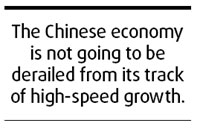
The Chinese economy is not going to be derailed from its track of high-speed growth because of this tragedy. And the macro policies would not change, either. The central bank issued several favorable policies for the disaster-hit areas, but the overall monetary policy remains as tight as it was. The primary targets for the economic policymakers continue to be to check inflation and prevent high-flying growth of investment in fixed assets.
There were worries that the earthquake might add to the inflationary pressure. There were two reasons for this: the earthquake may reduce the supply of agricultural produce for Sichuan province is a major agricultural base of the country; and, the reconstruction would boost the demand of cement, iron and steel and other building materials.
Although they have some grounds, the worries are not valid, either.
As mentioned above, the epicenter was located among the mountains, which are far from fertile farmland. Most affected areas are not grain-producing bases. The transportation network within Sichuan is working well. So the quake is not going to influence the supply of agricultural produces.
Admittedly, the inflation expectation of the market might be changed by the disaster, especially when people see huge volumes of food being sent to the disaster-hit zones. Some in the affected areas might feel nervous over the temporary shortage of food and it is also possible that inflation pressure intensifies for some time.
We have a good reference point in the scenario after an earthquake struck Taiwan island on September 21, 1999. The inflation level climbed by 0.5 percentage point after the quake and recovered two months later.
Considering the huge area and large number of grain-producing bases of the Chinese mainland, it may see an even lesser fluctuation in the inflation level than Taiwan did.
The current round of price-hike is driven not only by the prices of agricultural produce, but also by the property price. The inflation pressure is not going to be eased if the property price remains high.
Meanwhile, the fast-rising prices of grains, crude oil and other commodities on the global market are spreading into China.
The ongoing institutional reforms - of the land system, the labor market and the environmental protection scheme are more or less pushing up the costs of manufacturers, lifting the overall price level. Compared with these elements, the earthquake in Wenchuan is the least likely culprit for driving up inflation.
Insurance industry is often the one that feels the worst shocks from disasters. But the Chinese insurance companies have a relatively low penetration rate in the country, especially in less developed areas such as Wenchuan. So it is easy to predict the insurance companies would not have gigantic bills to pay.
The commercial banks would not see dramatic losses, either. By the end of 2007, Sichuan province got a loan of 600 billion yuan from commercial banks, which amounts to only 3 percent in the country's total bank loans.
In short, the tremor would only have temporary and restricted influences on China's economic growth. Also the inflation level for the disaster-affected areas would form a very limited portion in the national economy. It would not change the economic pattern or the tight monetary policy. The central bank would probably use fiscal policy tools, such as transfer payments and tax favors, to support the reconstruction of the disaster zone.
The author is a researcher with the Institute of Finance and Banking under the Chinese Academy of Social Sciences
(China Daily 05/29/2008 page8)
|
||
|
||
|
|
|
|