CHINA> Cool Guiyang

|
CHINA> Cool Guiyang
|
|
Luxuriant land
By RAYMOND ZHOU (China Daily)
Updated: 2008-09-01 07:48 When Wang Fuyu talks about Guizhou, his eyes sparkle and insightful phrases roll off his tongue.
"Many people believe Guizhou has only one house, one tree and a bottle, but I can tell you after working here for more than three years that Guizhou has everything except direct access to the ocean," said Wang, deputy Party secretary of the province.
Wang was referring to the province's noted tourism resources - one house is the building in Zunyi where power of the Communist Party changed hands to Mao Zedong, one tree is the biggest waterfall in China in Huangguoshu - literally Yellow Fruit Tree - and one bottle is Moutai, the most prestigious liquor in the country. Unfortunately, Guizhou is also associated with a few phrases with negative connotations. "Yelang's conceit" and "Qian's donkey at wit's end" - from a fable about encounters between a donkey and a tiger - are two popular sayings used to illustrate ignorance. Both Yelang and Qian are monikers for Guizhou. In ancient times, the landlocked land was cut off from the outside world and some folklore related to it became commonly used throughout the nation. Yet it must be noted that when people use the sayings today they no longer conjure up the province. Even so, Wang Fuyu is so passionately defensive of the province he offers linguistic explanations of the origins of the phrases, demonstrating "errors" in the evolution of their meaning. In Wang's eyes, Guizhou is a vast treasure house that has not been developed to its potential. Underground is 718 kinds of mineral resources, 76 of which have had their quantities verified, and 28 of which rank in the top five in China. Aluminum, gold and coal have bountiful deposits in Guizhou. The province also has bio-diversity aboveground. It has mountains, valleys and plains. It ranks second in the country in the variety of medicinal herbs. "We have a saying: Yelang is full of grasses and every grass is a gem," says Wang. He also calls Guizhou "a giant air-conditioner" with pleasant weather year round. It enjoys 1,700 hours of sunshine in a year, with temperatures of 16 to 31 C in summer and 2 to 12 C in winter. Average humidity is 75 percent, and average altitude is 800 to 1,200 m above sea level.
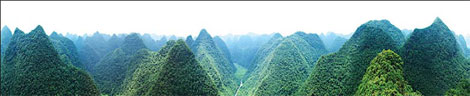
"When the wind blows at 2-3 m per second in summer, it is like a gentle breeze. By such yardsticks, Guizhou surpasses Florence and Vancouver in terms of comfort," says Wang. Guizhou is actually a mammoth parkland, with 70 percent of its surface covered in outcrops of karst limestone. "Ours is a karst kingdom. We have a karst forest in Libo in southeast Guizhou that is a miracle, and that's why it has been named a World Heritage Site by the United Nations," said Wang. Karst has also given the province tens of thousands of waterfalls. Along the 75-km Maling River Canyon there are 1,450 waterfalls. In Libo, one waterfall runs over 12 km and cascades down 68 steps. You can walk on it, drive under it and frolic in it in all ways imaginable. Like many waterfalls, much of its wonder is hidden inside numerous caves. The largest in the world is right here, 760,000 sq m in size. "It is like a secret treasure," said Wang. "But so far, only 460,000 sq m have been developed. You can't imagine how splendid it is inside. All it takes is your imagination - let it run free and you can see all kinds of objects inside. We also have the longest cave in the world." Libo has been called "the emerald belt along earth's waist". The whole southeast area of the province has a 65 percent forest coverage, "higher than Switzerland's 32 percent", Wang said. In addition to beautiful mountains, rivers and waterfalls, Guizhou is home to dozens of China's ethnic minorities, all with colorful cultures and lifestyles. Wang gives the examples of Miao and Dong singing: Miao people use singing as a dating ritual, sometimes with a couple standing on separate mountain peaks. The wafting of their songs is both "romantic and melancholy". The Dong people are the only ethnic group in China that incorporates harmony in choruses. Without accompaniment or a conductor, the Dong can deliver choruses so complex that even musicologists in Europe are amazed. Zhaoxing, a Dong town, was ranked one of 30 most beautiful towns by National Geographic magazine. It has five drum towers. A group of Europeans that gathered to enjoy the Dong chorus every night included a young man from Belgium. He said after he returned home he yearned to hear Dong singing again. So he returned to Guizhou and married a Dong girl. She is a wonderful singer, and now "I can enjoy Dong songs every day," he says. Wang notes that people in Guizhou can sing if they can talk, can dance if they can walk and can drink liquor if they can drink water. |
主站蜘蛛池模板: 宝山区| 肇东市| 蒲江县| 望谟县| 漠河县| 张掖市| 勃利县| 缙云县| 林州市| 额尔古纳市| 丹棱县| 浑源县| 绥阳县| 宁晋县| 浦东新区| 株洲县| 甘孜| 定边县| 宁晋县| 合江县| 诸暨市| 平安县| 衡阳县| 江陵县| 岳普湖县| 临潭县| 长垣县| 长寿区| 东光县| 托克托县| 香河县| 专栏| 阿拉善盟| 丹东市| 昌平区| 庆阳市| 县级市| 华阴市| 嵊州市| 府谷县| 北宁市| 富民县| 德钦县| 黄浦区| 息烽县| 新和县| 昂仁县| 延边| 巩留县| 洪洞县| 咸阳市| 皋兰县| 夏邑县| 敦化市| 万安县| 平昌县| 元谋县| 宁河县| 武威市| 灵石县| 宁化县| 八宿县| 龙胜| 巍山| 舟曲县| 遵义县| 永顺县| 平阴县| 揭西县| 麻江县| 赣榆县| 方山县| 尉犁县| 南康市| 仪陇县| 河东区| 韶山市| 唐海县| 台南县| 友谊县| 兴和县| 海安县|