CHINA> Regional

|
CHINA> Regional
|
|
Taking one's breath away
By Alexis Hooi (China Daily)
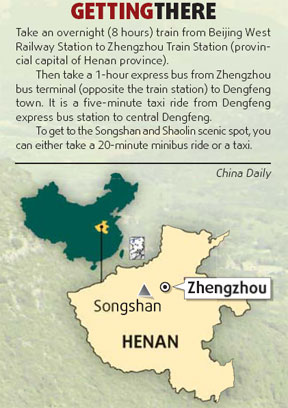
Updated: 2008-09-11 09:33 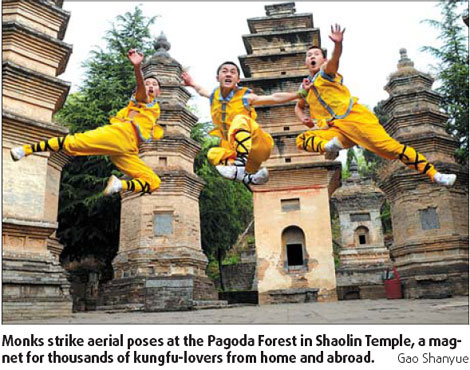 "Home to the Yellow Emperor, where Buddha's light shines forth from Longmen and Shaolin's kungfu is known to all under heaven... welcome to Henan province." This is the grand greeting you get on your cellphone as you step off the train in the provincial capital of Zhengzhou. Henan, of course, is the birthplace of the Yellow Emperor or Huangdi, legendary progenitor of the Chinese people. Along the banks of its Yi River are the ancient Longmen Grottoes, one of the finest repositories of Buddhist cave art.
It is also here in Henan that monks of the famed Shaolin Temple are said to practice their formidable form of martial arts, in the shadow of Songshan Mountain. Songshan itself is the center of the world. Taoists in the Middle Kingdom consider the mountain a symbol of earth, the central point of the five elements that make up the universe. With its highest peak of Shaoshi at 1,512m, the looming highland leaves no doubt as to the gravity of its stature and can seem intimidating to visitors at first. But the adventurous trekker with a full day on his or her hands will be rewarded with a veritable feast of mind-boggling breccia rock formations, gravity-defying chevron faults and breathtaking views of China's central plains - along a seemingly treacherous path that often clings to red- and gray-colored cliff faces dotted with turfs of greenery. Take a breather on the nearest boulder off the track as you head into the occasional valley and the colossal mountain offers temporary reprieves in the form of whispering brooks, singing cicadas and that welcome waft of cool breeze. As you continue the climb, look up at the towering grandeur of Heaven's Gorge as it reaches into the clouds and walk weightlessly on the rope bridge along the Narrow Path of the Three Emperors - all else will seem to revolve underneath. The cardinal position accorded to Songshan is also reflected in the firmly entrenched reputation of Shaolin Temple being the origin of martial arts. Legend has it that the temple's first disciples in the 5th century mimicked the natural motions of birds and beasts as relief between long meditation sessions, a practice that evolved into physical and spiritual combat over the centuries. In the world of Chinese pugilistic novels and film, Shaolin monks, with their evil-subduing cudgels and diamond-hard fists grounded to perfection through years of tough training, have few rivals in other kungfu sects. Students of the local 20,000-strong Ta Gou school today still practice wushu on the temple's adjacent dirt fields, while foreigners who also want a bit of the action take up short-term classes to try out moves at the temple. Those with less time on their hands can be part of about half a million foreigners a year who experience Shaolin's temple halls, Buddhist relics and well-stocked souvenir shops. Weave through the Pagoda Forest, a cemetery containing the ashes of monks stored in more than 200 pagodas and steles donated by foreign martial arts schools. Or venture into the adjoining hills west of the temple, where the top of the 750-m-high Wuru Peak is marked by a three-story-tall, white-colored statue of Damo, the patriarch who first taught Shaolin monks martial arts and positioned the temple as the birthplace of Zen Buddhism in China. Close to the top of Wuru lies the cave where Damo sat meditating long enough to apparently leave a shadow on the wall - that slab of the cave is now housed in Shaolin Temple itself. |
主站蜘蛛池模板: 淳化县| 平罗县| 都昌县| 宿州市| 康保县| 云安县| 莱州市| 南开区| 攀枝花市| 抚顺县| 嘉禾县| 曲松县| 永年县| 平乡县| 于都县| 松原市| 陵水| 邹平县| 霍山县| 崇信县| 温泉县| 泗洪县| 高平市| 扶沟县| 屯留县| 威海市| 湘西| 西丰县| 壤塘县| 图们市| 彩票| 琼结县| 闻喜县| 肥东县| 恩平市| 弥渡县| 潮州市| 栖霞市| 乌兰察布市| 新和县| 辰溪县| 霞浦县| 浦东新区| 榕江县| 海口市| 辽阳县| 黔东| 桂平市| 霸州市| 枣阳市| 彰化市| 正镶白旗| 赤壁市| 理塘县| 新和县| 广饶县| 稻城县| 富民县| 张家界市| 江川县| 当雄县| 临桂县| 许昌市| 凤阳县| 博兴县| 塔河县| 永善县| 阳谷县| 榆中县| 巩义市| 玉树县| 海安县| 元朗区| 肥东县| 延川县| 宝坻区| 凤凰县| 固始县| 永寿县| 且末县| 同德县| 赤水市|