CHINA> Focus

|
CHINA> Focus
|
|
Ramadan brings normalcy back to Kashgar
By Hu Yinan (China Daily)
Updated: 2008-09-19 09:59
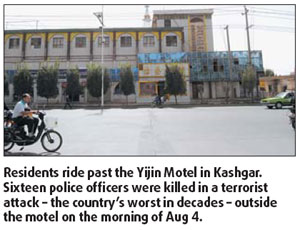
Kashgar, XINJIANG -- A month after a brutal terrorist attack near its front entrance, the three-storey Yijin Motel in this largely Uygur city re-opened for the Muslim holy month of Ramadan.
"Most of our guests are Uygurs, so we only have Uygur signs in our rooms. We're doing fine, only that tourism here has been bad in general because of the violence this year," a Yijin staff member told China Daily. "But the degree of tension has been exaggerated by outside media. I've been in Kashgar for more than 40 years; people get along here just like they do elsewhere." On Aug 4, two Kashgar natives brutally attacked a group of border patrol officers, killing 16. According to local authorities, the attackers were both Uygur and were driven by religious extremism to perform jihad.
A month later, there are hardly any signs of the tragedy. "This city is very much coming back alive again from that horrible disaster last month," said Nico Rodriguez, an American who has been in Kashgar since June. "It's like nothing ever happened."
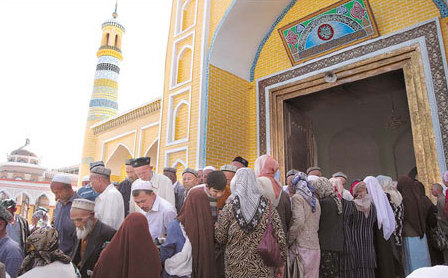
At dawn on any given day since the holy month began Sept 1, hundreds of worshippers gather at the Id Kah, which the locals claim to be China's largest mosque, for morning prayers. Beggars, too, flock to the sacred mosque for generous donations. According to foreign media reports, there has been a marked increase in security here since the attack. Ninety percent of the population here is Uygur, the highest number in the vast autonomous region of Xinjiang. Visitors to the four-star Tarim Petroleum Barony Hotel, across the street from site of the attack and the Yijin, are required to present their IDs to a pair of Uygur security officers at the door. "Only the rich stays in Barony," said a staffer at the Yijin. "A single room there costs 580 yuan per night. And they have hired security officers. But it's just as safe here." There are no security personnel at or around the Yijin, a decade-old motel with 24 shabby rooms. It was closed after the attack. Its eight rooms facing the street are still closed. Another staff member claimed they never opened in the first place. A single room at the motel costs 60 yuan ($8.8) per night, while a suite is 100 yuan. Air conditioning, which costs an extra 10 yuan, was cut off after the attack. Tensions have not been eased completely. A number of ethnic Han shopkeepers along Seman Road, a largely Uygur section of the city, have relocated. But the ethnically Han owner of the Yijin, who asked that her name not be used, is undeterred. "I know they are not against us," she said. "Few of the staff here speak Uygur but that doesn't seem to bother us."
There have also been a number of foreign media reports about a "government clampdown" on religious practices during Ramadan - in particular, on followers observing the sunrise-to-sunset Ramadan fast. Traditionally, Kashgar restaurants close during the day for Ramadan. Some were closed; others remained open for business, serving lamb kebabs, fruits and tea throughout the day. When asked about Ramadan dietary restrictions, a veiled female Uygur shopkeeper, who was eating sunflower seeds on a lazy afternoon, pounded on her husband's chest and said: "It's in there!" "Why need it here?" she said in broken Mandarin while pointing at her own mouth. Guli, a 19-year-old from Kashgar's Bachu county, is aware that there have been heightened security measures, but they hardly affect her. "I don't feel them. Young people like us don't normally observe the fast anyway; only the older generation does, and I don't see how they can be prevented from doing so," she said. "Why should I (be afraid)?" she continued. "You know what terror is? Terror is the bad thing that happens when you least expect it to. What happens around the clock is called life, not terror." "There is little feeling of terror here, unless you want to feel it. We're just living the same old lives, " she added. Nurlan, a 56 year-old Muslim taxi driver, said the August bombing is the most brutal attack he has yet seen, and that such tragedies will not be replicated. "I observe the fast. We all follow the Holy Scriptures here, so you always have many more good people than bad," he said. "I think Kashgar is safe - safer than most places, and definitely those to the west of us. Whatever other people may say, nothing can destroy our lives," he said. Kashgar prefecture borders Pakistan, Afghanistan, India, Tajikistan and Kirghizstan. It is home to 3.6 million people. |
|||||
主站蜘蛛池模板: 乐亭县| 宾阳县| 四平市| 呈贡县| 石楼县| 合山市| 寿宁县| 瑞金市| 双桥区| 中西区| 迭部县| 临洮县| 盐源县| 栾城县| 通山县| 大理市| 兴仁县| 永和县| 托克托县| 容城县| 沧州市| 加查县| 英山县| 黄浦区| 南丰县| 凤山市| 讷河市| 微山县| 平罗县| 芜湖市| 远安县| 布拖县| 绥中县| 朝阳县| 浦城县| 原平市| 清水河县| 兴安盟| 和林格尔县| 宣汉县| 通江县| 正定县| 桂阳县| 黄大仙区| 广汉市| 彩票| 响水县| 东乌珠穆沁旗| 砀山县| 永春县| 通许县| 丰宁| 多伦县| 乌什县| 乳源| 万源市| 曲沃县| 陆良县| 射阳县| 新昌县| 南部县| 松江区| 施秉县| 光泽县| 太湖县| 龙川县| 凯里市| 祥云县| 广水市| 独山县| 襄樊市| 广丰县| 武威市| 南阳市| 永寿县| 清流县| 绥芬河市| 安康市| 崇明县| 灌云县| 莱州市| 卢龙县|