CHINA> Backgrounder

|
CHINA> Backgrounder
|
|
Long wait for the moment
(China Daily)
Updated: 2008-09-26 07:23 Less than a day before the launch of the Shenzhou VII spaceship, astronaut Liu Boming said he couldn't wait to experience a "real" loss of gravity. "I will share it with you when I come back," said the 42-year-old, brimming with a smile.
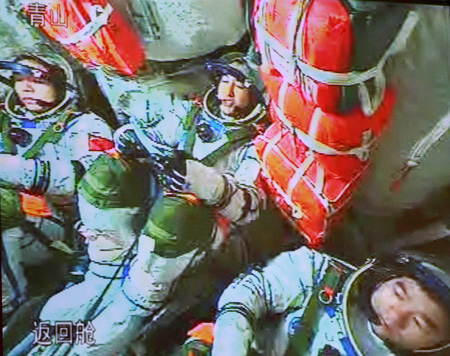
Wearing blue uniforms, Liu, Zhai Zhigang and Jing Haipeng exuded confidence and poise ahead of a challenging but historic mission. Exactly 10 years ago, the three were among a 14-member team selected for the country's manned space program. China has achieved a great deal in the past decade thanks to their and thousands of support staff's unfailing spirit of dedication to the country's space program. In October, 2003, China became the third country to send a man into space, after the former Soviet Union and the United States. Yang Liwei was the first-ever astronaut of China to greet the nation from outer space. In 2005, the country sent two more astronauts, Fei Junlong and Nie Haisheng, on a five-day journey on the Shenzhou VI spacecraft. Now three astronauts aboard Shenzhou VII have joined the elite ranks of space and national heroes. One of the most published stories about Yang Liwei is his arrival three days ahead of schedule for a medical checkup required in the astronaut selection process. "You just can't wait to be shot up into space, can you?" a nurse asked rhetorically. That was the summer of 1996, when China began picking astronauts from its ranks of fighter pilots. Thousands applied, and evaluations were based upon stringent qualification criteria like flight hours, academic degrees and physical condition. Hundreds were selected for interviews. By the end of 1997, just 14 had survived extensive testing. On January 5, 1998, the 14 men replaced their fighter pilot armband with a golden spaceflight armband. All remember their feelings of excitement, fearlessness and strong anticipation the day they assembled. From then on, they have led a life of abstinence to prepare for the rigors of spaceflight. According to strict rules, they were not permitted to dine outside their training centers or disclose their identities, and can only go home on weekends. Before the launch of the spaceship, they stayed in a heavily guarded quarantine facility to protect them from any viruses. They had to learn 58 disciplines ranging from English, astronomy and physics, a tall order they likened to 58 "ladders" to space. Besides academic pursuit, intensive training programs involving fast-spinning centrifuges and underwater training were also demanding. When the centrifuge is in motion, an astronaut must train himself to read signals and answer questions despite dizziness, contorting face muscles and spurting tears. "The machine had a red button at our fingertips in case we couldn't hold it any longer, but as far as I remember, no one has ever pushed the button," said Yang Liwei. Underwater training also took its toll on their bodies, leaving them unable to hold a pair of chopsticks after emerging from the water. "They are the most diligent and smartest trainees I have ever had," said Hu Yinyan, a trainer in spaceship maneuvering. "It requires years of relentless training and a deep commitment to your career to succeed, and I think they all have these qualities," she added. The first generation of Chinese astronauts has been honored as a group who realized the world's most populous nation's space dreams, but not all of them are rewarded with the chance to fly. Brotherhood and sacrifice As well as the Shenzhou VII trio, three other members of the squad get the chance to fly, and the rest will retire or transfer to other jobs because of an age limit. "Everyone wants to fly, but only a few get picked. Sometimes the wish has to give way to the fact and the next thing you do is to work harder," Zhai Zhigang said. Huang Weifen, deputy chief designer of the astronaut system, said "those who don't get picked can conceal the disappointment on their face, but you feel that in the training, they were harder on themselves. "An important thing is the members help each other because years of studying, training and staying together has forged a solid friendship among them," she said. Yang Liwei added: "We were so familiar with one another that if one moved a finger, I knew whether he wants water or wants to say something." |
主站蜘蛛池模板: 麦盖提县| 镇宁| 西丰县| 象山县| 黄大仙区| 庆安县| 唐山市| 荃湾区| 玉田县| 东台市| 溆浦县| 宁海县| 无为县| 都兰县| 乐平市| 芮城县| 霍山县| 荥经县| 龙泉市| 云南省| 江永县| 句容市| 闵行区| 广平县| 伊金霍洛旗| 城口县| 马山县| 南乐县| 浠水县| 宁远县| 永泰县| 吉木乃县| 喀什市| 平乐县| 出国| 霍林郭勒市| 武隆县| 鄂托克前旗| 东乌| 呈贡县| 景泰县| 响水县| 石柱| 剑阁县| 义乌市| 康平县| 天祝| 全州县| 五寨县| 奉贤区| 井研县| 阿克苏市| 修水县| 茌平县| 城步| 南开区| 安乡县| 内江市| 沅江市| 肥东县| 长海县| 镇原县| 阿拉善盟| 云林县| 渝中区| 莱阳市| 会东县| 蛟河市| 石城县| 新泰市| 招远市| 宜黄县| 灵宝市| 桦川县| 石楼县| 阜新市| 峨边| 扶风县| 乐安县| 六枝特区| 保亭| 三河市|