CHINA> Regional

|
CHINA> Regional
|
|
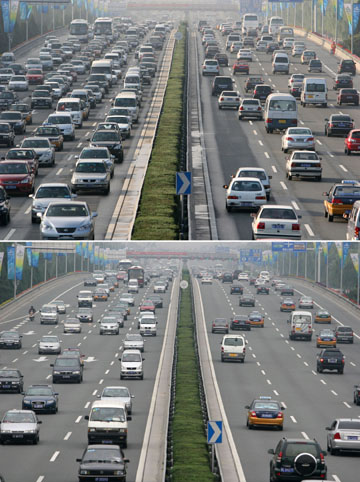
Beijing imposes car ban to ease traffic jams
(Xinhua)
Updated: 2008-09-28 16:37
Beijing has announced a series of post-Olympics car restrictions which will take effect next month and hopefully sustain the hard-won smooth traffic and good air quality during the Games. Under the new traffic restrictions, 30 percent of government vehicles will be sealed off as of October 1, said a circular issued by the Beijing municipal government on Saturday.
Cars whose number plates end with 1 or 6 will be taken off roads on Monday, while those ending with 2 or 7 will be banned on Tuesday, 3 or 8 on Wednesday, 4 or 9 on Thursday and 5 or 0 on Friday. The ban does not apply on weekends. The ban will be applicable within the Fifth Ring Road inclusive, from 6 am to 9 pm for private cars and round the clock for government and corporate vehicles. The new restrictions will take effect on a trial basis on October 11 for six months until April 10, but does not apply to police wagons, ambulances, fire engines, buses, taxies and other public service vehicles. "It's expected to reduce Beijing's average road traffic flow by 6.5 percent and speed up traffic within the Fifth Ring by 8 percent at least," said Wang Zhaorong, an official with the Beijing Municipal Committee of Communications, at a press conference on Sunday. In compensation, the restricted vehicles will be exempt from one month of vehicle tax and road maintenance fee a year. Drivers who are caught to have breached the new rule will not enjoy the exemption, according to Wang. While most people applaud the ban on government and corporate vehicles, the ban on private cars, however, has sparked an outcry from car owners, many of whom complain it is "unfair". "I need to take my daughter home from boarding school on Friday night," said Beijing bank clerk Zhang Min, whose number plate ends with "0" and will be banned on Friday. "Probably we need to buy another car." More than 2,400 people posted online comments on China's leading portal website sina.com within two hours after it published the ban. Very few postings were supportive of the ban on private cars. "To ban should not be the ultimate way to ease Beijing's traffic woes," reads one of the postings. "Instead, our city should be better planned and the road network better designed." While most people were tolerant of the two-month ban on vehicles on alternate days during the Olympics and Paralympics, many are now fed up with the idea to take public transport just once every week. But to like it or not, the Olympic traffic ban, which took nearly 2 million cars off the roads, was not only successful in easing congestion but also cleared the skies. During the ban, traffic flow within the Fifth Ring was reduced by an average 21.2 percent and the average speed at rush hours increased by 25.8 percent to 30.2 km per hour, according to the Beijing Municipal Committee of Communications. The city returned to its normal congestion after the ban was lifted on September 21. Urban streets are unbearably jammed in the rush before the week-long National Day holiday set to start on Monday. The debate over whether the ban should stay after the Games has lasted for weeks and Beijing authorities, apparently hard to find a solution that is effective and acceptable to all, are rather late in announcing the new ban. Alongside the ban, city authorities have also encouraged employers to adopt more elastic working hours -- even to work at home, if possible -- in order to ease congestion. Downtown department stores have been advised to open at 10 am instead of 9 am, as of October 11 and close one hour later than before. Except for schools, governments and the public service sector, many Beijing organizations will be advised to readjust their office hours to avoid the rush hour. The government is also considering raising downtown parking fees to ease congestion but no details are available yet. To improve the city's air quality, Beijing plans to ban a total of 357,000 "yellow label" vehicles from entering the Fifth Ring starting on January 1, said Du Shaozhong, deputy chief of the municipal environment protection bureau. By October next year, all the yellow label vehicles, mostly tippers and heavy-duty trucks, will be banned across Beijing, he said. Beijing's vehicles were issued green or yellow labels according to their emission levels and cars with a yellow label were banned from entering the city center during the day since two years ago. Exhaust emission from a yellow label vehicle is equal to that from 28 low-emission vehicles of Euro-IV standards, said Du. |
|||||
主站蜘蛛池模板: 大石桥市| 托克托县| 正定县| 黑水县| 涟水县| 葵青区| 中卫市| 白水县| 新闻| 鹿邑县| 方正县| 馆陶县| 保康县| 台东县| 巨野县| 白水县| 深州市| 溧阳市| 清水河县| 仁布县| 镇原县| 犍为县| 平果县| 治县。| 阿荣旗| 曲靖市| 南华县| 光山县| 屏边| 正镶白旗| 宜州市| 石景山区| 团风县| 天峨县| 玉林市| 诏安县| 绩溪县| 贺兰县| 荥阳市| 鞍山市| 麻江县| 清流县| 木兰县| 宝鸡市| 阳西县| 额尔古纳市| 高雄市| 泗洪县| 宣汉县| 高州市| 山东| 平阳县| 沂源县| 汪清县| 梅河口市| 富宁县| 凤凰县| 五华县| 洪湖市| 双鸭山市| 江油市| 乌拉特中旗| 扎兰屯市| 胶州市| 石阡县| 泊头市| 平遥县| 三门县| 额尔古纳市| 桑日县| 吉木萨尔县| 浙江省| 萍乡市| 买车| 郎溪县| 靖州| 河东区| 赣榆县| 天长市| 千阳县| 务川| 无极县|