CHINA> Highlights

|
CHINA> Highlights
|
|
Enjoying life through exercise
By Wu Jiao (China Daily)
Updated: 2008-10-08 07:46
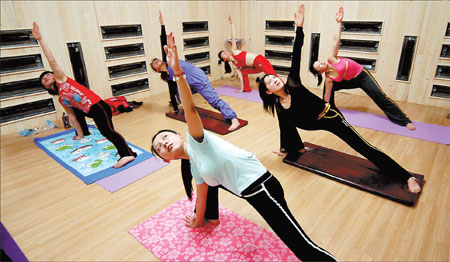
Most families in Beijing love to gather in front of TV sets after dinner. But Gao Ning, wife of Huang Xiaoying, and his parents have better things to do. They clean the dishes, laze around a bit, change into track suits, put on their sports shoes and leave home. The 32-year-old and his wife sweat it out on treadmills, go through the rigors of a group exercise session to tone their abs or do some stretching exercises under the guidance of personal trainers. And his parents join a group of retired people, most of them in their 60s, in a nearby community park to dance to the rhythms of traditional music. They use the intervals to chat with other members of the group, sharing their joys and pains. The Gaos represent a growing number of Beijing families that swear by exercise, especially because of the Beijing Olympics' public fitness drive. Gone are the days when many people considered physical labor as the only way of exercise. More and more middle-aged and elderly people have realized the importance of regular exercise.
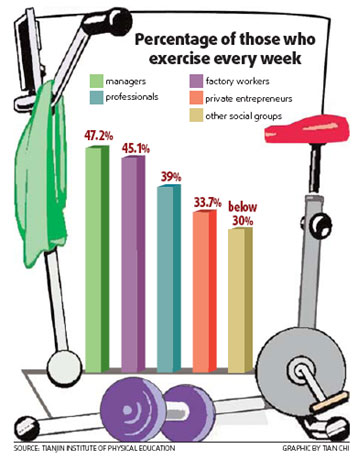
"Most of the people who join us for the group dancing sessions suffer from chronic diseases that need a certain amount of exercise as treatment," says Gao Ning's mother Gao Xiaohua, who suffers from allergic pneumonia. "It's a place for us to kill time, too." The senior Gaos prefer the public park to the gym because fitness clubs, which first appeared in the 1990s, are too extravagant for most of the elderly people. "Paying 1,000 yuan ($146) a year as club fees is a waste of money," says Gao Xiaohua. "Besides, we don't need that tough exercise routine." But the very concept of physical exercise has changed for many Chinese who have grown up during the past couple of decades when the country's economy grew by leaps and bounds. Gao Ning, a mid-level manager in a machinery company, says stress caused by work and the hours spent on Beijing's clogged roads forced him to join Hosa Gym, which has 28 branches in the capital's business district. "I feel relaxed and sort of reborn after a work-out," he says. "Without it my days are gloomy and I feel tired." Gao Ning and Huang Xiaoying make about $30,000 a year, and pay $200 each annually for their gym membership to get personal trainers for an hour a day. "It's money well spent," Huang says. "After you get all the necessities, money, job and a house, you realize how important health is. Without health, nothing is meaningful." On most weekday nights, the gym is packed with young professionals sweating it out on stationary bicycles, swimming or practicing yoga. The gym has been doing good business, says a manager surnamed Zhou. About 1,000 new gyms have been opening in China every year during the past few years. With 30 new gyms and fitness clubs coming up every year, Beijing has seen a boom in the fitness business. And then there are people who visit spas for full-body or foot massage, or aromatherapy. These spas are run by hotel chains, other organizations and even mom-and-pop establishments. But despite all this, the modern idea of fitness remains an urban, middle-class craze. A survey, conducted by a team of the Tianjin Institute of Physical Education, led by researcher Shao Xuemei, shows the awareness and willingness of taking to sports and exercise varies among people of different social strata. Government officials, factory workers and professionals are the three groups most frequently engaged in sports, according to the survey that covered more than 5,000 people in nine cities across the country. Government officials usually take to sport because they are the most aware of the benefits of physical fitness, says Shao. Factory workers engaged in sport either as recreation or as a means to keep fit. About 5 percent of the urban people - the relatively well-off, including managers, and those working for commercial or tertiary industries - join health clubs to keep fit, according to the survey. The proportion of those who pay to exercise is the highest among private entrepreneurs group, with 11 percent of them doing so. But they are the most inconsistent group when it comes to workouts, too, because of their busy schedule.
Physical exercise, however, is not a form of recreation for urban residents who just about manage to meet their needs, nor is it for farmers and migrant workers in cities. "We always think doing household chores and farming is working out. It's weird for us to think that a bit of additional exercise will help with our fitness," says Fang Dayue, a man in his 40s in a village in Anhui province. That is why fitness centers are a craze only in cities such as Beijing and Shanghai. Up to 70 percent of Beijing residents take part in sport, according to official data, whereas the national figure is only 33 percent. Besides, a majority of the middle-aged and old people exercise because they have been advised by physicians to do so to fight chronic illnesses. The initial results of the latest national physical fitness monitoring project, released by the General Administration of Sport of China (GASC) in 2006, show that the traditional "water towns" of Shanghai and Jiangsu province have more robust people than the country's tough northeast or the Inner Mongolia autonomous region. The study is carried out every five years to track the development of people's health and physical prowess in different regions. According to the GASC, the municipal and provincial governments on the east coast sponsor more advanced sports and fitness programs and thus the average resident in that region are fitter. The difference, however, reveals unbalanced distribution of sports resources in east and west, urban and rural areas, as well as major and small cities. "I want a place to loosen my muscles but there is simply no such place here," says Huang Hongqing, a 54-year-old resident of Anqing, a small city in Anhui. He used to play basketball with his son on the latter's school court. But after his son passed out of school, Huang lost his playmate, so he stopped playing altogether. "Ever since 2001, when China made a successful bid for the 2008 Olympic Games, people around me have become crazy about sports. But fields and courts are too few to meet the needs of everyone in a small city as ours," Huang Hongqing says. The sports facilities managed by subsidiaries of national or local sports authorities and those run by schools, universities and government and military institutions account for up to 88 percent of the total. 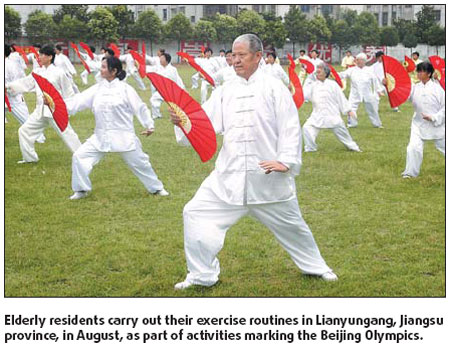 The public has limited or even no access to institutions run by schools, universities, governments and the military. That has restricted them from making more money, says Wang Jing, a researcher in sports with Northwest University of Politics and Law. To deal with the problem, the country is working on a national fitness plan with funds both from the government and social sectors being used to build public fitness centers in urban and rural areas alike. According to a specific plan for rural areas, 3 billion yuan from central and local governments' budgets will be used to build fitness centers in 100,000 or one-sixth of China's villages by 2010. About 87,000 villages have already completed their projects. In economic terms, a sound national fitness program will help boost the sports and fitness industry and contribute to national development. Right now, the output of the sports industry accounts for only 0.56 percent of the country's GDP, whereas the ratio is 1 to 3 percent in some European countries. The figure is 4 percent in the US, which has the most advanced sports industry, according to the GASC. To ensure a healthy and balanced development of the sports market, Liu Guoyong, deputy director of the GASC, says his administration has submitted a long-term plan blueprinting the national fitness cause to the State Council. The proposal is likely to be adopted soon. Experts, including Liu, say the sports market is set to expand because the Beijing Olympics has created fitness and sports awareness among a huge number of people. GASC figures show investment in sports and other recreational equipment leaped 8.5 percent to $1.5 billion in the first seven months of this year, compared with the same period last year. That should be music to the industry captains' ears, and an impetus to more people to keep themselves fitter.
|
主站蜘蛛池模板: 岐山县| 闸北区| 饶河县| 平果县| 阜康市| 乐陵市| 榆社县| 德江县| 兰坪| 泾阳县| 酒泉市| 兴和县| 扎赉特旗| 广元市| 武山县| 久治县| 临夏县| 上思县| 平顶山市| 曲阜市| 庆阳市| 周口市| 陕西省| 新泰市| 阆中市| 庄河市| 沧州市| 黑山县| 河曲县| 潜山县| 新安县| 滕州市| 松江区| 陇川县| 万山特区| 土默特右旗| 渝北区| 固镇县| 黔西县| 灵川县| 柯坪县| 潮安县| 芷江| 昌黎县| 汪清县| 三亚市| 乌鲁木齐县| 福州市| 海阳市| 望江县| 依安县| 武城县| 张家港市| 乌海市| 专栏| 湘西| 枞阳县| 华池县| 云安县| 甘肃省| 安图县| 兴化市| 沈丘县| 通道| 奈曼旗| 青浦区| 农安县| 贺兰县| 博野县| 贵定县| 无极县| 沅陵县| 茌平县| 苏尼特右旗| 辛集市| 金塔县| 平南县| 兰坪| 江津市| 华阴市| 连州市| 白山市|